
On February 17, 1972, the Volkswagen Beetle surpassed 15 million units produced and became the best-selling car in history — a record built on origins most owners never examine, and a story that makes the flower-power image look almost deliberately naive. If you’re thinking about buying, restoring, or simply understanding one of the most recognizable machines ever built, you need to know where it actually came from.
1934: Ferdinand Porsche Gets an Unwanted Assignment

The Volkswagen Beetle’s history doesn’t begin in an engineering studio with a blank sheet of paper. It begins in 1934, when Ferdinand Porsche proposed his design for a “people’s car,” the Volkswagen, to Adolf Hitler. That concept had a name: the Volkswagen, meaning “people’s car.”
Porsche wasn’t starting from zero. Through the late 1920s and early 1930s he had already sketched out a small, affordable car concept, shopping the idea to Zündapp and NSU. Both passed. He had detailed blueprints and no buyer — until a government contract arrived with state funding and no room to refuse.
Hitler’s specifications were blunt and specific: the car had to carry two adults and three children, cruise at 100 km/h (62 mph), deliver strong fuel economy, and retail for no more than 990 Reichsmarks — roughly three months’ wages for a factory worker. Porsche recognized his own shelved idea wearing a political uniform, and he took the contract.
His friction with the project was largely professional rather than ideological, at least on the record. Porsche wanted to build racing cars and high-performance machines. A utilitarian vehicle for the masses was, to him, a ceiling, not a canvas. But the state contract kept him locked to the brief — and that brief produced one of the most consequential automotive designs in history.
The Engineering Choices That Made the Shape Immortal

The rounded, unmistakable silhouette of the Beetle wasn’t styled — it was engineered. Every curve existed to solve a cost or function problem.
The air-cooled, rear-mounted flat-four engine was a deliberate structural decision. Eliminate the radiator and you eliminate freeze-related failures, reduce complexity, and lower the nose. That lowered nose created the bug-like profile that gave the car its nickname — first Käfer in German, then Beetle in English — applied organically by a public reacting to an unmistakable shape, not invented by any marketing department.
The aerodynamic body reduced drag without expensive tooling changes, keeping manufacturing costs in line with the price target. What looked like style was actually thrift. That combination — purposeful engineering wrapped in an accidentally appealing form — turned out to be the Beetle’s most durable competitive asset across six decades and multiple markets.
When the first Volkswagen rolled off the line, it carried no model name. It was simply called “the Volkswagen.” The nickname came later, and it stuck permanently.
The War Machine That Derailed the People’s Car
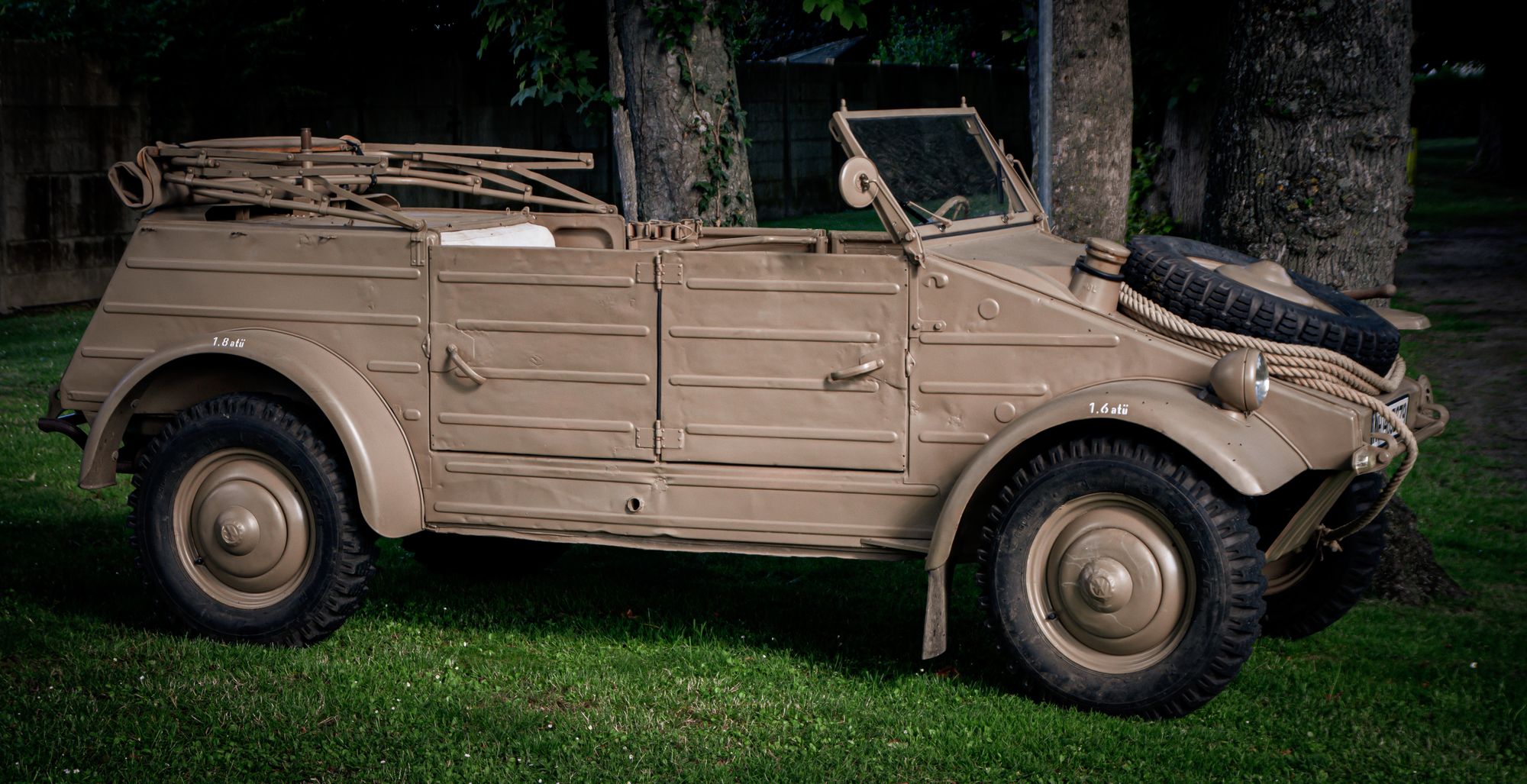
The KdF-Wagen savings scheme, launched in 1938, let German workers pay five Reichsmarks a week toward their own Beetle. It was a genuine mass-market financing mechanism — and it delivered nothing to civilians. World War II broke out before a single civilian took delivery. The Wolfsburg factory pivoted immediately to military production: Kübelwagens and Schwimmwagens for the Wehrmacht. The civilian car was suspended for the duration of the war.
After Germany’s defeat in 1945, the factory’s future was genuinely uncertain. British Army officer Major Ivan Hirst restarted the bombed-out Wolfsburg plant and began producing Beetles for Allied occupation forces. The civilian car finally reached real buyers under British military administration — not as a piece of wartime ideology, but as practical transportation in a devastated country.
Here is the detail that tells you everything about how badly the automotive establishment misjudged this car: every major British and American automaker that was offered the Volkswagen factory and its tooling as war reparations turned it down. The official verdict was that the Beetle was ugly, noisy, and commercially unviable. That judgment stands as one of the most expensive miscalculations in the history of the industry.
From Propaganda Tool to Counterculture Symbol

U.S. imports began in 1949. By the late 1950s, the Beetle was competing directly against Detroit’s chrome-laden, fuel-hungry full-size cars — and winning buyers on a simple, honest pitch: cheap to buy, cheap to run, easy to fix yourself.
The 1959 Doyle Dane Bernbach “Think Small” campaign crystallized that pitch into advertising history. The agency ran ads that mocked the car’s own appearance and celebrated its simplicity — a radical departure from the aspiration-driven automotive marketing of the era, and arguably the most influential car advertising campaign ever produced.
By the 1960s, the car originally commissioned for German workers had become the preferred vehicle of American students, artists, and anti-war protesters. The irony was enormous, and the marketing leaned into it rather than running from it. The 1968 Disney film The Love Bug completed the cultural transformation, cementing the Beetle’s association with cheerfulness and individuality in the mass imagination. As the Smithsonian documented, that February 1972 production milestone wasn’t just a number — it was the validation of a decades-long reinvention.
Why the Beetle Actually Sold: The Numbers Behind the Icon

Cultural iconography is real, but the Beetle earned it with mechanical and economic substance. The table below captures what the original car actually delivered — and why those specifications mattered to the buyers who chose it.
| Specification | Detail |
|---|---|
| Engine type | Air-cooled flat-four, rear-mounted |
| Displacement (early models) | 1.1 litres |
| Output (early models) | Approximately 25 hp |
| Fuel economy | Approximately 30-35 mpg |
| Production run | 1938-2003 (65 years) |
| Total units produced | Approximately 21.5 million |
| Final production location | Puebla, Mexico |
The fuel economy figures mattered far more than the modest horsepower output to buyers navigating tight household budgets and, later, two fuel crises. The 65-year production run on a single core platform is a record no other car has matched. The maintenance picture was a genuine competitive advantage: the air-cooled engine, accessible in a rear compartment, could be pulled and replaced with basic tools and no dealer visit. For buyers who couldn’t afford professional service rates, that wasn’t a minor benefit — it was frequently the deciding factor.
It is also worth noting that VW did not rest entirely on a static design. Engine displacement grew incrementally over the decades — from 1.1 litres in early models to 1.2, then 1.3, and eventually 1.6 litres in later variants — adding usable power while preserving the core architecture buyers already trusted and understood.
What Three Generations of Beetle Actually Mean

The word “Beetle” covers three mechanically distinct eras, and conflating them is a common and costly mistake for buyers.
The original Beetle (1938-2003, produced in Germany through 1978 and in Mexico through 2003) used the rear-mounted, air-cooled flat-four engine that defined the car’s character, its ownership economics, and its cultural identity. This is the car this article has been discussing.
The New Beetle (1998-2010) was a front-engine, front-wheel-drive car built on the Golf platform, wearing a rounded body that deliberately evoked the original’s silhouette. It was a competent and practical vehicle. It was not mechanically related to the original in any meaningful way.
The third-generation Beetle (2011-2019) continued on the Golf platform with a lower, wider, more assertive body — less deliberately retro than the New Beetle, and better to drive. Again, no mechanical kinship with the original’s engineering ethos. Volkswagen’s own heritage documentation acknowledges the distinction plainly if you know where to look.
If you are drawn to the original’s air-cooled mechanicals, its repairability, or its historical significance, the New Beetle and third-generation car offer none of those things. They offer modern Golf reliability in nostalgic packaging — which is a legitimate purchase, but a different one entirely.
What the Origin Story Means If You’re Buying One Today
The full sweep of original Beetle production covers significant variation in mechanical specification, and those differences carry real consequences for ownership costs.
- Pre-1967 cars use a 6-volt electrical system. Parts exist but require more sourcing effort. Retrofitting to 12-volt is common but adds cost and complexity that should be factored into any purchase negotiation.
- Post-1967 cars switched to 12-volt — broader parts availability, simpler compatibility with modern accessories, and generally easier day-to-day ownership.
- Later Mexican-built cars (through 2003) represent the most mechanically refined original Beetles, benefiting from 65 years of incremental improvement. They carry less collector cachet than early German-built examples, which means you typically get more car for your money if driving enjoyment and reliability matter more than provenance.
- Rust is the primary structural threat. Floor pans, heater channels, and rear fender edges are the critical inspection points. A car with a clean body and a worn engine is far more salvageable than the reverse.
You also need to price the iconography honestly. The Beetle’s cultural weight pushes collector values above what the mechanical specification alone justifies. You are partly paying for a shape that strangers recognize on sight — that recognition is real value, but it is not the same as buying a car with a robust modern drivetrain or contemporary reliability. Know which you are actually purchasing before you write the check.
The Beetle’s story — commissioned under authoritarian mandate, rescued by a British soldier in a bombed-out factory, rejected by every major automaker as a commercial failure, then adopted by a counterculture largely unaware of its origins — is exactly why it remains one of the few cars in history that requires no explanation anywhere on earth. That recognition is what you are buying into. Understand it clearly, inspect the heater channels carefully, and you will own something genuinely worth owning.