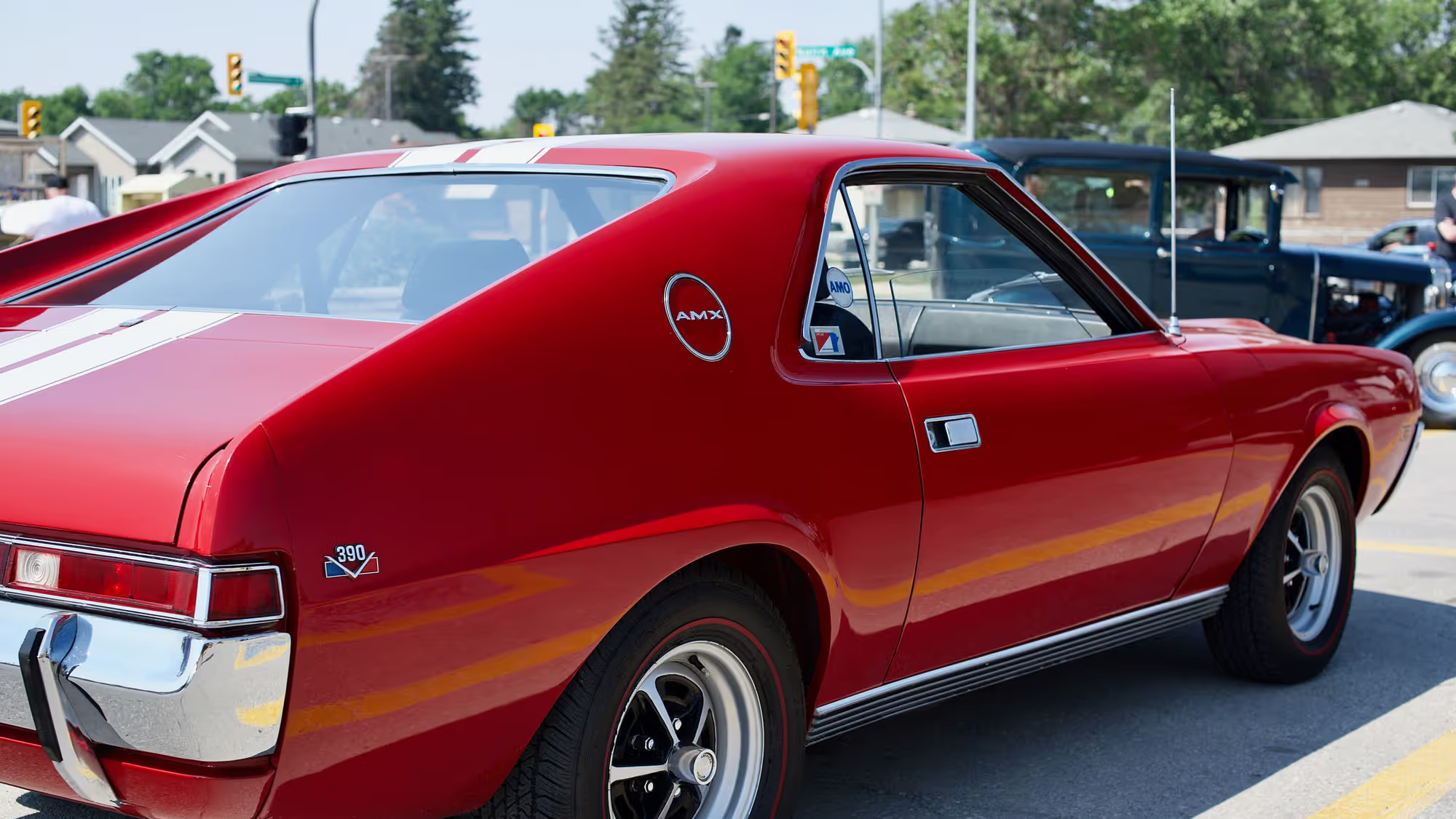
AMC built 52 cars in 1969, sold every one of them with zero factory warranty, and documented 10-second quarter-mile times that forced the NHRA to pay attention. If you are looking at one of these cars today — or trying to understand what an “as is” factory race car sale actually means — the answer involves more than curiosity about muscle car history. It involves real purchase risk, real legal exposure, and a specific set of questions that need to be answered before any money moves.
AMC Handed You a Race Car and Wished You Luck
In 1969, AMC built exactly 52 Super Stock AMXs — purpose-built quarter-mile weapons — and sold every single one “as is” with no factory warranty. These were not stripped economy cars with a performance option checked on the order sheet. They were race cars that happened to arrive on a dealer lot.
The documented capability was 10-second quarter-mile times at over 125 mph. Those numbers put the Super Stock AMX in direct competition with purpose-built factory drag packages from Ford and Mopar — from a company that most buyers in 1969 associated with the Rambler. That disconnect between brand perception and documented performance is part of what makes this car historically significant.
The no-warranty clause was not fine print buried in a lease agreement. It was AMC acknowledging in writing, at the point of sale, that this vehicle existed outside the bounds of normal ownership. The factory was telling you explicitly: this is a race car, it was built to race, and what happens to it after it leaves this lot is your problem. If you are looking at one today, that original condition has not changed in its legal logic. You are buying a known-quantity race car with a historically and legally established zero-safety-net purchase structure.
What 52 Cars and a Baffled NHRA Actually Tell You About Rarity
With a production run of 52 units, the 1969 Super Stock AMX is not rare in the way a low-sales-year trim is rare. The limited run was deliberate — AMC needed to build a minimum number of street-legal examples to qualify the car for NHRA Stock Eliminator class racing under homologation rules. AMC built exactly enough, and reportedly not many more.
The NHRA was reportedly baffled by the car. That is not marketing language — it signals that AMC’s strategy worked. Build the minimum required, make them fast enough to matter, and force the sanctioning body to respond. When a factory car creates an administrative problem for a racing organization, that is a credible measure of how seriously it needed to be taken on the strip.
Rarity at this scale means comparables are almost nonexistent. Any valuation you encounter should be scrutinized against documented auction results with matching provenance — build sheet, original title chain, period documentation — not against broad AMC collector market trends. The AMC collector market and the Super Stock AMX market are not the same thing, and treating them as equivalent will cost you money on either side of a transaction.
The “As Is” Sale: What It Meant in 1969 and What It Means Now
In 1969, “as is, no warranty” on a new car was legally and practically extraordinary. It meant AMC explicitly disclaimed responsibility for mechanical failure, component longevity, or roadworthiness from the moment of delivery. That was not a standard new-car transaction. It was a factory acknowledging that the product it was handing you was outside the scope of normal consumer protection expectations.
Today, buying any used modified classic car “as is” carries the same core legal weight: the seller owes you nothing post-sale. Implied warranty protections under the Uniform Commercial Code vary by state, and some states provide stronger consumer protections for private sales than others. Research your specific jurisdiction before signing anything, and have legal language reviewed by an attorney if the purchase price is significant.
For a surviving Super Stock AMX specifically, “as is” compounds across two eras. You are inheriting the original factory disclaimer plus more than 55 years of unknown storage history, handling, and potential undocumented modifications. A pre-purchase inspection by a mechanic who specializes in AMC vehicles is not optional. It is the only practical due-diligence tool available when no warranty exists and no factory support is coming.
The Engineering Behind the 10-Second Claim
A factory 10-second quarter-mile at over 125 mph in 1969 required substantial engine preparation beyond a standard performance package. The Super Stock AMX was built around AMC’s big-block engine, heavily modified with race-specification internals appropriate for the class. These were not street-tuned engines with an aggressive camshaft profile. They were built to produce maximum power at wide-open throttle in a controlled race environment.
Weight reduction was equally deliberate. These cars were stripped of creature comforts: no rear seat, minimal sound deadening, lightweight front bodywork. Those changes make a car fast in a straight line and genuinely unpleasant — and potentially unsafe — for extended street use. If you are evaluating one today, the condition of those weight-reduction components matters as much as the state of the engine.
When assessing the drivetrain, confirm whether it is numbers-matching original or has been rebuilt. A correctly rebuilt race engine may actually be more mechanically reliable than a 55-year-old original that has not been run, but it will affect collector value significantly. Those two considerations — reliability and value — often point in opposite directions, and you need to decide which matters more to your specific use case before purchase, not after.
Fuel economy on a car tuned for maximum power at wide-open throttle is essentially irrelevant as a purchase criterion. If you ever run this car on pump fuel, plan for single-digit mpg figures. That is not a flaw — it is the expected output of a purpose-built race engine operating outside its design parameters.
Buying a Drag Car: The Honest Trade-Off Table
| Category | Reality for a Super Stock AMX Buyer |
|---|---|
| Street drivability | Minimal to none. Race suspension tuning, aggressive carburetion, and drag-specification tires make routine driving physically demanding and potentially hazardous on public roads. |
| Insurance | Standard classic car policies exclude racing use. A car sold new with a no-warranty race disclaimer may face coverage disputes. Obtain written confirmation of what your policy covers before purchase closes. |
| Parts availability | Limited. AMC big-block race components require specialist suppliers with long lead times and costs that exceed Ford or GM equivalents. Budget and timeline accordingly. |
| Storage and transport | Ongoing costs. A car with 23 original miles did not reach that figure by being driven regularly. Budget for trailer fees, climate-controlled storage, and specialist transport if you plan to show or sell. |
| Fuel economy | Single-digit mpg on pump fuel. Not a practical ownership consideration, but worth understanding if you ever plan to run it. |
| Collectible value | Dependent entirely on documented provenance. Without a build sheet, original title chain, or period documentation, value claims are unverifiable and negotiating leverage disappears. |
The 23-Mile Car: Collectible Logic vs. Driver Logic
At least one 1969 Super Stock AMX exists with just 23 miles on its odometer, which tells you something important: some buyers took delivery, trailered the car, and never raced it. They recognized immediately that what they had was a collectible, not a tool. That decision, made in 1969, is what preserved the car’s originality across more than five decades.
From a pure investment standpoint, originality and documented provenance — build sheet, window sticker, original title chain — are what protect long-term value in this market, not whether the car runs or has ever turned a quarter-mile. A 23-mile survivor with full documentation is a fundamentally different asset than a raced example with provenance gaps, even if both are genuine Super Stock AMXs.
Low mileage does not mean ready-to-run. Rubber fuel lines, brake components, and seals degrade with age regardless of how far a car has traveled. Static storage introduces its own failure modes — dried gaskets, varnished fuel systems, compromised brake hydraulics. A fresh mechanical inspection matters as much on a 23-mile car as on one that has been campaigned regularly. Do not allow the odometer reading to substitute for a proper mechanical assessment.
If your intent is actually to race or drive the car, a correctly restored higher-mileage example with a fresh, documented drivetrain may serve you better than a fragile survivor that no one wants to touch for fear of affecting its value. Those are genuinely different cars for genuinely different buyers. Knowing which buyer you are before you start shopping will save you significant money and frustration.
Before You Buy: The Questions That Replace the Missing Warranty
Because no warranty exists — and never did — your due diligence has to do the work that factory documentation would otherwise provide. These are not optional questions. They are the minimum threshold for a rational purchase decision on a car at this price point and rarity level.
- Can the seller document the original sale? A window sticker, build record, or period title chain confirming this is a genuine Super Stock AMX — not a tribute or a clone built on a base AMX shell — is the foundation of any value claim. With only 52 cars built, the documentation burden is high, and sellers of legitimate examples should be able to meet it.
- Has the car been inspected by an AMC specialist within the last 12 months? Write a full inspection contingency into your purchase agreement before any deposit changes hands. On an “as is” purchase with no post-sale recourse, this is non-negotiable.
- What is the documented ownership chain since 1969? Known accidents, flood events, or fire damage affect both structural integrity and insurability. Gaps in the ownership history are not automatically disqualifying, but they need to be explained and reflected in the asking price.
- Do you have storage, transport, and a specialist contact confirmed before delivery? A car this rare should not spend its first week in a driveway while you work out logistics. Have the trailer booked and the storage solution confirmed before you sign any paperwork.
- Have you verified insurance coverage in writing? Call your insurer, describe the car’s history accurately — including the original no-warranty factory race disclaimer — and obtain written coverage confirmation before the transaction closes. A verbal assurance from an agent is not sufficient.
What This Car Actually Is — and Who Should Own One
The 1969 AMC Super Stock AMX is a documented piece of American drag racing history with performance credentials that held up against anything Detroit produced in the same era. The deliberate production limit, the factory warranty disclaimer, and the NHRA’s forced response to it are not marketing mythology — they are verifiable facts supported by period records and surviving examples.
But the same characteristics that make it extraordinary — the race-only build, the production limit of 52 units, the explicit factory disclaimer — make buying one a genuinely complex transaction with no institutional safety net. The right buyer is someone who has answered every question above before making contact with a seller, not someone who plans to sort out the details after falling in love with the car. Go in prepared, or reconsider going in at all.