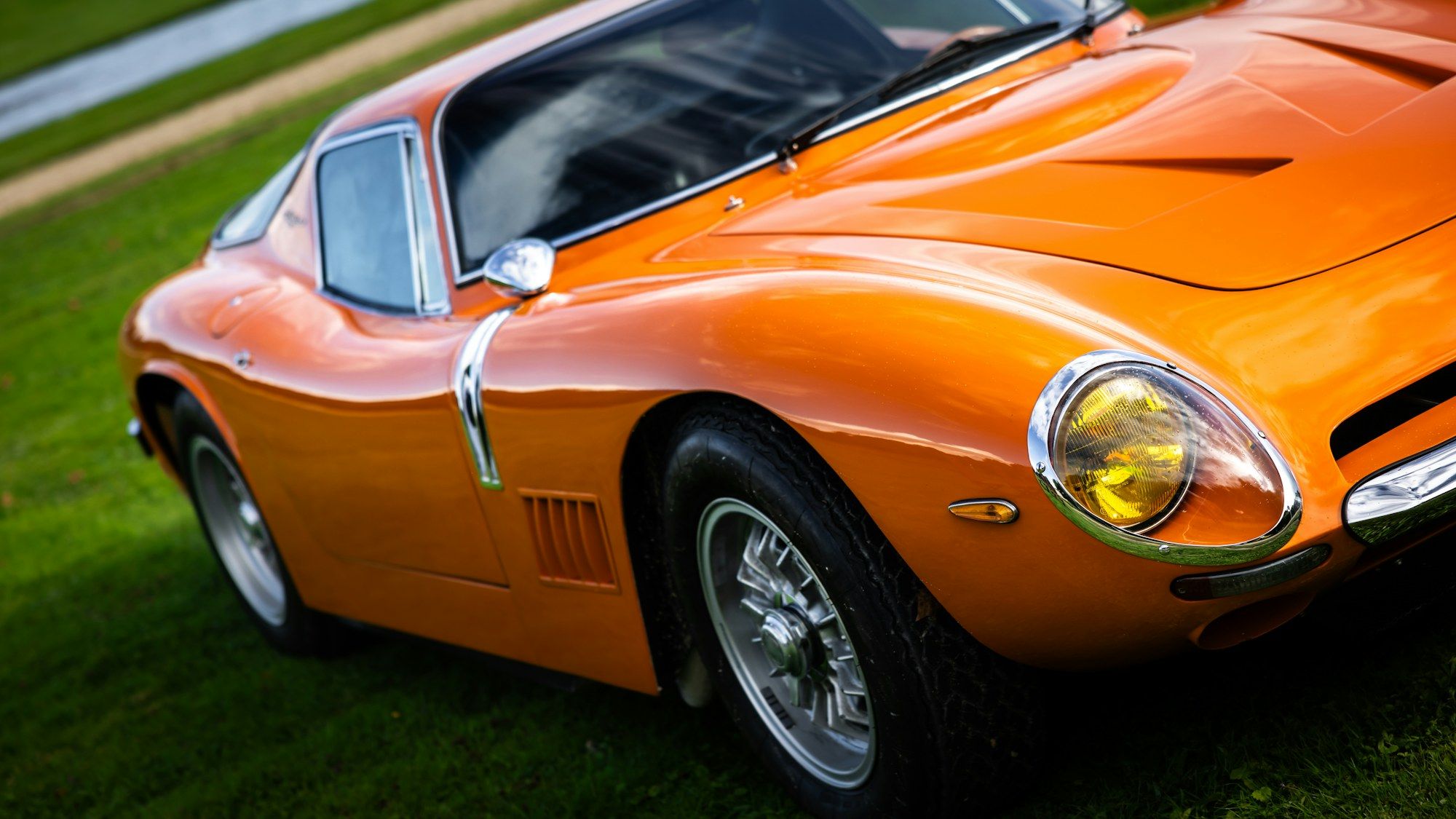
Giotto Bizzarrini spent the early 1960s helping develop one of the most consequential GT cars in motorsport history — the Ferrari 250 GTO — then departed Maranello in the mass resignation known as the 1961 “Palace Revolt” and applied exactly the same aerodynamic and structural instincts to a car almost nobody remembers: the Iso Grifo A3/C, a purpose-built competition GT that reached Le Mans in the mid-1960s powered by a Chevrolet V8. That combination — Italian coachwork, an aircraft-derived aluminum chassis, and American muscle — made the A3/C one of the more rational engineering exercises of its era and one of the least celebrated.
From Road Car to Race Car: The A3/L and A3/C Distinction
The Grifo racing program began with the A3/L — the “L” standing for Lusso — a road-biased grand tourer that shared its platform with the production Iso Grifo Series I. The A3/C (Competizione) was the stripped, aerodynamically reworked derivative built explicitly for endurance racing, and the distinction matters when evaluating what the car was actually designed to do. Though both variants drew on the same fundamental architecture as the production Grifo, the A3/C received substantially revised bodywork by Bertone: a lower roofline, a revised greenhouse, and a more purposeful front treatment aimed at reducing drag for the high-speed circuits where it would compete. It looked related to the road car the way a thoroughbred racehorse looks related to a carriage horse — the bloodline is real, but the purpose has completely diverged.
The historical production window for the A3/C is documented as 1963 to 1965. Exact build numbers remain uncertain in publicly available sources, and any figure cited by enthusiasts should be treated as an estimate pending archival confirmation. Financial backing from industrialist Renzo Rivolta kept the program viable — a non-trivial fact, because Iso was not a volume manufacturer and racing expenditure without industrial-scale sales revenue represented genuine organizational risk for a small Milanese firm.
The Aluminum Riveted Chassis: Why Construction Method Was an Engineering Argument
The A3/C’s most consequential structural choice was its aluminum riveted chassis, a technique drawn from aircraft and racing practice rather than the pressed-steel monocoques common in Italian GT production of the period. Riveting rather than welding aluminum preserves the material’s properties at the joint, reduces heat distortion during fabrication, and — critically for endurance racing — allows individual panels to be replaced after accident damage rather than requiring full structural repair. At Le Mans distances, that last advantage is not cosmetic; it is operational.
Bizzarrini’s GTO experience informed this philosophy directly. Stiffness-to-weight ratio mattered more than manufacturing simplicity for a car intended to run 24 hours without structural fatigue becoming a deciding factor. The result was a competition car that shared conceptual DNA with the production Grifo but was engineered from the contact patches upward, not adapted from a road car downward. That discipline — beginning with racing requirements and working toward a finished structure — is what separates the A3/C from the many GT cars of the era that were merely lightened production vehicles wearing aerodynamic addenda.
The Chevy 327 Decision: Pragmatism as Engineering Strategy
The choice of a Chevrolet 327 cubic-inch (5.4-liter) small-block V8 — rated at approximately 300 horsepower in the Grifo’s configuration — was not a compromise. It was a deliberate technical argument. By the mid-1960s the 327 was extensively developed through American club and professional racing, supported by a large and inexpensive aftermarket parts supply, and available through established channels that no bespoke Italian competition engine could match for accessibility. For an endurance program run by a small company, parts availability and engine rebuild speed between sessions were existential concerns, not marginal preferences.
The 327 was paired with a ZF five-speed transmission, a respected European competition unit used by multiple manufacturers across the decade. The combination — American torque with proven European gearbox engineering — was a rational integration rather than an awkward hybrid. It is worth noting that this configuration was not unique to Iso: the AC Cobra followed broadly similar logic, and the approach would later be validated commercially in the De Tomaso Pantera. The more defensible historical point is not a “first” claim — establishing precise priority would require more specific sourcing than is currently available — but simply that Bizzarrini and Rivolta were working along a line of thinking that others subsequently confirmed made sense.
Specific chassis documentation for a surviving 1965 example — chassis B 0216 — can be reviewed at CLASSIC.COM’s listing for the 1965 Iso Grifo A3/C VIN B 0216, which provides useful physical reference for the car’s configuration and specification.
Le Mans: What the Racing Record Honestly Supports
The A3/C competed at Le Mans — that much is documented. Specific year-by-year finishing positions and class results are best drawn from ACO historical records rather than stated from secondary memory, and gaps in the verified public record should be acknowledged plainly. What can be said with confidence is that competing at Le Mans as a small independent against factory Ferrari, Aston Martin, and Ford programs in the mid-1960s required the car to pass technical scrutineering, meet minimum circuit speed thresholds, and survive race-distance mechanical stress. That is a credible engineering validation on its own terms, and it is enough of one.
Claims that the A3/C “beat Ferrari” in outright terms require direct race-result evidence with matching class and year to be stated as fact. That level of verified specificity is not available in the sources consulted for this piece, and responsible editorial practice does not retrofit a triumph narrative onto an incomplete record. The honest position: the A3/C was a credible Le Mans competitor built by one of the era’s most accomplished chassis engineers, running in the same races as factory programs from manufacturers with vastly greater resources. That is a meaningful achievement without requiring embellishment.
Bertone’s Body and the Turin Targa Footnote
Bertone’s styling for the A3/C was functionally motivated as well as aesthetic. The lower, wider body relative to the production Grifo was shaped around the aluminum chassis and the requirements of a racing interior — not retrofitted onto a road car silhouette. The collaboration placed the A3/C in distinguished company: Bertone’s 1960s portfolio included the Alfa Romeo Giulia Sprint GT, and from 1965 onward, under Marcello Gandini, the Lamborghini Miura. The A3/C is a less famous object from the same design environment, which is a useful reminder that the celebrated and the obscure sometimes share more than their historical reputations suggest.
In October 1966, after the A3/C’s competition production had effectively concluded, Iso showed the first targa-top Grifo — chassis number 97 — at the Turin Motor Show. That appearance anchors the production Grifo’s continuing development timeline and usefully separates the road car’s ongoing story from the closed A3/C competition program. The two threads are related but should not be conflated; the targa Grifo was a commercial exercise for the road market, not a continuation of the racing effort.
Collecting the A3/C: Honest Trade-Offs
The A3/C’s obscurity relative to Ferrari and Lamborghini contemporaries follows a clear and unsentimental logic: small build numbers, an American engine in an Italian body, and a parent company that ceased production in 1974 meant the car accumulated none of the dealer network, spare-parts infrastructure, or media repetition that sustained those marques in collector consciousness across subsequent decades. Supercar Nostalgia’s Iso Grifo A3/C overview provides useful entry-level context on the model’s history and rarity for enthusiasts approaching the marque for the first time.
Ownership trade-offs are real and worth stating directly. The Chevrolet small-block remains one of the most parts-abundant engines in existence — a genuine and durable advantage for running costs and mechanical upkeep compared with orphaned Italian competition engines of the same era. Aluminum riveted bodywork repair, however, requires specialist fabricators with appropriate skills and materials, and those fabricators are neither numerous nor inexpensive. Documentation for a car with uncertain build numbers demands careful provenance research before any purchase commitment. A 1965 Iso Grifo A3/C appeared at RM Sotheby’s Monterey 2026 auction, which provides a current market reference point for how documented competition examples are being valued — though specific results should be verified directly with the auction house. The Hess Classic collection also maintains a detailed entry on the Iso Grifo A3/C that is worth consulting for comparative specification and historical context.
For enthusiasts tracking Italian cars with American V8 powertrains, or the broader history of the Iso Rivolta brand, the A3/C is the most consequential single artifact in the catalog: a car that distills Bizzarrini’s structural discipline, Rivolta’s commercial pragmatism, and Bertone’s functionally grounded design into one short, underappreciated production run. Its obscurity is a market condition, not an engineering verdict — and those two things are worth keeping separate.