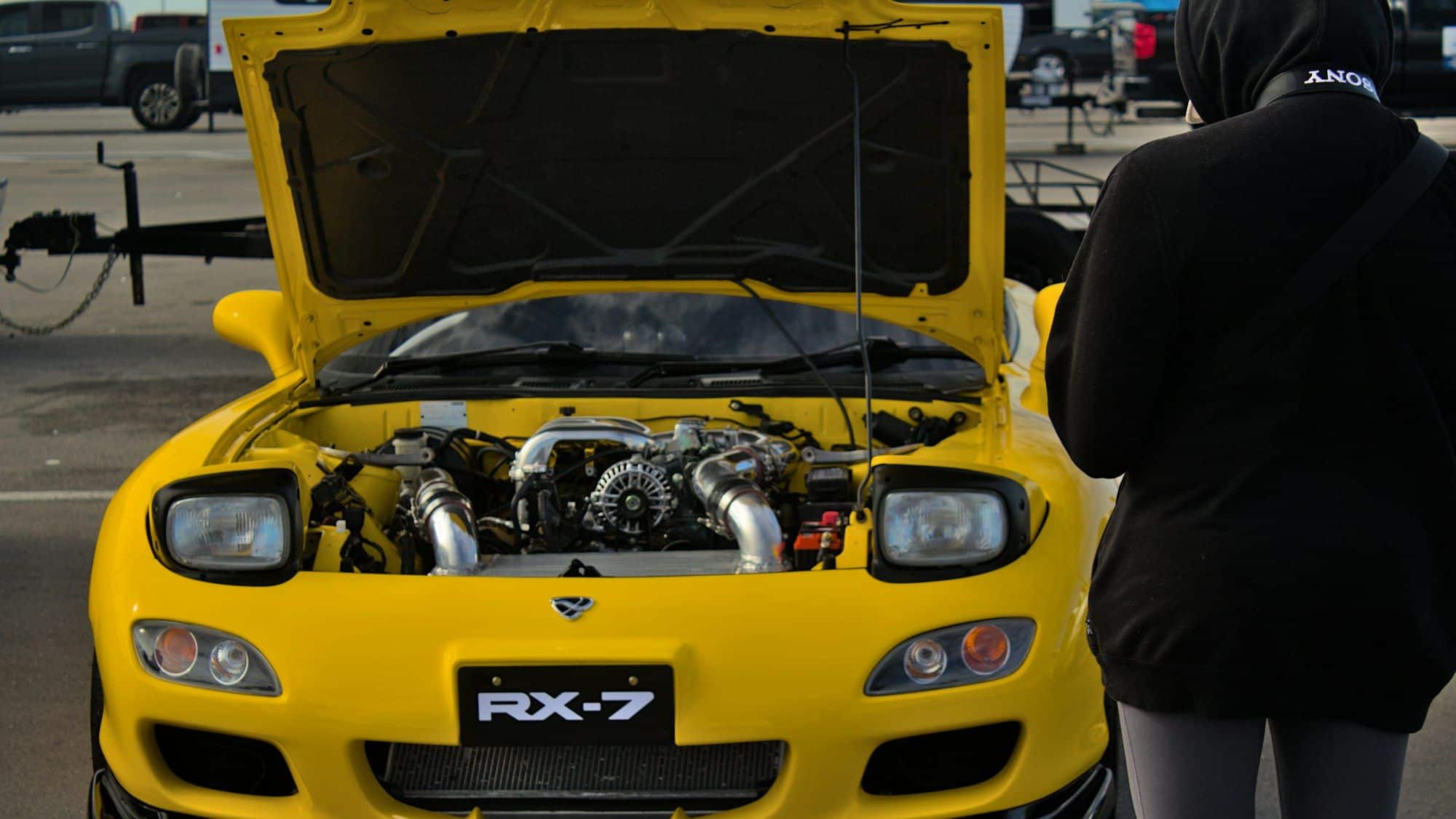
The Mazda RX-7 uses roughly half the moving parts of a comparable piston engine — no valves, no camshafts, no connecting rods — yet its engine became the single biggest reason buyers walk away from one today. That contradiction is worth understanding before you hand over money for one, because the failure mode is not random bad luck. It is predictable, it is manageable, and it flows directly from the same engineering decisions that make the car exceptional.
The Rotary Paradox: Fewer Parts, More Demanding Ownership
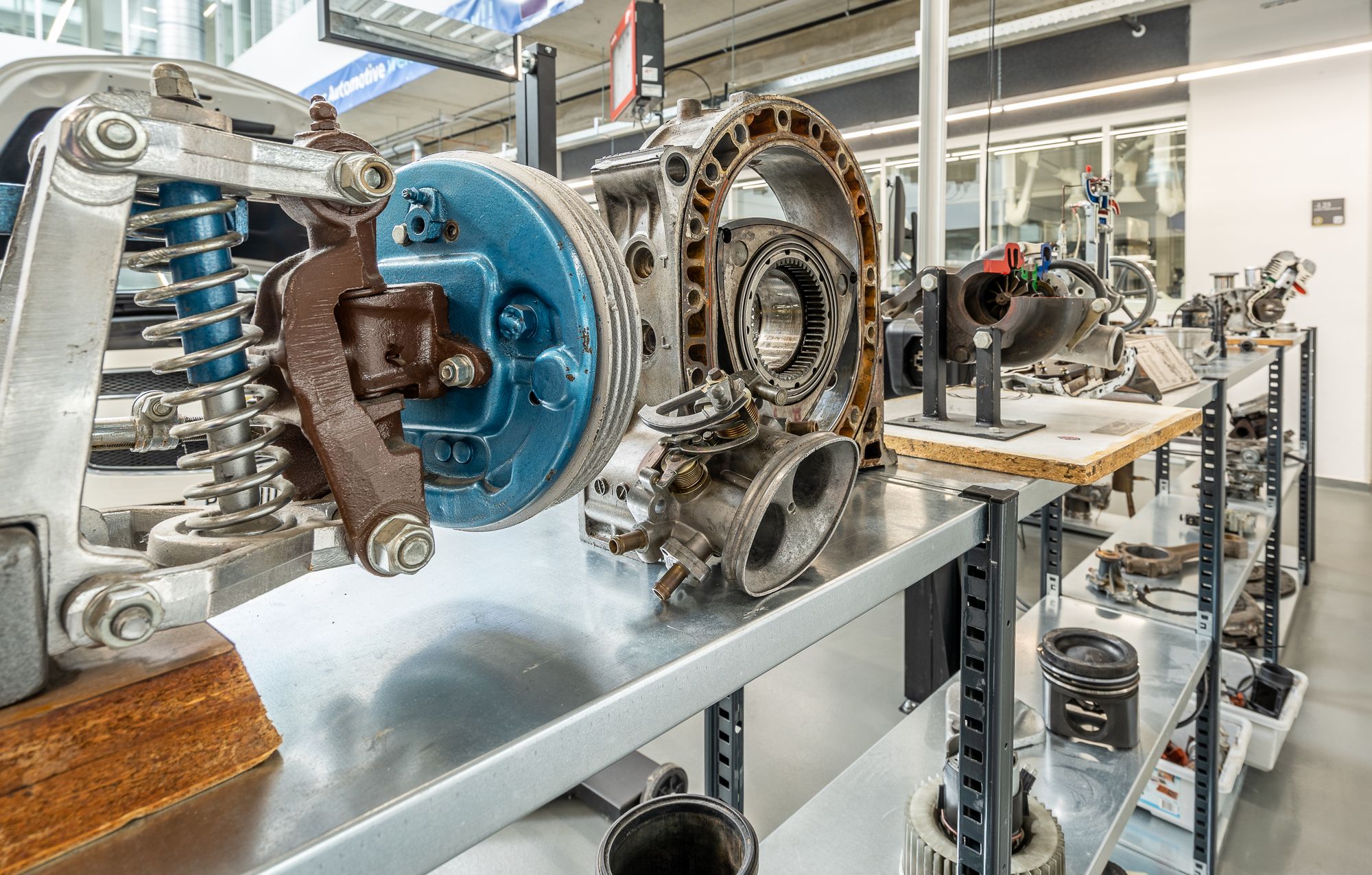
The Wankel rotary replaces the entire reciprocating assembly of a piston engine with triangular rotors spinning inside oval housings. Where a four-cylinder carries pistons, connecting rods, wrist pins, intake and exhaust valves, and dual camshafts, the rotary achieves the same four-stroke combustion cycle with a dramatically smaller parts count. On paper, that should mean fewer things to break. In practice, the RX-7 built a reliability reputation that has followed it into the collector market and inflated the cost of ownership for every used example sold today.
The reason that simplicity failed is not that the Wankel is a bad design. It is that the rotary trades away three things piston engines handle almost passively: conventional crankcase lubrication paths, low-speed sealing geometry that remains stable across a wide temperature range, and the thermal cycling that piston crowns experience between strokes — cycling that incidentally helps manage heat and carbon deposits. Remove those passive advantages and you have an engine that rewards attentive ownership and punishes neglect faster than almost anything else in its price class.
If you are evaluating a used FD or FC RX-7, or trying to keep one running, every engineering point in this article connects directly to a cost or maintenance decision you will face.
What the RX-7’s Rotary Actually Is — and Why Mazda Chose It
The Mazda RX-7 uses a front mid-engine, rear-wheel-drive layout. The rotary’s compactness was not an aesthetic choice — it was structurally necessary to achieve the weight distribution the car was designed around. The twin-rotor 13B displaces just 1.3 liters across two rotors. That allowed Mazda to position the entire powertrain behind the front axle line, producing near-50/50 weight distribution that a piston engine of equivalent output, with its longer block and heavier reciprocating mass, could not have delivered in the same wheelbase.
Early SA and FB first-generation RX-7s used the carbureted 12A, a 1.2-liter two-rotor unit producing approximately 100 hp. The car weighed under 2,400 lb. That combination produced handling competitive with European sports cars costing considerably more, which is why the formula worked commercially despite the engine’s emerging reliability reputation.
The FC RX-7, sold from 1986 to 1992, introduced the 13B in both naturally aspirated and turbocharged form. The turbocharged FC produced between 146 and 200 hp depending on market specification — a meaningful step up that also introduced the turbo system complexity that would define the generation’s ownership experience.
The FD RX-7, sold from 1992 to 2002 in most markets, escalated the formula further with the 13B-REW: a twin-turbocharged sequential setup where a smaller primary turbocharger spins up at low rpm and a larger secondary takes over at higher engine speeds. The stated goal was to boost low-end torque and top-end power. That sequential packaging was only feasible because the engine itself was small enough to leave room for two turbocharger assemblies, associated plumbing, and an intercooler in a relatively compact engine bay. The size advantage was structural, not incidental.
The Apex Seal Problem: Engineering Root Cause, Not Bad Luck
Each rotor carries three spring-loaded apex seals. Their job is to maintain a gas-tight boundary between combustion chambers as the rotor sweeps the housing. At high rpm or under sustained heat, those seals operate under continuous mechanical and thermal stress across a contact surface that never fully cools the way a piston crown does between strokes. That is the core vulnerability.
Unlike piston rings, which are bathed in oil from the crankcase, apex seals rely on a metered oil-injection system that introduces small amounts of oil directly into the intake charge. If that metering pump is under-serviced, starved, or the driver runs the engine hard before the housing has fully reached operating temperature, the contact geometry between seal and housing degrades. Compression drops. The failure is progressive and measurable before it becomes catastrophic — which is why a compression test is the most important single diagnostic step before buying any used example.
Carbon buildup from the oil-injection process accelerates wear when the engine sees predominantly short, low-rpm trips. The rotary does not reach temperatures sufficient to burn off deposits unless you drive it hard enough and long enough to do so — the precise opposite of how most owners treat a 25-to-30-year-old sports car used as an occasional weekend vehicle. The result is a failure mode that is behaviorally driven: the engine fails not because the design is fundamentally flawed but because its thermal and lubrication requirements are unforgiving of casual-use patterns.
Engine flooding is a related failure specific to the rotary architecture. If you stall a cold engine and immediately attempt a restart, unburned fuel can wash the residual oil film from the apex seals. The correct procedure is to allow the engine to fully warm before shutdown and to follow the proper flooded-restart sequence if the situation arises. Skipping this step is a common cause of premature seal wear on cars that otherwise look well-maintained on paper.
One point that generates consistent debate in the ownership community concerns the relationship between the two rotor housings and their respective wear rates. Because the front and rear rotors operate in slightly different thermal environments within the same engine, compression loss often appears unevenly between them. A compression test that checks each rotor face individually — rather than treating the engine as a single unit — gives you a more accurate picture of where the engine actually stands.
Specs at a Glance: What You Are Actually Buying
| Generation | Engine | Displacement | Power (factory claim) | Turbo | Layout |
|---|---|---|---|---|---|
| SA/FB (1978-1985) | 12A carbureted | 1.2 L (two-rotor) | ~100 hp | None | Front mid, RWD |
| FC (1986-1992) | 13B-T / 13B-NA | 1.3 L (two-rotor) | 146-200 hp (market variant) | Single (turbo models) | Front mid, RWD |
| FD (1992-2002) | 13B-REW | 1.3 L (two-rotor) | 255-280 hp (USDM/JDM variance) | Sequential twin | Front mid, RWD |
JDM-spec FD figures were quoted at 280 hp; USDM figures were 255 hp. Both reflect manufacturer claims under their respective test standards, and independent dyno results varied from those figures. Treat them as relative benchmarks rather than verified absolutes. The variance between markets has generated genuine confusion among buyers — worth researching carefully before you negotiate on any specific car.
Fuel economy is a consistent weak point across all generations. The rotary’s thermodynamic efficiency is lower than a comparable piston engine, and the FD’s sequential twin-turbo system raises consumption further. Budget for 15-18 mpg in mixed real-world driving as a realistic baseline. If that figure materially affects your ownership calculus, the RX-7 is the wrong car regardless of how much you like everything else about it.
FD curb weight in USDM trim was approximately 2,800 lb (1,270 kg) — heavier than the FB but still light by current sports-car standards. The power-to-weight ratio remains competitive with many modern performance cars at similar market prices, which is part of why FD values have continued to climb.
The Other Failure Points Buyers Underestimate
The sequential turbo system on the FD is mechanically complex independent of the engine itself. Solenoid-controlled switching valves, two separate turbocharger units, and an associated vacuum line network all age poorly. Diagnosing a boost fault on a car that is now approaching 30 years old requires either a specialist with specific RX-7 experience or a willingness to work through the system methodically yourself. Neither option is free, and both take time. Price this into your offer on any car where boost behavior has not been independently verified.
Cooling is a documented vulnerability. The rotary generates substantial heat in a small package, the FD’s radiator is sized with limited margin, and any degradation in coolant flow or thermostat function risks housing warp. A warped rotor housing turns a maintenance item into an engine-out repair. Check coolant condition, thermostat function, and radiator efficiency as part of any pre-purchase inspection — not as an afterthought once you have already agreed on a price.
The vacuum line network that controls the sequential turbo system deserves its own inspection step. These lines crack and harden with age, and even small leaks produce boost behavior that is difficult to diagnose without first confirming the vacuum circuit is intact. Replacing the entire network with fresh silicone line is a relatively low-cost preventive measure that experienced owners typically address early.
Pre-purchase compression testing is non-negotiable. A healthy 13B-REW should show at least 8.5 kg/cm² (approximately 120 psi) per rotor face. Anything materially below that indicates seal wear requiring engine work in the near term. Price the rebuild cost into your offer or treat the result as a walk-away condition depending on your budget and risk tolerance. Walk away from any seller who refuses to allow a compression test before purchase.
Rotary Pros and Cons: The Honest Trade-Off
- Exceptional power-to-size ratio enabling the front-mid layout and near-50/50 weight distribution in a production car — advantages you feel immediately in how the FD handles at the limit.
- Linear, high-rpm power delivery with no valve float ceiling — the engine pulls cleanly to redline in a way that most piston engines of equivalent displacement do not.
- Mechanical simplicity at the engine core — fewer reciprocating parts means less inherent vibration and a smoother power delivery character than a piston engine of equivalent output.
- Distinct driving character that is genuinely unlike any piston-engined sports car at comparable price points in today’s used market.
- Lower thermodynamic efficiency than a piston engine of equivalent output translates directly to higher fuel costs across every mile you drive.
- Apex seal replacement requires full engine disassembly — there is no shortcut, and labor costs reflect that reality completely.
- Oil consumption is by design, not a fault, but it must be monitored actively. Running low on oil between changes accelerates seal wear faster than almost any other single factor in day-to-day operation.
- Intolerance of casual use patterns — short trips, infrequent full warm-up cycles, and inconsistent oil monitoring are more damaging to this engine than to virtually any other sports car in its price range.
- Specialist knowledge is geographically uneven. If you do not have a competent rotary shop within reasonable distance, labor costs and turnaround times will be worse than parts costs alone suggest.
The rotary is not inherently unreliable — Mazda’s own racing programs demonstrated longevity under controlled, properly managed conditions, and the engineering case for the platform remains sound in the right hands. But it is demanding of attentive ownership in ways that a Honda or Toyota of the same era is not, and that gap widens as the cars age and as ownership passes to buyers less familiar with the engine’s specific requirements.
What This Means If You Are Buying One Now
Budget for a rebuild or a replacement engine as a contingency from day one. A professionally rebuilt 13B-REW from a reputable rotary specialist costs roughly $3,000-$6,000 for the core work in the US market as of late 2024 — verify current quotes directly with specialist shops before committing, since prices vary by shop, parts sourcing, and whether housings are within tolerance. That figure does not include removal, reinstallation, or ancillary repairs discovered during the process.
Prioritize service history and documented driving habits over raw mileage. A 60,000-mile car that was commuted slowly and rarely fully warmed up is higher risk than an 80,000-mile car with documented consistent oil changes at the correct grade and regular full-temperature operation. Ask specifically whether the previous owner added oil between changes, ran the engine to full operating temperature regularly, and followed the flooded-restart procedure. Vague or evasive answers are informative in themselves.
The parts supply situation is mixed and worth researching before you commit. Wear items and turbo components remain available through specialist suppliers. Some housing and rotor components are becoming difficult to source new, particularly FD-specific items. Factor long-term parts availability into your ownership plan if you intend to keep the car beyond the near term.
Values for clean FD RX-7s have risen substantially since 2018 and show no sign of reversing. A stock, well-documented car commands a premium that modified examples rarely match, because modifications that make the car faster rarely make it more valuable to the next buyer. The RX-7’s place in Mazda’s own history is now firmly established, and the market reflects that clearly.
Buy the best-documented example you can find, verify the compression on each rotor face before you commit, and treat the engine’s specific requirements as standard operating procedure rather than exceptional maintenance. Do that consistently, and the failure rate is genuinely manageable. Ignore it, and the rotary will demonstrate exactly why its reputation developed the way it did.