
In the entire span of Chevrolet Corvette production history, one fact stops most enthusiasts cold: you cannot buy a 1983 Corvette because GM built approximately 43 pre-production units, found the quality unacceptable, scrapped the run, and skipped the model year entirely — the only time a nameplate that launched in June 1953 simply went dark. That decision nearly ended the Corvette for good, and understanding it tells you more about every generation that followed than any spec sheet alone.
The Year America’s Sports Car Simply Didn’t Exist
The transition from C3 to C4 was supposed to be a straightforward generational update. Instead it became a documented crisis. GM’s Bowling Green, Kentucky assembly plant was retooled for the new C4 platform, and when the pre-production cars came off the line, quality problems — panel fitment, electrical systems, water sealing — were severe enough that the entire run was condemned. Rather than ship defective cars and absorb the warranty and reputation damage, GM halted the program and pushed the launch to model year 1984.
For a buyer, this is not trivia. It explains why C4 serial numbers begin in 1984, why any car claimed to be a legitimate 1983 production Corvette is essentially nonexistent in the retail market, and why early C4 build quality issues are a documented ownership variable rather than forum mythology. Total production numbers by model year show the gap plainly: the 1982 C3 ends the previous generation’s count, and the next entry is 1984.
The commercial cost of that missed model year was real. Dealers had no new Corvette to sell for an entire retail cycle. More significantly, internal GM deliberations in the early 1980s included serious proposals to discontinue the Corvette nameplate entirely or convert it to a front-wheel-drive platform — a scenario documented in contemporaneous automotive press reporting, not reconstructed from hindsight. The nameplate survived, but it survived on a razor’s edge.
One additional consequence is worth noting: the sole surviving 1983 pre-production Corvette is on display at the National Corvette Museum in Bowling Green, Kentucky. It exists as a historical artifact, not a retail automobile, and its presence underscores just how close the entire production run came to disappearing without a trace.
C1 Through C3: Thirty Years of Front-Engine Foundation (1953-1982)

To understand why the C4 crisis mattered so much, the baseline matters. Corvette’s production history began in June 1953 with a deliberately cautious 300 hand-assembled cars built in Flint, Michigan — a market test, not a volume launch. Chevrolet needed to know whether American buyers would actually pay for a two-seat sports car, a format the domestic market had not validated at scale.
They would. The C1 generation (June 1953 through August 1962) established the convertible-only format and scaled quickly once the audience was confirmed. By 1959, Chevrolet was building 9,670 Corvettes in a single model year — every one of them a convertible — demonstrating that the nameplate had moved well past its experimental phase. The original 1953 cars used a 150-hp Blue Flame inline-six paired with a two-speed Powerglide automatic, a powertrain that drew criticism from sports-car enthusiasts at the time. The arrival of the 265-cubic-inch V8 for 1955, and then the fuel-injected 283 V8 producing 283 hp for 1957, answered that criticism and set the template for every generation that followed: the engine is the story.
The C2 Sting Ray (September 1962 through July 1967, production years 1963-1967) introduced the first Corvette coupé in 1963 alongside the convertible, added independent rear suspension, and delivered the split-window fastback styling that still commands auction premiums today. The split rear window appeared for one year only — 1963 — because chief stylist Bill Mitchell’s design was considered a visibility obstruction and was replaced with a single pane for 1964. That single-year styling detail is why 1963 coupes carry a persistent collector premium. Peak factory output reached approximately 435 hp with the 427 cubic-inch V8 in 1966-67.
The C3 Shark (1968-1982) stretched fifteen years across the muscle-car peak and the emissions-strangled early 1980s. The generation is usefully divided at 1972, when SAE net horsepower ratings replaced the gross figures previously used — a change that made the numbers look worse even when the actual output was comparable. The 1970 LT1 small-block produced approximately 370 hp (gross) at the C3’s peak; by 1982, the base engine was producing roughly 200 hp (net). That contraction illustrates exactly the pressure the C4 was under to deliver something meaningfully better.
Convertible production also ended with the C3 after 1975, a casualty of anticipated federal rollover regulations that never materialized — the Corvette would not offer a convertible again until 1986. That eight-year gap is relevant if you are evaluating C4 convertibles today, because the return of the body style mid-generation was itself a signal that GM was paying attention to what buyers wanted.
The C4 Crisis: Why GM Nearly Pulled the Plug (1984-1996)
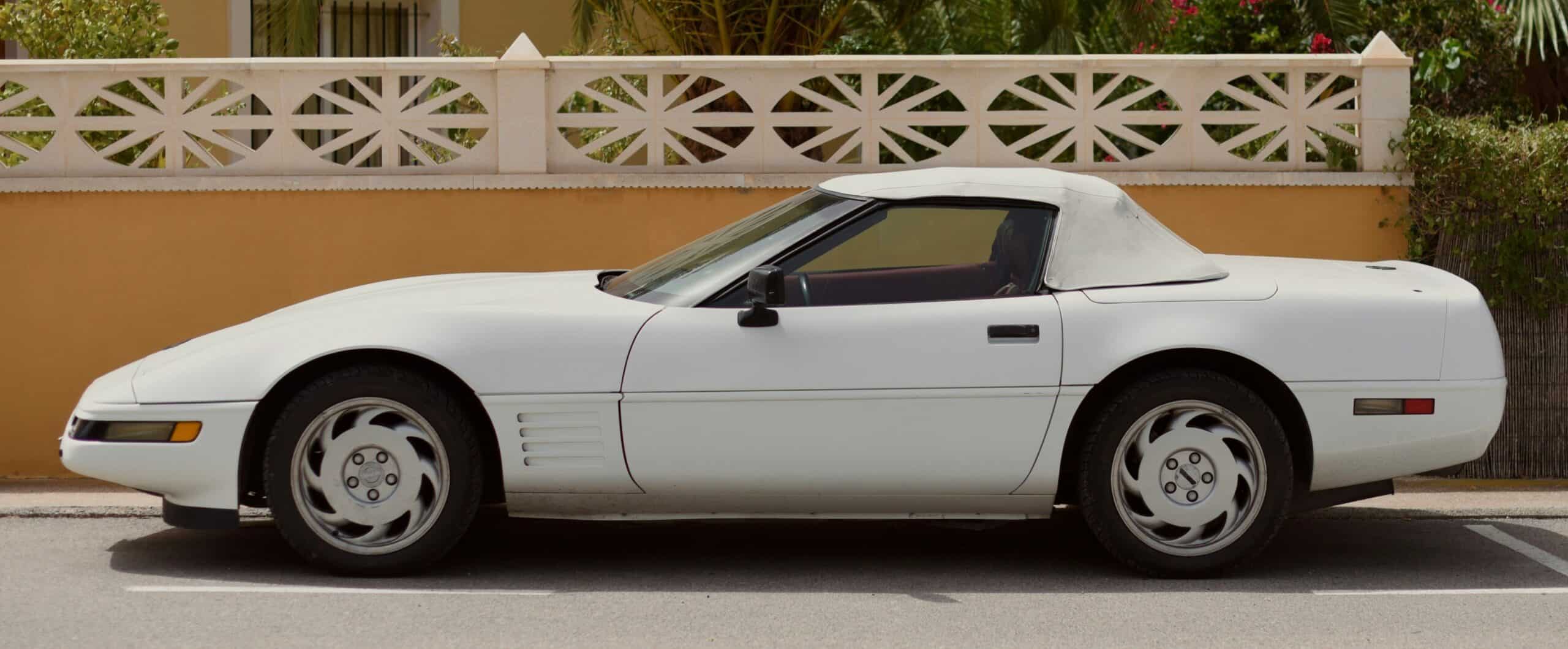
The C4 ran from 1984 through 1996 — twelve years that began in humiliation and ended with a variant capable of embarrassing European sports cars. If you are evaluating a C4 for purchase today, the generation splits into two distinct ownership propositions.
Early C4 production (1984 through roughly 1989) drew consistent criticism in period road tests: panel gaps, electrical gremlins, and water leaks were documented complaints across multiple publications. These are known due-diligence checkpoints for a pre-purchase inspection, not scare stories. The base engine produced 205 hp at launch — a credible improvement over the outgoing C3 but not a dramatic one. A notable bright spot in the early C4 run was the return of the convertible for 1986, the first since 1975, which confirmed that the body style had a commercially viable future.
The C4 also introduced the first standard anti-lock brakes on a Corvette in 1986, and traction control arrived for 1992 — both firsts for the domestic market in a volume sports car context, and both relevant checkpoints when inspecting a specific car’s options configuration.
The LT5-powered ZR-1 (1990-1995), co-developed with Lotus Engineering, changed the conversation. Its all-aluminum, dual-overhead-cam V8 produced 375 hp at introduction and was upgraded to 405 hp in 1993. Period road tests confirmed 0-60 mph times in the 4.4-4.5 second range — genuinely competitive internationally for the era. The ZR-1 was visually distinguished from base C4 models by a wider rear body section to accommodate wider rear tires, a detail that is relevant for parts sourcing today because rear body components are not interchangeable between ZR-1 and standard C4 cars. The trade-off was price: approximately $65,000 in period dollars placed the ZR-1 in a different segment than the base C4, which is a relevant cross-shopping variable if you are comparing C4 variants today.
C5 and C6: Rebuilding the Case for American Performance (1997-2013)
The C5 (1997-2004) was the structural reset the nameplate needed after the C4’s rocky decade. A hydroformed perimeter frame, a torque-tube rear-mounted transaxle producing near-50/50 weight distribution, and the LS1 V8 at 345 hp — delivered at a base price that undercut comparable European sports cars — re-established the Corvette’s core value argument. The C5 also reintroduced the fixed-roof coupé as a distinct model from 1999, offering a stiffer body structure at a lower price than the convertible, a configuration that remains a strong used-market proposition.
The C5 Z06, introduced for 2001 with the LS6 producing 385 hp and upgraded to 405 hp for 2002, used the fixed-roof coupé body exclusively. It deleted the spare tire, used lighter components throughout, and produced a track-capable car at a base price that placed it well below European alternatives with comparable lap times. It remains one of the stronger value-per-performance propositions in the used Corvette market. One ownership caveat: the C5 Z06 uses a titanium exhaust system that is expensive to replace and was not shared with the standard C5.
The C6 (2005-2013) refined rather than reinvented, and the refinements were substantive. Exposed headlights returned for the first time since the C3, the wheelbase was shortened slightly to improve agility, and interior quality took a meaningful step forward from the C5 — though period reviews still identified it as below par for the transaction price at the top of the range. The Z06’s LS7 7.0-liter V8 produced 505 hp; the ZR1’s supercharged LS9 6.2-liter V8 produced 638 hp. Both figures were verified in period testing and gave Corvette documented supercar performance data to cite against European competition at a fraction of the price.
Two trade-offs deserve honest weight. First, fuel economy: EPA ratings for the base C6 coupe with the LS3 and manual transmission ran approximately 16 city / 26 highway — acceptable for the segment but a real operating-cost variable if you drive year-round. Second, the C6 Z06 uses a dry-sump lubrication system and a specific engine cradle not shared with the base C6; parts and service costs for the Z06 powertrain are meaningfully higher than for the LS3-equipped base car. Know which model you are buying before you budget for maintenance.
C7 to C8: The Last Front-Engine and the First Mid-Engine (2014-Present)
The C7 (2014-2019) brought carbon-fiber body components to the base Z06 and pushed supercharged output to 755 hp in ZR1 form with the LT5 engine. It also addressed the interior quality criticism that had followed the nameplate for three decades — C7 cabin materials represented a documented step forward in period assessments, with a genuinely usable infotainment system and improved fit and finish across the range.
The C7 Z06 introduced a supercharged LT4 V8 producing 650 hp, paired with either a seven-speed manual or an eight-speed automatic transmission — the first time an automatic was available in a Z06. One documented ownership variable for the C7 Z06: early examples with the automatic transmission experienced overheating under sustained track use, a problem GM addressed with a revised transmission cooler. If you are evaluating a C7 Z06, confirming whether that update has been applied is a standard pre-purchase checkpoint.
The C8 (2020-present) moved the engine behind the driver for the first time in Corvette’s production history. Engineers and GM executives had studied mid-engine layouts since at least the CERV I concept of 1960, and several mid-engine show cars followed over the subsequent decades, but each production generation deferred the change because a mid-engine architecture requires fundamentally different body structure, tooling investment, and customer re-education. The 2020 launch finally committed. The base C8 Stingray’s 6.2-liter LT2 V8 produces 490 hp (495 hp with performance exhaust), and independent period testing placed Z51-equipped cars at 0-60 mph in the 2.8-2.9 second range.
If you are budgeting for C8 ownership, one structural fact matters: the C8 body architecture is incompatible with C7 and earlier components. Parts commonality with prior generations is essentially zero. Service and parts costs are still maturing in the market, which is a real variable for long-term ownership planning. The C8 Z06’s flat-plane-crank LT6 V8 produces 670 hp at 8,400 rpm — the redline itself is a meaningful departure from the pushrod V8s that defined every prior Corvette generation. The E-Ray hybrid (introduced for 2024) adds a front-axle electric motor producing 160 hp to the standard LT2 V8, delivering all-wheel drive and a claimed 0-60 mph time of 2.5 seconds. A ZR1 variant with a twin-turbocharged engine has been announced with output targeted above 1,000 hp — distinguish announced specifications from independently tested and delivered results before making any valuation decision based on those numbers.
For a full picture of the Corvette’s complete production lineage, the Wikipedia entry is a reasonable reference for generation boundaries and production volumes, though specific figures should be verified against primary sources.
Corvette Generations at a Glance: The Numbers That Actually Matter
| Generation | Production Years | Body Styles at Launch | Notable First | Approx. Peak Factory HP (period rating) |
|---|---|---|---|---|
| C1 | Jun 1953-Aug 1962 | Convertible only | First Corvette; first fuel-injected V8 (1957) | 283 hp (283 V8 fuel injection, 1957) |
| C2 Sting Ray | Sep 1962-Jul 1967 | Convertible + Coupé | First coupé; first independent rear suspension; split-window (1963 only) | ~435 hp (427 V8, 1966-67) |
| C3 Shark | 1968-1982 | Convertible + Coupé (convertible dropped after 1975) | Longest-running generation; last convertible until 1986 | ~370 hp gross (1970 LT1); ~200 hp net by 1982 |
| C4 | 1984-1996 (no 1983 model) | Coupé + Convertible (from 1986) | First standard ABS (1986); ZR-1 Lotus-developed LT5 (1990) | 405 hp (ZR-1 LT5, 1993-95) |
| C5 | 1997-2004 | Coupé + Convertible + Fixed-Roof Coupé / Z06 (from 1999/2001) | Rear-mounted transaxle; near-50/50 weight distribution | 405 hp (Z06 LS6, 2002-04) |
| C6 | 2005-2013 | Coupé + Convertible + Z06 + ZR1 | Exposed headlights return; LS9 supercharged V8 | 638 hp (ZR1 LS9) |
| C7 | 2014-2019 | Coupé + Convertible + Z06 + Grand Sport + ZR1 | Last front-engine Corvette; first automatic-available Z06 | 755 hp (ZR1 LT5 supercharged) |
| C8 | 2020-present | Coupé + Convertible + Z06 + E-Ray + ZR1 (announced) | First mid-engine production Corvette; first hybrid (E-Ray, 2024) | 670 hp (Z06 LT6, flat-plane crank) |
Use this table as a reference frame, not as a valuation guide. Transaction prices depend on trim, mileage, options, documented service history, and market conditions at the time of purchase or sale. The absence of a 1983 row is not a formatting error — it is the most consequential single fact in the Chevrolet Corvette production timeline.
Assembly: One Plant, One Nameplate
A detail that shapes parts availability, regional dealer expertise, and collector documentation is worth naming directly: since 1981, every Corvette has been built at a single facility — the Bowling Green Assembly Plant in Bowling Green, Kentucky. Prior to that, C3 production ran at both Bowling Green and St. Louis, Missouri, and C1 production began in Flint before moving to St. Louis. The consolidation to a single plant means that build documentation, National Corvette Museum proximity, and factory delivery programs are all centered in one location — a fact relevant to buyers who value provenance verification or the factory-delivery experience. A detailed account of Corvette assembly plant history outlines the full facility timeline if you need to verify where a specific car was built.
What the Missing Year Tells You About Buying a Corvette Today
The 1983 production gap is evidence of an organization willing to absorb the commercial cost of a missed model year rather than ship a defective product. That standard is worth remembering when you assess any generation’s reputation — GM demonstrated, at least once, that it would absorb a revenue loss before a quality compromise.
For a purchase decision today, the generational trade-offs are straightforward once named honestly:
- C4 (1984-1996): Budget for a diligent pre-purchase inspection specifically targeting electrical systems, water sealing, and panel fitment on cars from the first half of the production run. ZR-1 variants command a significant premium and require ZR-1-specific parts availability checks, including rear body panels not shared with standard C4 cars.
- C5 (1997-2004) and C6 (2005-2013): The most predictable ownership cost relative to performance delivered. The C5 Z06 and C6 base coupe have historically represented strong value-per-horsepower propositions in the used Corvette market. Interior quality is a documented limitation; powertrain durability is a documented strength. Confirm Z06 and ZR1 variant-specific parts costs before budgeting.
- C7 (2014-2019): The last front-engine layout, improved interior, and modern connectivity. Z06 and ZR1 variants deliver numbers that were exotic-car territory a decade earlier. Used market pricing has begun to normalize. Verify the transmission cooler update on any C7 Z06 automatic before purchase.
- C8 (2020-present): Mid-engine dynamics at a base MSRP that remains below most direct European competitors — that value argument is real. Parts and service costs are still maturing in the market, the architecture shares nothing with prior generations, and the announced ZR1 output figures have not yet been independently verified in production form. Factor all three into a long-term ownership budget before committing.
You can read a deeper account of the full Chevrolet Corvette evolution from a dealer-history perspective, or consult Haynes’ Corvette history overview for a generation-by-generation technical summary. Both are useful secondary references; neither substitutes for a pre-purchase inspection from a Corvette-specialist shop.
The line from 300 hand-built 1953 roadsters to a 670-hp flat-plane-crank mid-engine Z06 runs straight through every generation — including the one that never existed. The nameplate’s survival was not inevitable; it was earned, model year by model year, and once nearly lost entirely. The informed buyer knows that history. The impulsive one finds out the hard way on a pre-purchase inspection bill.