
Hybrid vehicles posted a 50% sales jump in the first two months of 2025 — outpacing the growth rate of EVs over the same period — and three automakers are quietly capturing most of that windfall. If you’re shopping for a new vehicle right now, understanding who built this market and why tells you exactly where the most mature, most reliable hybrid technology actually lives.
The Structural Shift Happening at Your Dealership

U.S. hybrid sales surged roughly 50% in early 2025 while EV growth came in around 13% — and hybrids beat EVs in raw volume, not just growth rate. This isn’t a momentary blip driven by a single hot model. It’s a structural shift in what American buyers are actually choosing when they walk into a dealership.
High fuel prices are the obvious trigger, but they’re not the whole story. The deeper driver is trust. Hybrids eliminate range anxiety because the gas engine is always there as a backstop. The charging infrastructure problem that continues to frustrate EV adoption simply doesn’t apply — you fill up at any gas station, the hybrid system works invisibly in the background, and you change nothing about how you use a car.
Automakers have also spent years shedding the “econobox” stigma. The hybrid of 2025 is not the hybrid of 2005. Sportier styling, quicker acceleration, and genuinely engaging driving dynamics mean buyers no longer make an aesthetic or performance sacrifice to get 40-plus MPG. Three automakers — Toyota, Ford, and Honda — have captured roughly 70% of that surging market, converting decades of hybrid investment into a competitive moat that latecomers will find very hard to close quickly.
Toyota: The Company That Invented This Category and Still Owns It
No other mass-market automaker comes close to Toyota’s hybrid penetration. The brand’s electrified vehicles — overwhelmingly hybrids, not battery EVs — now represent approximately 57% of Toyota’s total U.S. sales volume. Hybrid dominance at Toyota isn’t a niche story; it’s the main story, and it explains why the brand consistently places multiple models among America’s best-sellers.
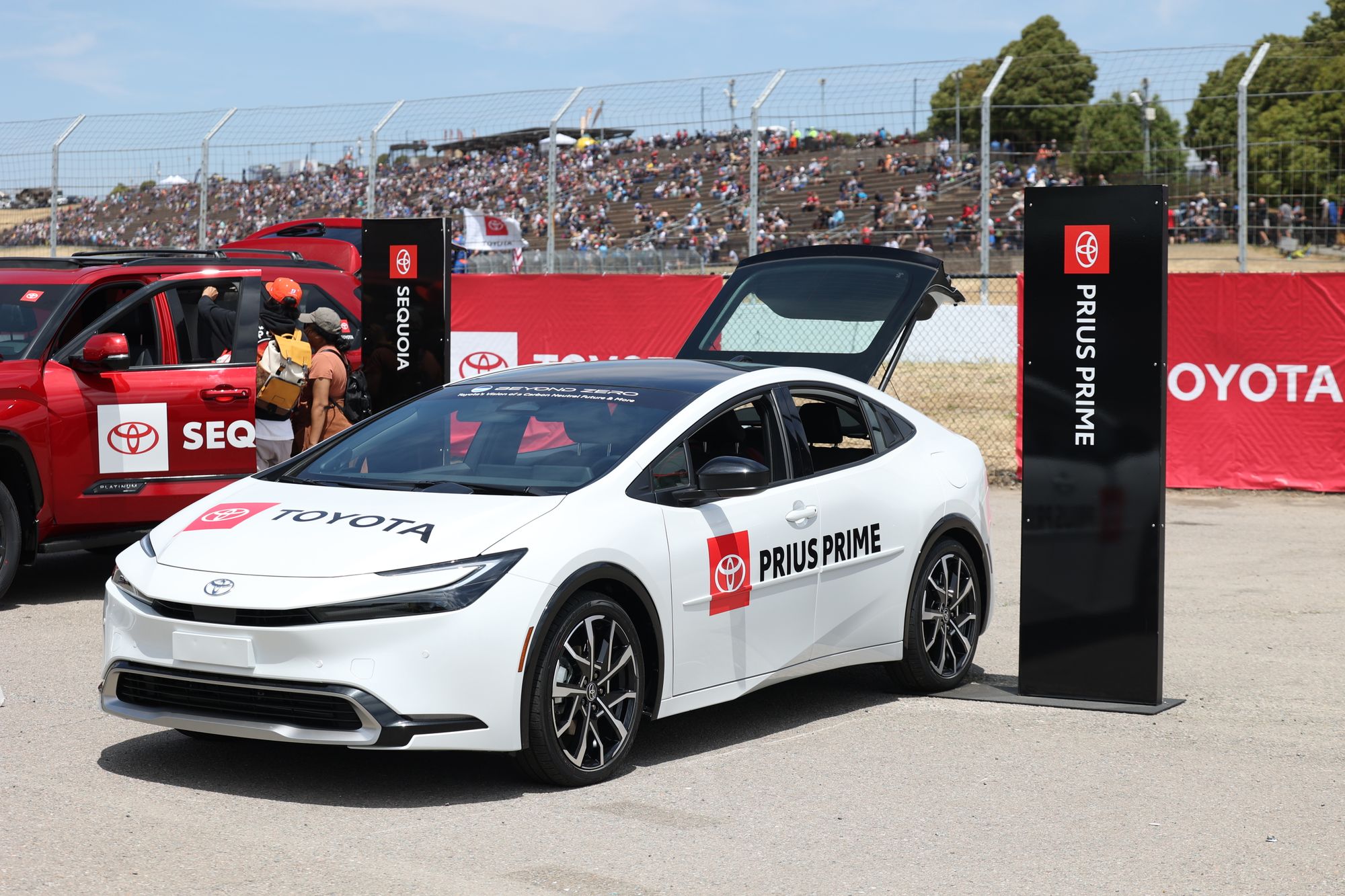
Lineup breadth is a genuine advantage for buyers. Toyota sells a hybrid variant across nearly every segment it competes in: the RAV4 Hybrid for compact SUV shoppers, the Camry Hybrid for sedan buyers, the Highlander Hybrid for three-row families, the Sienna (sold exclusively as a hybrid), the Venza, and the Prius that started it all. You can access Toyota’s hybrid technology at almost any price point without being forced into an unfamiliar model.
The hardware behind all of this is Toyota Hybrid System II and its derivatives — a self-charging, parallel hybrid architecture refined over more than 25 years of continuous production. That longevity translates into real-world reliability data that no competitor can match on volume and time in service. When you’re making a multi-year ownership decision, that track record matters more than any spec sheet comparison.
For buyers considering a foot in both worlds, Toyota’s RAV4 Prime adds roughly 42 miles of electric-only range on top of the standard hybrid architecture. If you have home charging available, that PHEV variant deserves a serious look alongside the standard hybrid lineup.
Trade-off worth knowing: Toyota’s hybrid premium over an equivalent non-hybrid trim runs roughly $2,000-$4,500 depending on model and configuration. High-demand models like the RAV4 Hybrid also attract dealer markups in a tight market, so arrive with your target transaction price already researched before you sit down with a salesperson.
Ford: The American Brand That Made Hybrids Work for People Who Actually Use Their Trucks

Ford’s hybrid strategy is fundamentally different from Toyota’s, and it’s smarter than it looks on the surface. Rather than building standalone hybrid-specific models, Ford embedded hybrid powertrains inside the vehicles Americans already buy in massive numbers — the F-150, the Escape, and the Explorer. If you weren’t going to switch away from a truck or mainstream SUV for an EV, Ford’s approach meets you exactly where you are.
The F-150 PowerBoost hybrid is the sharpest example. It doesn’t ask truck buyers to compromise on what a truck needs to do — it adds a 7.2 kW onboard generator and measurable fuel economy gains to America’s best-selling vehicle. For a contractor, a weekend warrior, or anyone who uses their truck as a mobile power source, that’s a productivity upgrade packaged as an efficiency story. Ford also offers the Explorer Hybrid in PHEV form, giving SUV buyers a plug-in option alongside the standard hybrid lineup.
Ford’s hybrid pricing premium runs roughly $3,000-$5,000 over base trims, toward the higher end of the three automakers covered here. The real-world MPG range is also wider — from around 24 MPG in larger truck applications up to approximately 44 MPG in the Escape Hybrid — reflecting the fact that Ford is competing in heavier, less aerodynamically efficient segments than Honda or Toyota’s car-based offerings.
Honest trade-off: Because Ford’s strategy is integration-first rather than ground-up hybrid design, some ownership refinements you’d find in a vehicle engineered as a hybrid from the chassis up are less developed. If maximum hybrid-system sophistication is your priority, Toyota or Honda have a measurable edge. If you need a truck or a large SUV, Ford’s approach is hard to replicate elsewhere.
Honda: The Focused Contender With a Two-Motor System That Earns Its Price

Honda doesn’t command the same hybrid mindshare as Toyota, but its two-motor hybrid system is technically distinctive in ways that show up directly in fuel costs and daily driving experience. The system — deployed in the Accord Hybrid, CR-V Hybrid, and Civic Hybrid — operates more like a series hybrid at low speeds and a parallel hybrid at highway speeds, with no traditional multi-speed automatic transmission mediating the power flow. The result is unusually smooth, linear power delivery and real-world efficiency numbers that are competitive at Honda’s price points.
The Accord Hybrid regularly posts 46-48 MPG combined in real-world driving. The CR-V Hybrid runs around 40 MPG combined in a segment where most rivals come in meaningfully lower. Honda’s hybrid premium over non-hybrid trims is also the lowest of the three automakers here — roughly $1,500-$3,500 — which compresses the break-even timeline on fuel savings relative to the upfront cost.
Honda’s lineup is smaller than Toyota’s, but that’s a feature, not a bug. Every model Honda sells in hybrid form is well-executed because the brand hasn’t spread hybrid development thin across a large number of nameplates. It has concentrated effort where it can deliver a complete, refined product. As hybrid adoption accelerates across the industry, that focused approach is proving durable.
How the Three Stack Up: A Decision-Ready Comparison
Use this table as a starting framework. Actual transaction prices vary by trim and region, but the positioning is consistent: Toyota leads on lineup breadth and proven longevity; Ford leads on truck and large-SUV utility integration; Honda leads on value efficiency and driving refinement per dollar spent.
| Automaker | Key Models | Est. Hybrid Premium Over Base | Real-World MPG Range | Best For |
|---|---|---|---|---|
| Toyota | RAV4 Hybrid, Camry Hybrid, Prius, Highlander Hybrid, Sienna, RAV4 Prime | $2,000-$4,500 | 37-52 MPG | Maximum lineup choice, proven long-term reliability |
| Ford | F-150 PowerBoost, Escape Hybrid, Explorer Hybrid | $3,000-$5,000 | 24-44 MPG | Truck and large-SUV buyers who want utility plus efficiency |
| Honda | Accord Hybrid, CR-V Hybrid, Civic Hybrid | $1,500-$3,500 | 40-48 MPG | Value-focused buyers prioritizing fuel economy per dollar |
One honest trade-off applies across all three: hybrids carry an upfront cost premium over non-hybrid counterparts in the same nameplate. Your break-even point depends on annual mileage and local fuel prices — the higher both are, the faster fuel savings recover the premium. If you drive under 10,000 miles a year in a low-fuel-cost market, the math is slower. If you’re at 18,000 miles a year paying above-average pump prices, you’re looking at a materially shorter payback window.
One additional check before you commit: if you tow regularly, verify the hybrid’s rated towing capacity for your specific trim and configuration. Some hybrid powertrains trade towing headroom for efficiency gains. The F-150 PowerBoost is the least compromised here, but confirm the numbers match your actual use case regardless of brand.
What to Do Before You Buy in 2025

The 50% sales surge in hybrids has real consequences for your shopping experience. Inventory on high-demand models — particularly the RAV4 Hybrid and Accord Hybrid — is tighter than it was two years ago, and dealer markups are more common. Build your target out-the-door price before you enter a showroom. Knowing the invoice price and regional transaction averages gives you a factual anchor for negotiation rather than letting the dealer set the frame.
It’s also worth cross-shopping beyond the top three. The multi-propulsion market is already here and expanding rapidly, and competition is intensifying. American car buyers are gravitating to hybrids across a broadening set of brands, and Hyundai and Kia are closing the gap fast — Hyundai’s hybrid sales rose approximately 90% and Kia’s jumped around 179% over the same early-2025 period. Vehicles like the Tucson Hybrid and Sportage Hybrid may offer more negotiating room precisely because they aren’t the obvious first choice. That competition benefits buyers across every nameplate.
The hybrid segment is no longer a compromise category — it’s where the most developed and most reliably efficient powertrains on the market currently live. Toyota, Ford, and Honda got there first by investing when the category was still a curiosity. That head start shows in the breadth of their lineups, the depth of their reliability records, and the competitiveness of their real-world efficiency numbers. For most buyers in 2025, one of these three is the right place to start your search — and now you have a clear map for deciding which one fits your actual needs.