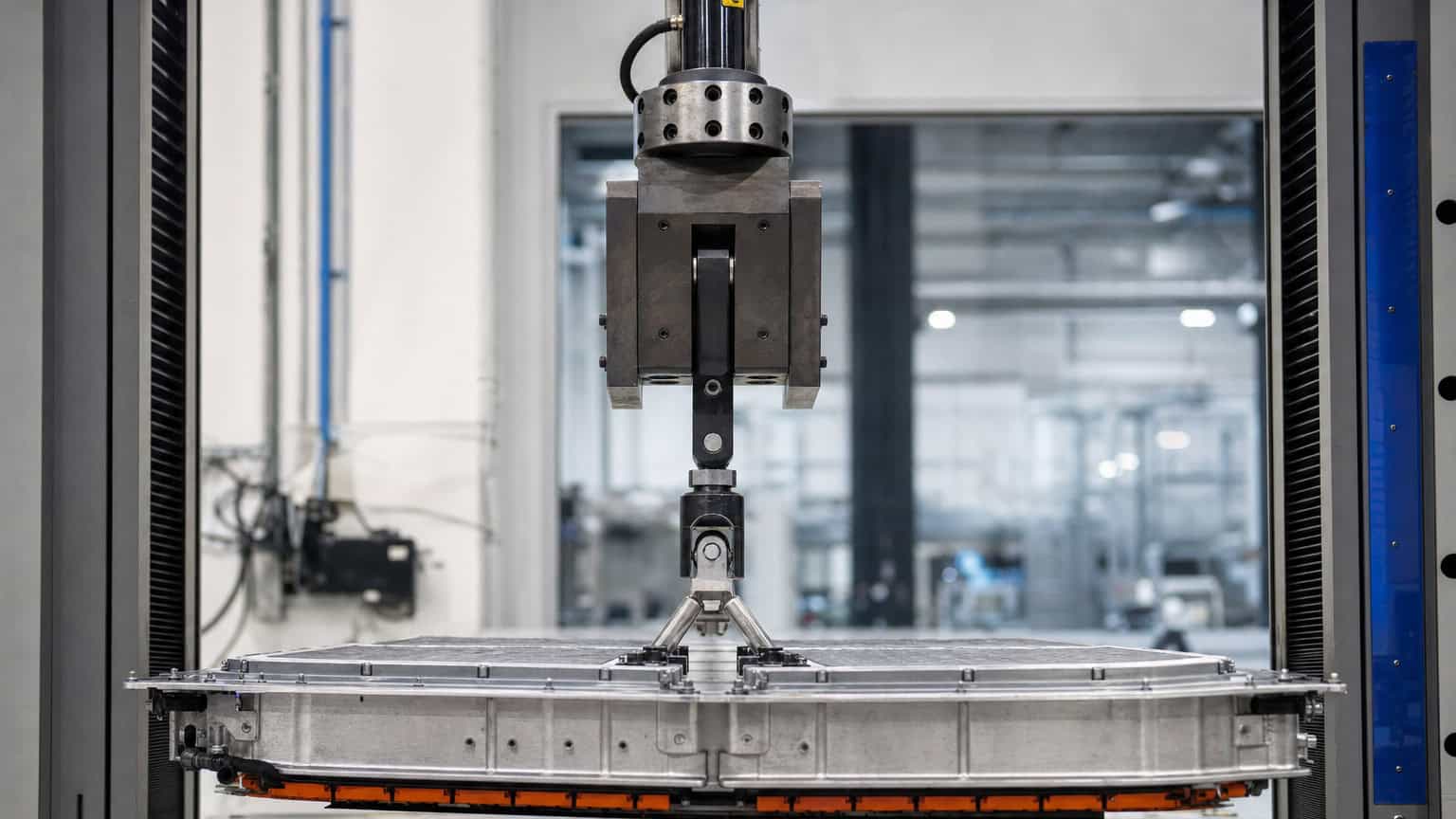
Before your EV rolls off the assembly line, its battery pack has already been pulled apart in a lab — deliberately, methodically, and to the point of failure. That pull test, known as a tensile test, is one of the least-discussed and most consequential steps in determining whether the structure around those cells holds together when a 4,000-pound vehicle meets a pole at 40 mph.
One Test, One Question: Does This Hold?

A tensile test applies a controlled pulling or stretching force to a material specimen until it yields or fractures. The resulting data — yield strength, ultimate tensile strength, and elongation at break — tells engineers exactly how a material behaves under load before it fails. For an EV battery pack, that single stress-strain curve decides whether the steel enclosure, the aluminum side rails, the copper busbars, and the weld seams can absorb crash energy without exposing live cells to a short circuit or, worse, thermal runaway.
This matters to buyers because tensile testing sits upstream of every crash rating, every warranty clause, and every real-world abuse scenario the pack will face across a 150,000-mile ownership cycle. The five-star NCAP score on the window sticker is the visible output. The tensile characterization of enclosure materials is the invisible input that made it possible. Tensile testing helps EV manufacturers verify the strength, safety, and reliability of battery components, wire harnesses, and metals — not as a one-time certification exercise, but as a continuous engineering tool invoked every time a material substitution or design revision is proposed.
What Tensile Testing Actually Measures — and Why Battery Packs Need It
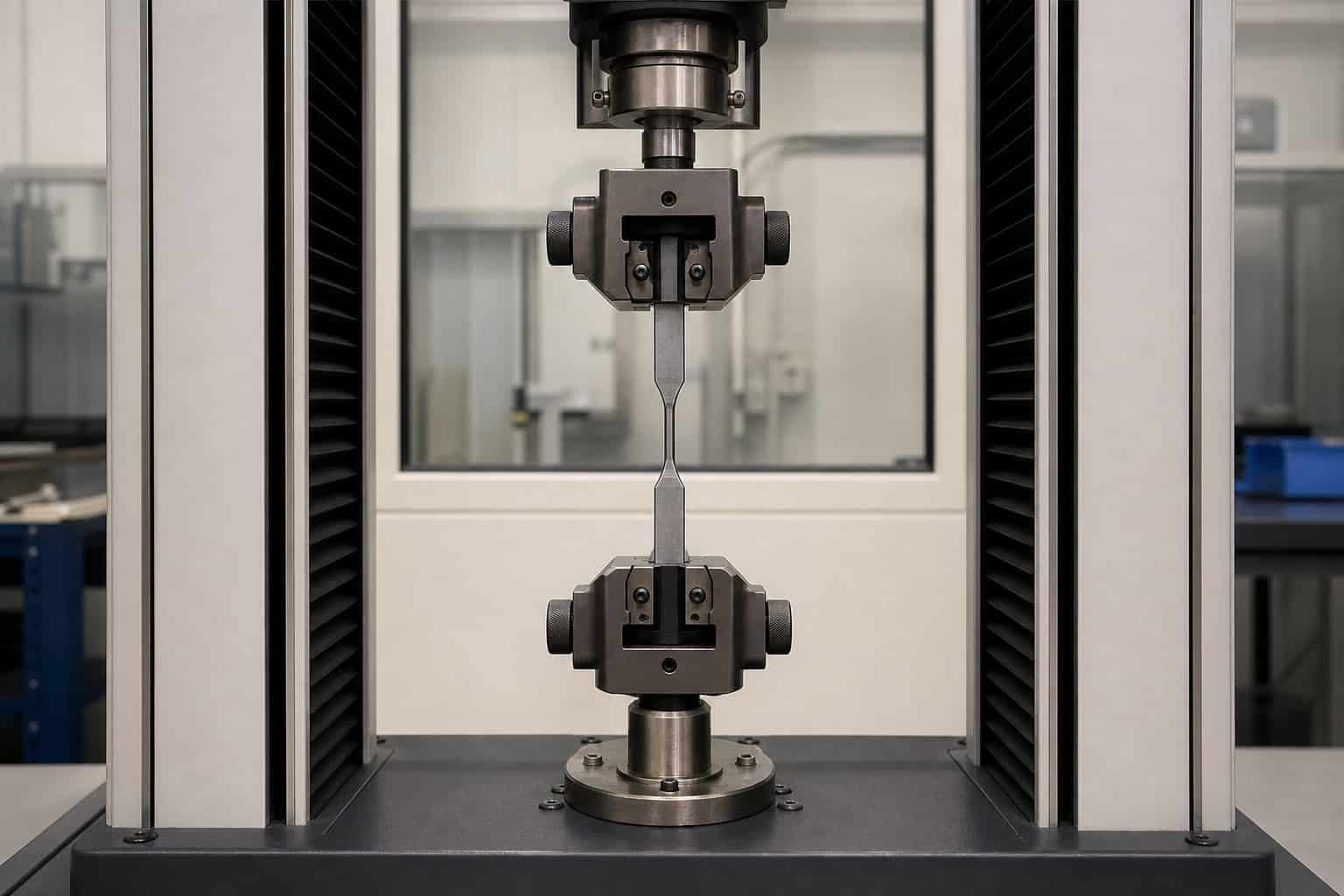
The test itself is straightforward in concept: a standardized specimen of the target material — steel sheet, aluminum alloy extrusion, copper busbar stock, polymer housing — is gripped at both ends and pulled at a controlled rate. The machine plots force against elongation in real time. What engineers extract from that curve is what determines whether the design is viable.
- Yield strength marks the point where the material begins to deform permanently. Below this threshold, the pack enclosure springs back to its original shape. Above it, the deformation is irreversible.
- Ultimate tensile strength is the peak load the material can carry before it begins to neck and fracture.
- Elongation at break measures ductility — how much the material stretches before it separates completely.
For battery enclosures, ductility is at least as important as raw strength. A brittle material that cracks suddenly at high load is more dangerous than a ductile one that deforms predictably, because crack propagation can pierce pouch cells or sever coolant lines. A pack that crumples in a controlled, energy-absorbing way is the design goal; one that shatters is not.
Wire harness terminals and cell interconnects are tested using the same tensile principle. A pull-off or peel-force test verifies that a crimp or spot weld joint will not separate under the inertial loads of a crash or the cumulative fatigue of road vibration. When a manufacturer switches from one aluminum alloy grade to a lighter one to reduce pack mass, new tensile characterization is required before that change reaches production. The data does not get generated once and filed away.
Crash Engineering: How the Pack Absorbs and Redirects Impact
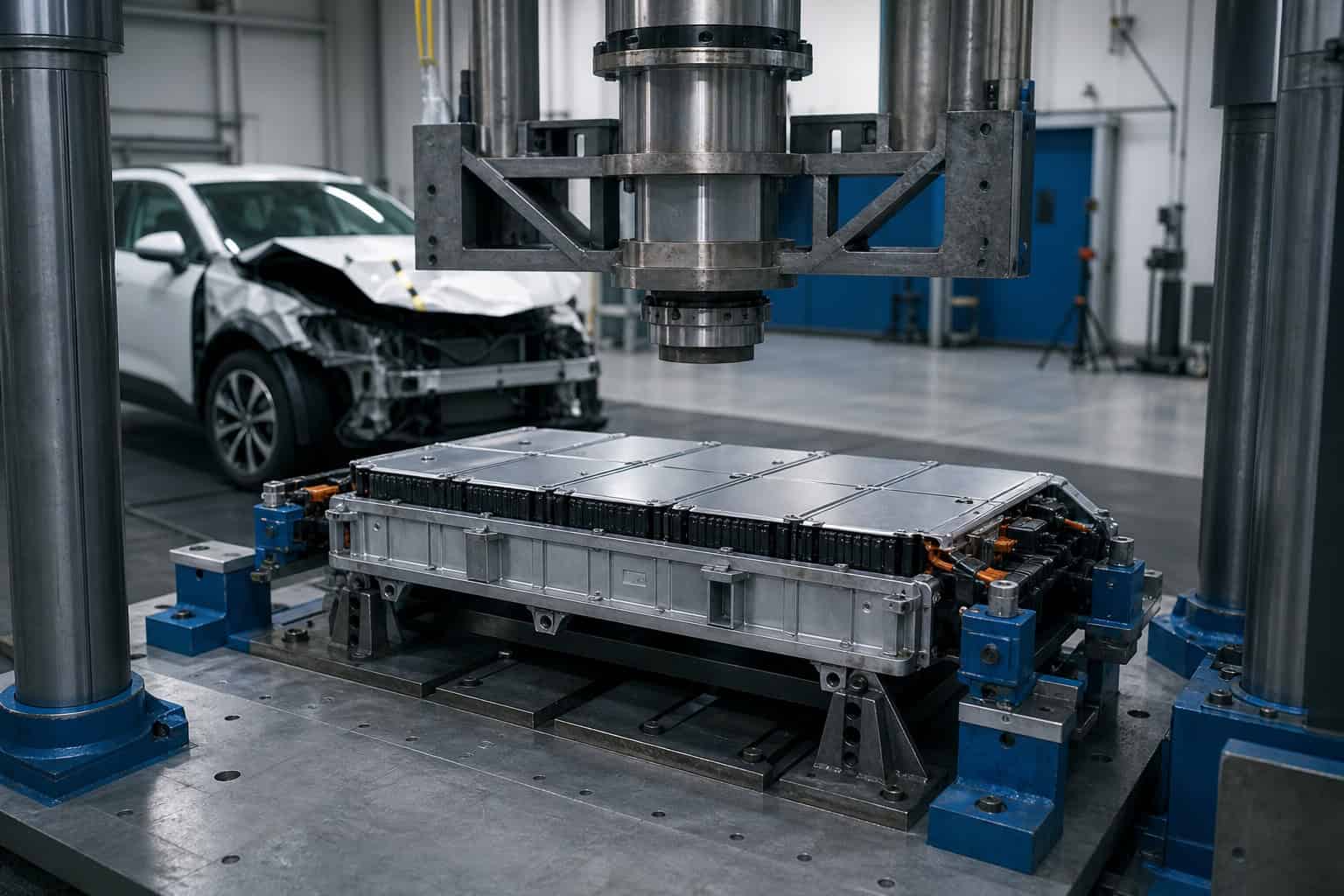
Effective battery pack design must address three distinct mechanical threats during a collision: vibration, shock, and crash-crushing of the battery pack. Each demands different material properties, and each is validated through tensile and mechanical testing protocols that assess the full reliability and safety performance of the pack structure.
Side-pole impacts represent the critical design case for enclosure sidewalls. A pole concentrates force on a small contact area, requiring high local tensile and shear strength in that zone. Underfloor scrape scenarios — highway debris or a curb strike — can peel weld seams and compromise the bottom sheet. This is why peel-strength tensile tests on seam welds are a standard part of pack validation, not an optional check.
Structural battery packs, in which the enclosure also serves as a load-bearing element of the vehicle floor, raise the stakes further. The pack must simultaneously resist crash intrusion and the bending moments of normal chassis flex over hundreds of thousands of miles. That dual requirement pushes enclosure material specifications harder than a conventional bolt-in pack design ever demands.
Finite element analysis allows engineers to simulate hundreds of crash scenarios digitally before cutting tooling — but those simulations are only as reliable as the tensile data fed into them. Physical test data calibrates the model. Without accurate material characterization as an input, the simulation produces an educated guess, not an engineering prediction.
Performance Trade-Offs: When Structural Integrity Costs You Range
EV battery performance testing covers energy density, charge retention, and cycle life. All three metrics are essential to optimizing battery design and enhancing vehicle performance — but all three are also constrained by the structural choices that tensile testing validates.
The honest trade-off runs like this: thicker, higher-strength enclosure materials add mass, and mass cuts energy density. A pack engineered with a conservative tensile safety margin may carry meaningfully more enclosure mass than a lightly optimized design, and that difference shows up directly in EPA-rated range at equivalent cell chemistry. This is not a packaging failure on the part of the heavier pack — it is a documented engineering decision about where the design operates relative to its structural limits.
When comparing two EVs at similar price points with different range figures and similar battery capacities, the enclosure specification is a relevant variable. Dedicated EV platforms — designed from the ground up around the battery pack — generally allow more geometric freedom to optimize enclosure structure for tensile performance than ICE-converted architectures, where the pack must fit into a chassis designed around a different powertrain layout.
Cylindrical cell formats, used across several high-volume platforms, rely heavily on validated nickel tab welds at the interconnect level. The pull strength of those welds is a tensile test specification, and it matters as much to long-term reliability as the cell chemistry itself. A module housing that passes 1,000 charge cycles but whose weld joints degrade in tensile strength over that same period represents a latent safety risk — one that only integrated structural and electrochemical testing protocols catch together.
What “Tested to Standard” Actually Guarantees — and What It Doesn’t
Battery pack structural testing references standards including UN ECE R100, ISO 6469, and SAE J2464, all of which incorporate mechanical integrity requirements that tensile characterization of materials must satisfy before the pack enters formal certification. EV battery mechanical testing at this level covers the full range of structural abuse scenarios the pack must survive.
Passing a standard means the design met the minimum threshold. It does not mean the design was tested to its absolute limit. The safety margin above that threshold is proprietary to each manufacturer, and that margin is precisely where real-world differentiation in crash performance is established. Two packs that both pass SAE J2464 may have very different distances between their normal operating point and their failure point.
Independent NCAP programs test completed vehicles, not isolated packs. A five-star result reflects system-level performance, including body structure energy management and restraint systems. It does not isolate pack-level tensile design margins, which are largely absent from public certification documents and rarely disclosed in consumer-facing materials.
One further distinction is worth making explicit: when a manufacturer states that every production pack undergoes end-of-line weld pull testing, that is a verifiable quality claim tied to production process documentation. When the same statement appears only in a press release without audit data or independent process verification, it should be treated as a stated target rather than a confirmed manufacturing reality.
The Ownership Decision: What You’re Actually Paying For
When an EV manufacturer offers a structural warranty covering the battery enclosure — distinct from the capacity warranty — that coverage is implicitly backed by tensile test data establishing the design margin. Before purchase, it is worth confirming specifically whether the structural warranty covers physical deformation from road debris or a minor underfloor impact. Many capacity warranties explicitly exclude this scenario.
Reliability engineering uses tensile characterization as a baseline for fatigue life prediction. A material cycling repeatedly at 60 percent of its yield strength has a calculable fatigue margin and a predictable service life. One cycling at 85 percent does not behave the same way over an identical time period. This is why vibration isolation mounts on the pack are an engineering reliability feature with measurable, testable consequences — not a refinement added primarily to reduce noise complaints.
The practical summary is this: a lighter pack extends range and may operate closer to its structural limits under crash loads. A heavier, more conservatively engineered pack sacrifices some efficiency for a documented margin above failure. Neither choice is objectively wrong. But understanding which one you are buying matters, because that choice determines how the pack behaves in the scenario you hope never happens.
As platforms mature through 2025 and beyond, advanced high-strength alloys and forming processes are progressively narrowing the weight penalty associated with higher tensile safety margins. Until independent long-term durability data exists for those newer materials in sustained production volumes, the conservative engineering approach remains the lower-risk ownership position — even when the range figure on the sticker is not the highest in its class.