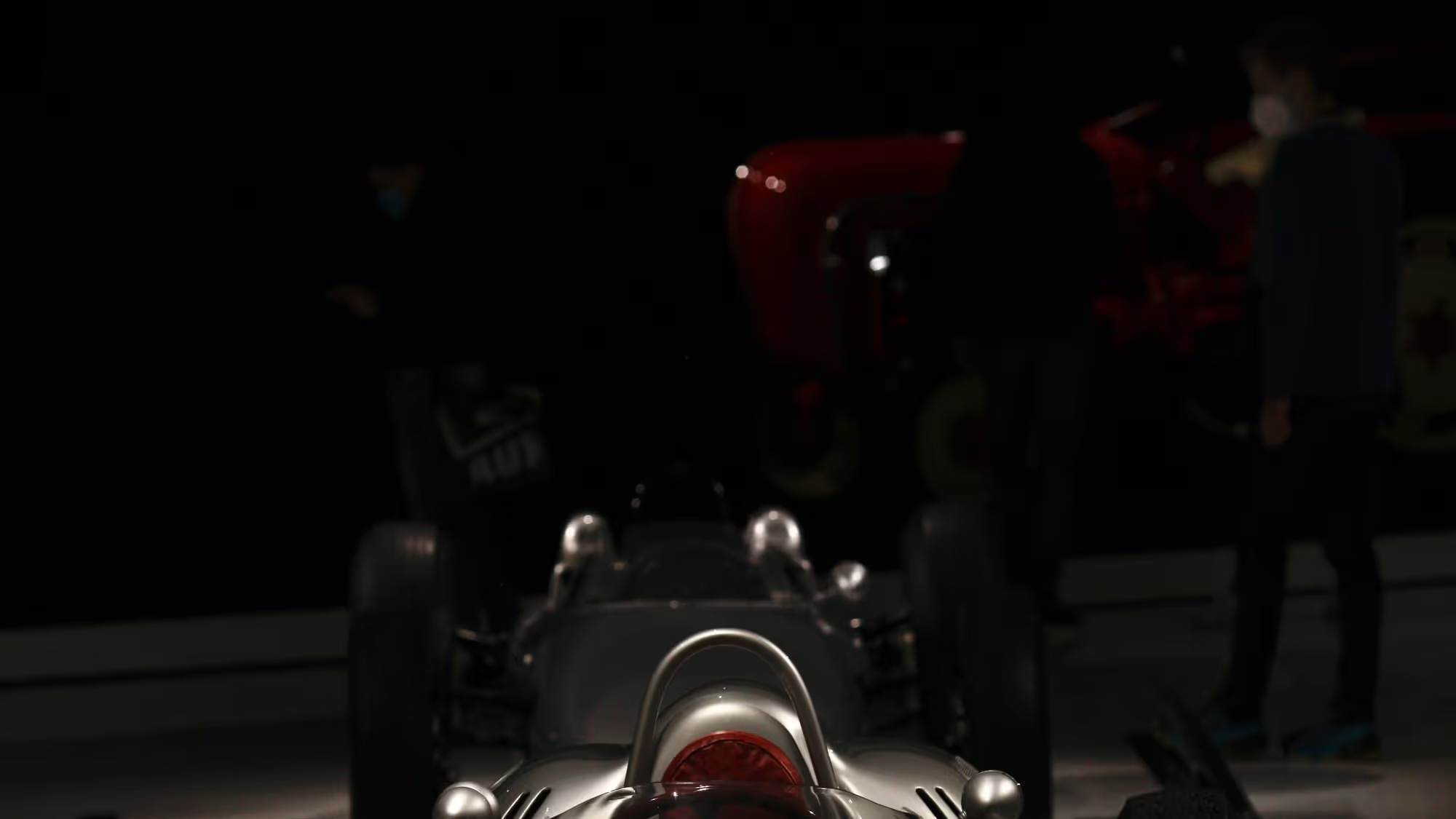
In 1961, a Porsche finished second in a Formula One World Championship race — not once, but three times — using a car that was never designed to be there in the first place. If you own or are considering a modern 718 Cayman or Boxster, that sentence is probably not in any brochure you have been handed. Stuttgart has never made it the centrepiece of its heritage marketing. What follows is a straight account of what actually happened, why it matters, and what it honestly means for anyone evaluating the nameplate today.
The Car That Accidentally Went Formula One
The Porsche 718/2’s path to Formula One was not a strategic factory assault on the sport’s top tier. It was a consequence of timing, regulations, and the kind of iterative engineering ambition that defined Porsche as a small but technically aggressive manufacturer in the late 1950s and early 1960s. The 718/2 grew from the 1957 RSK sports-racing car — a mid-engine, open two-seater built for endurance competition — and when Formula One adopted a 1.5-litre displacement limit for 1961, Porsche’s existing hardware happened to fit the rules closely enough to make a credible attempt at the category.
That is not the same as Ferrari arriving at a new formula with a purpose-built machine and factory infrastructure calibrated for championship pursuit. The 718/2 was an adaptation, not a ground-up F1 project. Understanding that distinction is the starting point for assessing what the car actually achieved and where its genuine limits were — and for understanding why this chapter sits quietly in Porsche’s official history rather than leading it.
From RSK Sports Car to Single-Seater: The Engineering Backstory
The 718 series ran from 1957 to 1962. The RSK — a mid-engine sports-racer whose nickname referenced its handling characteristics — was the founding member of that family. Porsche engineers developed an open-wheel, single-seat variant from that platform: the 718/2. It retained the original car’s aerodynamically efficient bodywork philosophy and its 1.5-litre engine, mounted in the middle of the chassis. The displacement match to the new F1 regulations was a coincidence of timing, not a design intention.
Five 718/2 cars were built in total. Chassis 718/2-05 served as the factory’s dedicated development car, receiving a continuous programme of mechanical and bodywork revisions across its working life. That means no two cars in the programme were identical for long, and the 718/2 that finished a race in mid-season was not the same specification as the one that started the year. That iterative approach is a defining characteristic of how Porsche operated at that scale and in that era.
The slippery bodywork inherited from the RSK endurance programme gave the 718/2 a measurable straight-line efficiency advantage on certain circuits. On tracks where the outright power of Ferrari’s purpose-built 156 was less decisive, that aerodynamic efficiency contributed directly to the results the car was able to achieve. It was a narrow competitive window, and Porsche used it precisely.
What the 718/2 Actually Achieved in 1961
The documented record is specific: three second-place finishes in the 1961 Formula One World Championship season, resulting in third place in the Constructors’ Championship behind Ferrari and Lotus. This was documented in a collaboration between the Porsche Newsroom and Motor Sport Magazine, so the figures are attributable, not promotional approximations.
Third in the Constructors’ Championship in a car’s first and only full Formula One season — with hardware that was not originally conceived for the category — is a genuinely unusual result. It is not a title challenge. Ferrari’s 156 dominated that season comprehensively, and Porsche was never in contention for the championship. But calling the 718/2’s campaign a footnote understates what was actually delivered by a small manufacturer working from a sports-car platform against constructors whose machines were built expressly for the formula.
Porsche did not return to Formula One as a constructor in the premier class after 1962. The 718/2’s season stands entirely alone in the brand’s history at that level, which makes the three podiums more significant, not less: there was no second attempt to surpass them.
Why Porsche Rarely Leads With This Story
There are straightforward reasons the 718/2 does not appear on the showroom wall. The programme predates the 911 by several years and belongs to a period when Porsche was a commercially modest, technically ambitious manufacturer operating at a scale that bears little resemblance to the company’s current position. It does not slot cleanly into the 911-centred heritage narrative that drives modern brand communication.
The modern 718 nameplate was revived in 2016 for the fourth-generation Boxster and Cayman — itself a quiet acknowledgement of the heritage — but the marketing emphasis has remained on the 911 lineage rather than on the sports-racer that briefly ran at F1 level. The story is not suppressed: it has been published through the Porsche Newsroom and documented in the specialist automotive press. It is niche enough, however, that the majority of buyers discovering the modern 718 Cayman or Boxster will never encounter it through standard dealership or configurator material.
The more complete explanation is proportional. The 718/2 season, however well executed, is a single campaign from more than sixty years ago. Set against Porsche’s subsequent record — outright Le Mans victories, dominant prototypes, a sustained GT racing programme — one season of F1 podiums from an adapted sports car is a minor chapter by comparison. That is not dismissal; it is accurate weighting.
Programme Snapshot: What the Numbers Actually Say
| Detail | Specification / Result |
|---|---|
| Engine | 1.5-litre mid-mounted |
| Origin platform | 1957 Porsche 718 RSK sports-racer |
| Cars built | Five total; chassis 718/2-05 designated factory development car |
| Formula One season | 1961 World Championship (single season; did not return) |
| Best results | Three second-place finishes |
| Constructors’ Championship | Third place (behind Ferrari and Lotus) |
| Customer availability | Not applicable — factory programme only, never offered for sale |
The 718/2 was not a customer car and was never sold. It existed entirely as a factory racing programme, which is why auction values and ownership records for this specific variant do not apply in the way they do for the contemporary production sports-racers of that era. If you encounter a listing described as a 718/2 at auction, you are looking at a recreation, not an original factory car. That distinction matters practically: original 718 RSK roadgoing variants do appear on the market, and period 718 RSK examples surface through specialist classic car dealers, but the racing 718/2 single-seaters themselves were never dispersed.
What This Means If You Are Looking at the Modern 718
The modern Porsche 718 Cayman and Boxster carry the name but share no mechanical DNA with the 718/2. The connection is deliberate brand heritage signalling, not a lineage you can trace through shared engineering decisions. That is an honest statement, not a criticism: naming a production sports car after a significant racing predecessor is a legitimate form of brand communication, provided you understand what the connection actually is and are not paying a premium on the basis of a misapprehension.
If your purchase decision rests on motorsport credibility, the relevant data points for the current car are its track lap times, the choice between PDK and manual transmission, and the capabilities of the GT4 and Spyder variants — not a 1961 F1 campaign conducted with hardware that no longer exists in driveable factory form. The modern flat-four turbocharged engine fitted to the standard 718 attracted criticism when introduced precisely because it replaced a naturally aspirated flat-six, but it delivered measurable efficiency and performance gains. That willingness to adopt a configuration that looked wrong on paper but worked in practice is a reasonable parallel to the 718/2 programme — a car that looked wrong for F1 on paper but delivered three podiums against constructors with purpose-built machinery.
The historical parallel has some real substance, even if Porsche’s marketing rarely makes it explicit. Small teams, iterative development, entering a category the hardware was not originally built for: those are not invented brand values. They are documented characteristics of how the company operated in the period that produced the 718/2, and they are worth knowing regardless of whether they influence your final choice of specification.
The Bottom Line on a Chapter Stuttgart Underplays
Five cars, one season, three podiums, third in the Constructors’ Championship. The numbers are modest by the standard of Porsche’s later motorsport record, which is probably the most honest explanation for why the 718/2 does not lead the brand’s official history. It is a specific, documented achievement in a single season, not the foundation of a sustained championship campaign, and Porsche has bigger stories to tell.
What it is, accurately, is this: the Porsche 718 raced in Formula One before the 911 existed. That is a verifiable fact, sourced from the Porsche Newsroom and attributable automotive reporting. It tells you something precise about the manufacturer — its technical opportunism, its willingness to compete beyond its weight class, its preference for iterative engineering over single grand gestures — that a decade of brand advertising does not. If you are buying a modern 718 Cayman or Boxster, that context will not change what you pay, what economy you achieve, or how the car behaves on a wet back road. But it is accurate context, and accuracy about where a name actually comes from is worth considerably more than the vague invocation of racing heritage that most buyers are offered in its place.