
The 2026 Kia EV9 arrives with impressive numbers on paper — but what owners are actually reporting behind the wheel turns out to be more nuanced, and in most cases more reassuring, than the window sticker alone suggests.
Why Real-World Range Matters More Than EPA Numbers

EPA range figures are generated under controlled laboratory conditions. They don’t account for highway speeds above 75 mph, a full load of passengers and luggage, winter temperatures, or aggressive acceleration habits. Real-world Kia EV9 range varies with speed, climate, driving style, and cargo weight — and owner reports show results that deviate from the EPA rating in both directions.
This article focuses on what you can realistically expect during daily ownership, so you can make a confident buying decision. The 2026 Kia EV9 starts at $54,900 and reaches approximately $71,900 fully configured. At that price point, range anxiety should not be a defining feature of ownership — and for most buyers, it isn’t. Whether you’re cross-shopping rivals, already own one, or evaluating whether a three-row electric SUV fits your actual driving life, real numbers are what matter.
EPA Claims vs. Owner-Reported Range

The 2026 EV9 RWD Long Range carries an EPA rating of approximately 304 miles. Owner reports from automotive forums and third-party testing suggest real-world results typically land between 270 and 310 miles depending on conditions — a relatively tight gap for a large, heavy three-row SUV. The AWD dual-motor variant is EPA-rated at approximately 270 miles, and owners who regularly cruise above 75 mph on the highway tend to report figures closer to 230-245 miles. That’s a meaningful reduction if long interstate runs are a routine part of your schedule.
Cold weather compounds the issue. Below 20°F, usable range on E-GMP platform vehicles — including the EV9 — can drop 20-30%, consistent with behavior documented on the EV6. If you live in a northern climate, plan for that reduction rather than treating it as an unexpected surprise in January.
| Model | EPA Range | Real-World Average | Highway Real-World (75+ mph) |
|---|---|---|---|
| EV9 RWD Long Range | ~304 mi | ~270-310 mi | ~265-275 mi |
| EV9 AWD Dual Motor | ~270 mi | ~245-260 mi | ~230-245 mi |
| EV9 GT (performance variant) | TBD | TBD | Expect reduction vs. AWD standard |
Where the EV9 Genuinely Outperforms Expectations

Many full-size electric SUVs underdeliver their EPA range by 10-15% in everyday driving. The EV9 RWD is consistently matching or modestly exceeding its EPA figure in mild-weather city and suburban use — which covers the majority of miles most owners actually drive. That consistency is worth highlighting in a segment where overstated range estimates remain a common frustration.
The E-GMP platform’s thermal management system and regenerative braking calibration contribute meaningfully to that result. One-pedal driving in urban environments regularly returns efficiency at or above the EPA baseline, and the battery pre-conditioning system prepares the pack for fast charging automatically during navigation — reducing the range loss that poorly managed thermal states can cause on road trips.
The surprise for most owners isn’t that the EV9 breaks efficiency records. It’s that a non-luxury three-row SUV delivers this level of consistency in a category where most competitors still struggle to honor their own advertised figures. For a detailed breakdown of powertrain configurations and trim levels, the Car and Driver EV9 review is worth reading before you finalize a trim choice.
Charging Speed: Fast Enough for Serious Road Trips

The EV9 uses Kia’s E-GMP 800-volt architecture, supporting DC fast charging at up to 240 kW peak. Under optimal conditions at a compatible high-output charger, that enables a 10-80% charge in approximately 24 minutes and adds roughly 54 miles of range in around 4-5 minutes. Those figures make the EV9 a practical family road-trip vehicle rather than a vehicle constrained to local use.
Real-world charging speed varies with station output, network congestion, and battery temperature. At many public CCS stations, average throughput runs closer to 150-180 kW rather than the 240 kW peak. Plan route stops accordingly and verify station availability along your intended corridors before departure — particularly outside major metro areas where high-output charger density is still inconsistent.
For daily commuting, a home Level 2 charger running at 48 amps adds approximately 35-40 miles of range per hour. The average American driver covers around 37 miles per day, meaning a standard overnight charge cycle keeps the EV9 full without requiring any active management on typical weekdays.
How the EV9 Compares to Its Closest Rivals

The EV9 occupies an unusual market position: it is currently one of the only non-luxury three-row electric SUVs available below $60,000. That context shapes every comparison meaningfully.
- Rivian R1S: Starts around $75,900, delivers longer range in its Max Pack configuration, and offers genuine off-road capability the EV9 doesn’t match. If performance and range are top priorities and budget is flexible, this is the most direct cross-shop — but you’re paying at least $20,000 more at entry.
- Tesla Model X: Starts around $79,990, accelerates faster, and benefits from Tesla’s extensive Supercharger network. However, the price premium is substantial, and its interior design has not kept pace with newer competitors including the EV9.
- Hyundai IONIQ 9: Shares the E-GMP platform, offering comparable range and identical charging architecture. The choice between the EV9 and IONIQ 9 comes down to styling preference, interior layout, and local dealer availability — there is no meaningful technical argument favoring either over the other.
- Mercedes EQS SUV: Starts above $104,000. The luxury experience is superior, but real-world range does not improve proportionally to the price premium. The value equation is difficult to justify unless the brand matters to you specifically.
For buyers requiring three rows, a sub-$60,000 entry price, and 800-volt fast charging capability, the EV9 currently has no direct competitor. That market position carries real weight when you’re evaluating options.
Trade-Offs to Evaluate Before You Sign
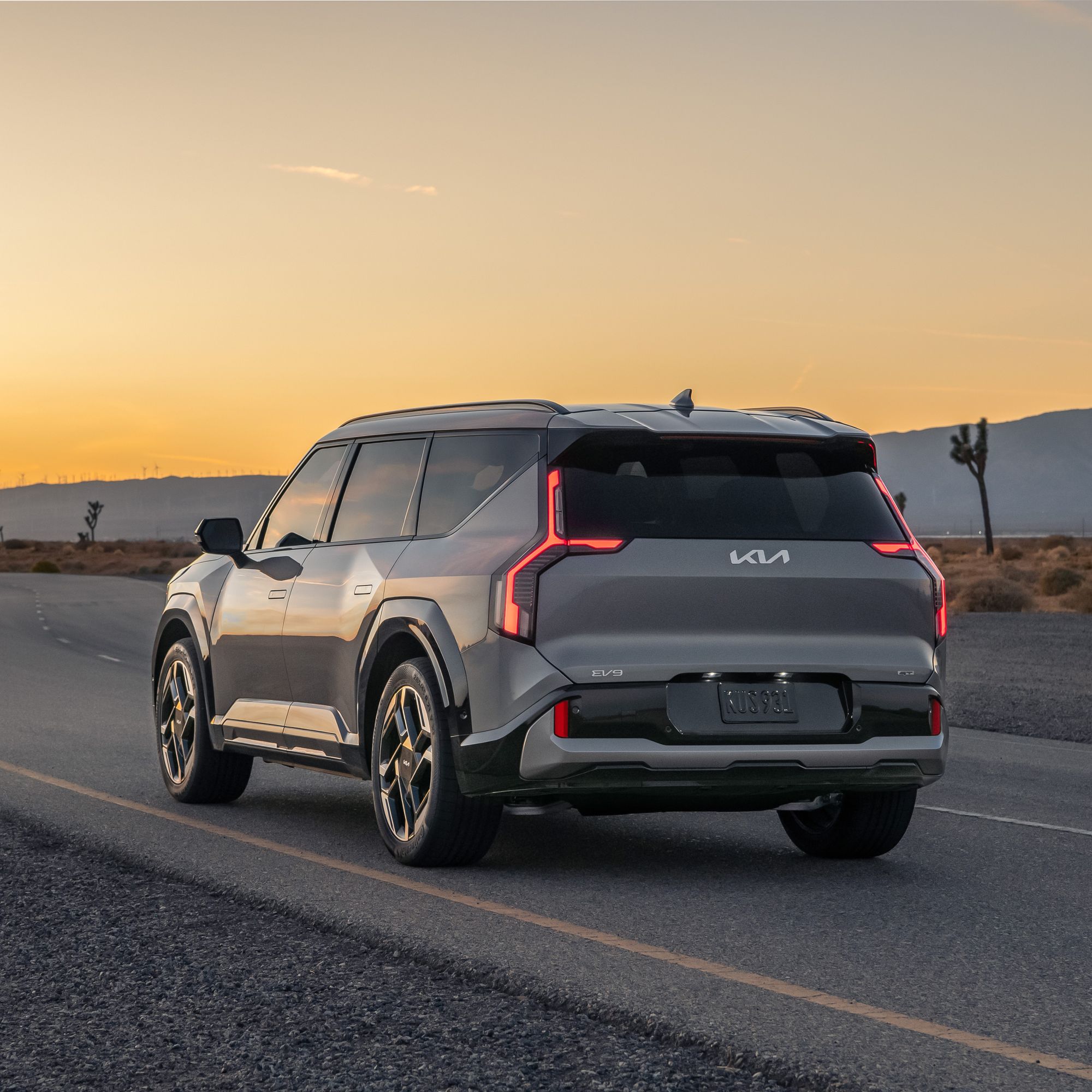
No thorough EV9 review should avoid the legitimate trade-offs. Here are the ones that deserve honest consideration.
The AWD model’s range reduction is real. If your regular driving includes frequent 200-plus-mile highway trips, the RWD Long Range is almost certainly the more efficient choice unless your climate or terrain genuinely requires all-wheel traction. Calculate your actual needs before defaulting to AWD out of habit or vague concern.
The EV9 GT — aiming to break 500 horsepower — has not yet received EPA range certification as of this writing. High-output performance variants consistently sacrifice range for power, and the GT will follow that pattern. If the GT interests you, wait for confirmed figures before committing. The performance may be worth the trade-off depending on your priorities, but the range reduction will be real.
At $71,900 fully loaded, the EV9 approaches luxury-brand pricing without the luxury badge. The interior quality and feature set justify that cost for most buyers, but the Rivian R1S becomes a closer call at similar price points than Kia’s own marketing implies.
Long-term reliability data on the EV9 is still accumulating. The EV6 established a strong early track record on the E-GMP platform, which is an encouraging signal — but the EV9’s full ownership picture is not yet established. Buyers who are early-adopter-averse have legitimate grounds for caution. You can review real transaction prices and current inventory through CarGurus’ EV9 listings to understand what dealers are actually accepting versus MSRP before you negotiate.
Bottom Line: Who Should Buy the 2026 Kia EV9
If you need a three-row electric SUV under $60,000, the EV9 is currently one of the only credible non-luxury options — and it earns that position on merit rather than by default. Real-world range on the RWD model is honest and consistent, 800-volt fast charging makes longer trips practical, and the interior comfortably supports full-family road trips without compromise.
The two legitimate reasons to pause before signing are the AWD range penalty and the still-developing long-term reliability record. Neither is disqualifying for most buyers, but both deserve clear-eyed consideration. For a comprehensive look at owner satisfaction scores and reliability context, the U.S. News EV9 review provides useful data worth reviewing before you decide.
At $54,900 to start, the EV9 delivers technology, interior space, and charging capability that commanded six-figure luxury pricing just a few years ago. For buyers in this segment right now, that value equation is difficult to dismiss — and the real-world ownership data increasingly supports it.