Group B lasted four years, killed competitors and spectators, and produced the most powerful rally cars ever built — then the FIA shut it down permanently after the 1986 season. Four decades on, the homologation specials it generated sell for six figures at auction, and the engineering decisions made under those regulations still run through Audi’s current four-wheel-drive lineup. If you want to understand why this era still commands serious attention, start with what the rules actually permitted — and what they catastrophically failed to restrict.
Four Years. No Power Ceiling. No Real Limit on What Manufacturers Could Build.
In 1982, the FIA introduced Group B regulations with a homologation threshold of just 200 road-going production units. The stated intent was to bring sophisticated grand touring machinery into competition. What actually happened was a four-year arms race in which Audi, Peugeot, Lancia, Ford, and others fielded cars producing outputs that climbed well beyond 400 bhp on stages shared, often by little more than a rope and a marshal, with spectators standing inches from the racing line.
The regulations imposed no upper limit on engine displacement, forced induction, or power output. Manufacturers were constrained mainly by what they could homologate and what the stages could physically sustain. By 1983 the competitive landscape had already shifted hard from the original intent: mid-engine layouts, four-wheel drive, and turbocharged engines with anti-lag systems capable of boost spikes far above quoted figures became the norm, not the exception. The 200-unit requirement simultaneously produced a secondary market of extraordinarily rare homologation specials — cars you can still buy today, at prices that reflect exactly how few were built.
What the Group B Rules Actually Said — and What They Left Out
The core framework was straightforward: homologate 200 road-going examples, compete. What was absent from the regulations matters as much as what was present. There was no power ceiling, no mandatory safety cell specification in the early years, and no meaningful restriction on engine placement or boost management. The 200-unit threshold was low enough that factory engineers could build almost anything they could conceive and call it street legal.
The road cars that resulted — the Audi Sport Quattro, Peugeot 205 Turbo 16, Lancia Delta S4 Stradale, and Ford RS200 — were built to satisfy a rulebook, not to provide comfortable transportation. Period road tests consistently noted turbo lag so severe that power arrived in a single violent surge rather than a progressive build. Cockpit conditions in competition variants were described as extreme: heat from mid-mounted turbocharged engines, minimal sound deadening, and suspension calibrated for gravel stages rather than public roads.
Anti-lag systems on competition versions reduced lag but introduced exhaust temperatures and mechanical stress that shortened engine life dramatically. The engineering was genuinely innovative — composite body construction, active turbo management, purpose-built AWD transfer cases — but it was being developed and deployed simultaneously on closed stages where the feedback loop between failure and consequence was brutally short. That compression of development time and competitive risk would prove fatal.
The Audi Quattro and the Car That Triggered the Power Spiral
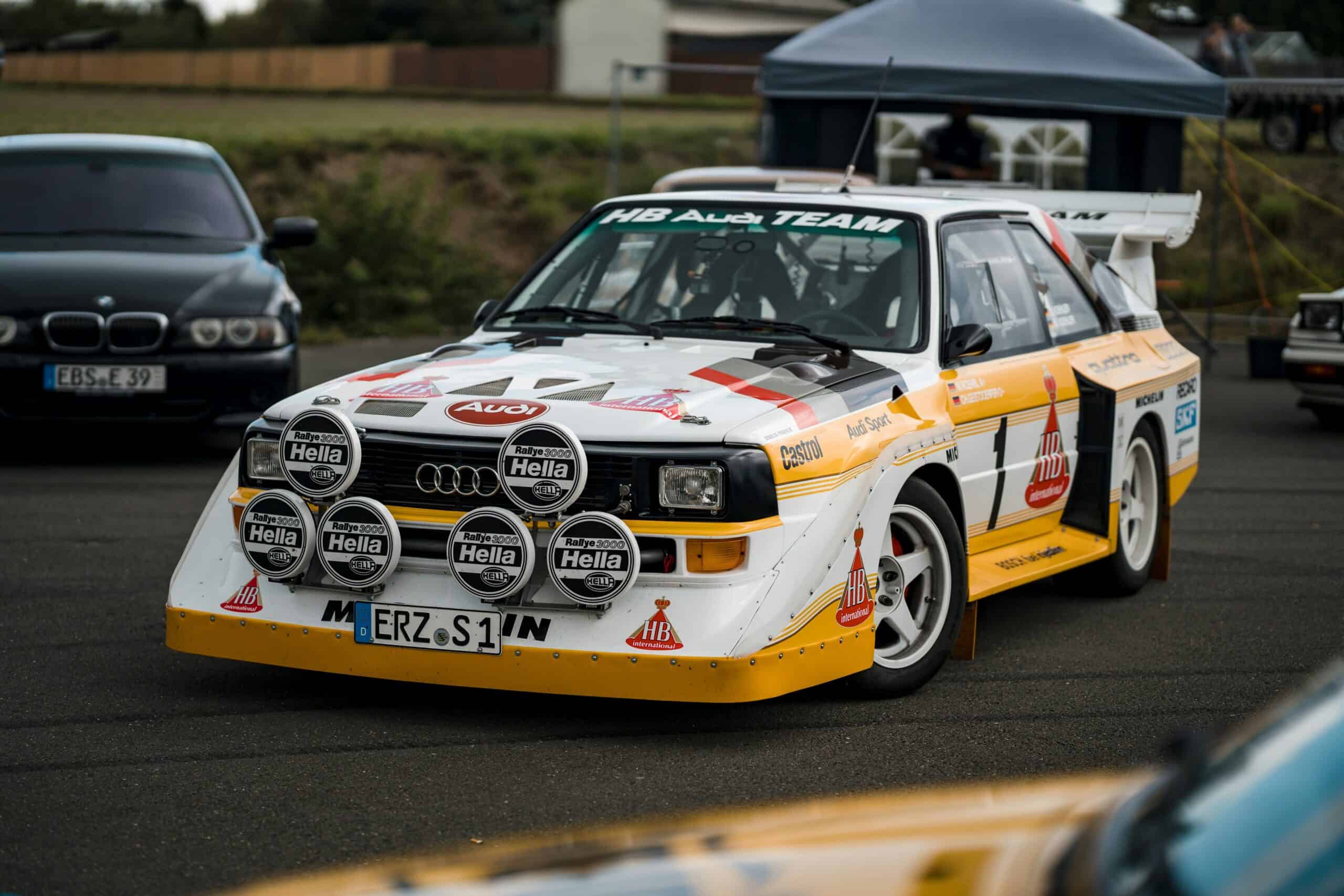
Audi’s Quattro entered Group B in 1982 with a turbocharged five-cylinder engine and permanent four-wheel drive. It was the first time 4WD had been used competitively at the top level of rallying, and that configuration immediately rendered rear-wheel-drive rivals obsolete on loose surfaces. Audi won the manufacturers’ championship in 1982 and 1984, and the drivers’ title with Hannu Mikkola in 1983 and Stig Blomqvist in 1984. Every rival then spent their development budget chasing the template Audi had established.
The evolution from the original Quattro to the short-wheelbase Sport Quattro S1 saw power figures cited by period sources in the 450-500 bhp range in full competition trim, against a kerb weight the factory quoted around 1,090 kg — a power-to-weight ratio that had no contemporary road car equivalent. The four-wheel-drive systems of the era were passive and centre-differential-based — nothing like electronically managed AWD in a current Audi. They gave genuine traction advantages on gravel and snow that period road testers described as transformative, but they were mechanical solutions operating under extreme thermal and mechanical stress that competition conditions amplified considerably.
One point worth clarifying for anyone researching ownership: the road-going Sport Quattro produced to satisfy homologation is a distinct vehicle from the later S1 competition car. The road car used a different body, a shorter wheelbase than the standard Quattro, and a quoted 306 bhp in period press material. Confusing the two when evaluating a purchase is a common and expensive error.
Peugeot, Lancia, and Ford: The Cars That Pushed the Ceiling Further
Peugeot’s 205 Turbo 16 represented a more radical departure than even the Quattro. Where Audi had adapted an existing road car platform, Peugeot built a purpose-designed mid-engined, four-wheel-drive car clothed in bodywork that bore only cosmetic resemblance to the standard 205 hatchback. The competition version produced power figures that period sources placed above 450 bhp in full evolution trim. Timo Salonen won the 1985 drivers’ championship in the 205 T16, and Peugeot took the manufacturers’ title that year and in 1986.
Lancia’s Delta S4 was arguably the most technically complex Group B car built. It used both a supercharger and a turbocharger — the supercharger providing immediate low-speed response while the turbocharger delivered peak power at higher revs — in an attempt to eliminate the lag that afflicted single-turbocharged rivals. The road-going Stradale version was built in just over 200 units to satisfy homologation. It was a Delta S4 that Henri Toivonen was driving when the era ended.
Ford’s RS200, designed by Tony Southgate and developed with assistance from Ghia, took a similar approach to Peugeot: a bespoke mid-engined platform with four-wheel drive, built specifically for Group B with minimal reference to any existing Ford road car. Approximately 200 road-going examples were produced. The RS200 never won a world championship round before Group B was banned, but its competition history and rarity have made surviving examples among the most sought-after homologation specials from the era.
The Deaths That Made the Ban Inevitable
Group B rally deaths were not a single catastrophic event. They were an accumulating toll across multiple seasons, involving both competitors and spectators killed on open stages where crowd control was minimal by any modern standard. The safety record and the competitive spectacle enthusiasts celebrate are inseparable — you cannot understand one without confronting the other.
The 1986 season became the breaking point. Henri Toivonen and co-driver Sergio Cresto were killed when their Lancia Delta S4 left the road on the Tour de Corse in May 1986. The car caught fire and neither occupant survived. The cause was never definitively established. Weeks later, Joaquim Santos’s Ford RS200 suffered a suspension failure on the Rally de Portugal, left the road, and struck spectators. Multiple fatalities resulted and the event was stopped.
The FIA banned Group B from the World Rally Championship with effect from the end of the 1986 season. The successor Group S regulations — which would have continued the high-power philosophy but mandated roll cages and fire suppression systems — were cancelled before a single car competed. The class did not wind down. It was ended, decisively, by an accumulation of deaths that made continuation untenable regardless of whatever safety upgrades manufacturers proposed.
What made the safety situation structurally different from other motorsport categories was the combination of factors specific to rallying: stages ran through public forests and mountain roads rather than purpose-built circuits; spectator access was largely uncontrolled; and the cars were becoming faster than the infrastructure around them could safely accommodate. Closed circuit racing had dangerous periods too, but it had physical barriers between cars and crowds. Group B rally stages, in many cases, did not.
Buying a Group B Homologation Car in 2025-2026: What the Market Actually Looks Like
The core homologation specials — the Lancia Delta S4 Stradale, Ford RS200, and Peugeot 205 Turbo 16, each built in approximately 200 units — represent the tangible residue of the Group B era. Auction results at major houses through 2024-2025 placed well-documented examples of the RS200 and 205 T16 in the £300,000-£600,000 range depending on provenance, specification, and condition. These are reference points, not guarantees. Verify current valuations with an auction house before transacting, because this market moves and individual car history affects value significantly.
The Audi Sport Quattro has a broader range of surviving examples and condition grades, and is treated by the market as a serious collector car rather than a usable road car. If you are evaluating one, the distinction between a genuine homologation Sport Quattro and later modifications or tribute builds matters enormously to value. The same caution applies across all Group B homologation specials: provenance documentation, matching numbers, and an unbroken ownership history each carry measurable premiums.
Parts supply for all Group B homologation specials is specialist-only. None of these vehicles should be purchased without a pre-purchase inspection by a marque-specific expert and a clear, documented understanding of which parts are simply unavailable new. In the UK, all qualify as historic vehicles and are exempt from standard MOT testing — but that exemption does not substitute for mechanical integrity checks before road use, and it does not simplify insurance, which requires specialist historic vehicle cover. Registration and road-use requirements vary by jurisdiction; confirm the specifics for your market before purchase.
You should not approach any of these vehicles as a usable daily driver. Their maintenance costs and parts availability in 2025-2026 reflect exactly what they are: low-volume engineering exercises built under regulatory pressure, operated in competition conditions that destroyed components at a rate no road-use scenario was designed to match. For a broader sense of which cars defined the era and why collectors prioritise certain models, Petrolicious’s assessment of the top Group B cars covers the competitive and aesthetic case for each major contender in depth.
What Group B Actually Teaches You — About Regulation, Engineering, and Risk
Group B demonstrated, with fatal clarity, that a minimal homologation threshold combined with no power ceiling produces rapid, uncontrolled escalation. The FIA applied that lesson directly when writing World Rally Car rules for 1997 and in every subsequent regulatory revision. The successor formula introduced explicit power limits, mandatory safety structures, and crowd-exclusion zones that simply did not exist in the Group B framework. The absence of those requirements in 1982 was not an oversight — it reflected a philosophy that manufacturer innovation should face as few constraints as possible. By 1986, the sport had paid for that philosophy in full.
The era also produced genuine engineering advances that filtered into production cars through the 1990s. Audi’s Quattro AWD system is the most direct lineage still visible in current production — the permanent four-wheel-drive architecture that debuted competitively under Group B sits in the genealogy of every Audi quattro sold today. Turbocharging management, composite construction techniques, and centre differential design all advanced under the pressure of Group B competition in ways that benefited road cars that followed. The competitive history of Group B and those engineering legacies are closely linked: the pressure to win faster on each successive rally is what drove the development pace that made the technology transferable.
For you as an enthusiast or potential buyer, the four-year span is not incidental. It reflects exactly how long it takes for a permissive regulatory environment to escalate from competitive innovation to unacceptable risk. The cars that resulted are historically irreplaceable and priced accordingly — not because of nostalgia alone, but because they represent the last moment in top-level rallying when manufacturers operated without meaningful power limits, and because the consequences of that freedom ended the category permanently.
The most powerful rally cars ever built are also the ones that ended their own class. That tension — between what these machines achieved and what they cost — is what makes the Group B era worth understanding precisely, rather than simply celebrating.