
Ferrari engineers didn’t just watch the Acura NSX from a distance — they bought examples and drove them to work, using Honda’s supercar as a benchmark to understand exactly what they were up against. That’s not a rumor; it’s one of the most frequently cited stories in automotive history, and it tells you everything about what kind of car the NSX actually is.
The Car That Made Ferrari Nervous
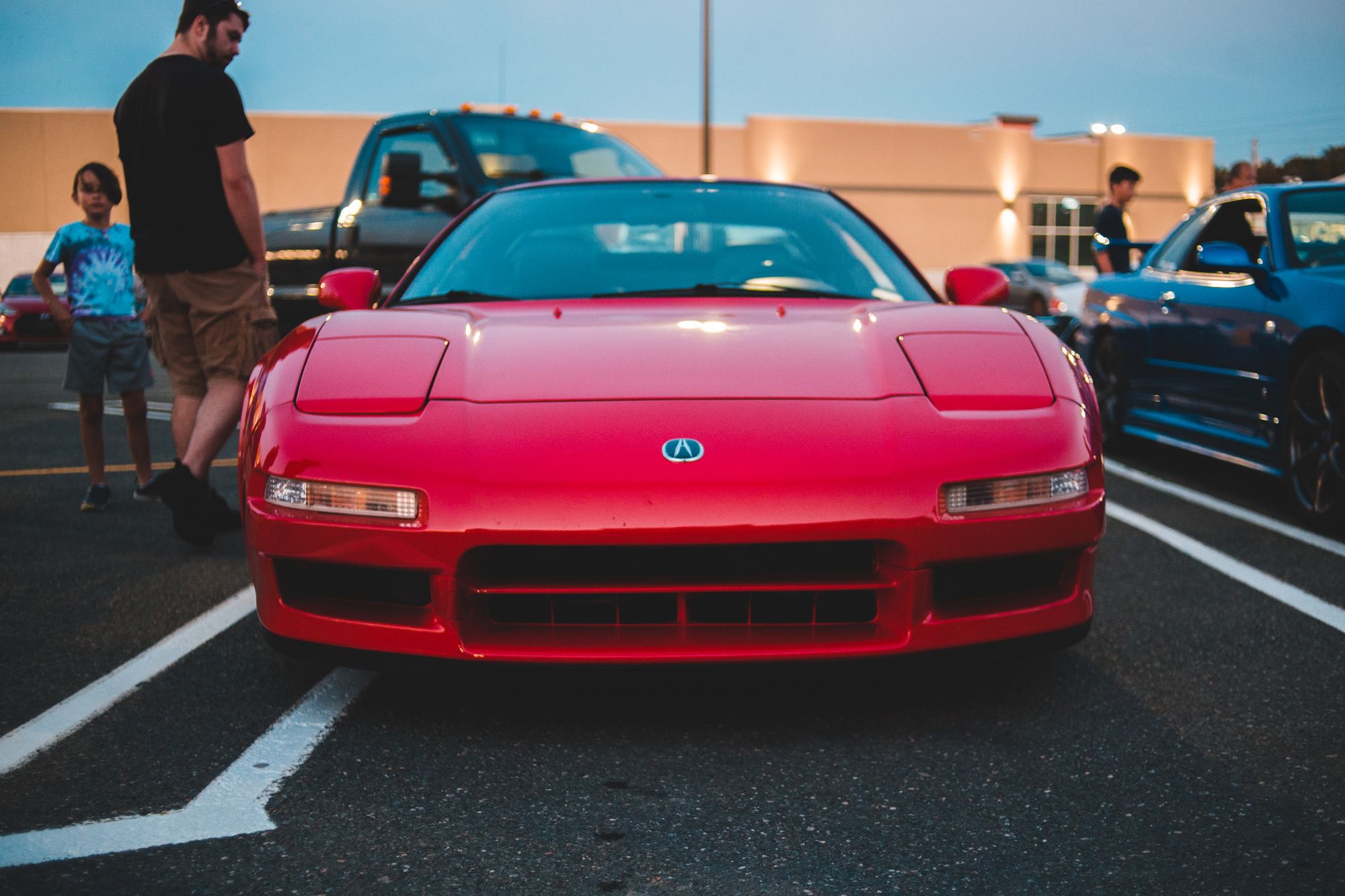
When the original NSX arrived in 1990, it didn’t fit the supercar template. It started reliably, didn’t overheat in traffic, and could be serviced at a Honda dealer. For Ferrari, Lamborghini, and every other exotic manufacturer that had built a business model around mystique and mechanical drama, this was genuinely threatening. A supercar that worked like an appliance — and still embarrassed V8 exotics on a back road — attacked the entire premise of the Italian exotic market.
Whether you’re researching Acura NSX history, shopping a used second-generation car, or deciding between the NSX and something with a prancing horse on the hood, the two-generation arc of this car demands serious attention. The first generation ran from 1990 to 2006 in the United States — an analog, naturally aspirated legend. The second ran from 2017 to 2022 — an electrified reinvention that pushed the concept further than most buyers expected. Both generations were built on the same obsessive engineering philosophy: make it fast, make it usable, make it last.
Generation One (1990-2006): What Made It Revolutionary

The original NSX launched as a mid-engine, all-aluminum two-seater — among the first production cars built around an all-aluminum monocoque body. That decision cut curb weight dramatically versus the steel-bodied competitors it was targeting, and it gave the chassis a rigidity that translated directly into handling precision. This wasn’t a styling exercise. Every material choice had an engineering rationale.
Ayrton Senna’s involvement in chassis development is well-documented. His feedback during pre-production testing directly influenced the steering feel and suspension calibration, and the result was a car that felt connected and predictable in a way that most exotics of the era — with their heavy, twitchy dynamics — simply didn’t. Senna reportedly told Honda engineers the car was too good for most drivers, which, depending on how you read it, is either a warning or a compliment.
Power from the naturally aspirated V6 started at 270 hp and grew to 290 hp in later model years — numbers that look modest on paper against V8 Ferrari rivals. But the power-to-weight ratio told a different story, and the chassis balance meant you could use all of that power in a way you couldn’t in heavier, more nervous alternatives. Honda ran this car in essentially the same fundamental form for over a decade without needing to reinvent it — a statement of confidence that few other supercar manufacturers of the era could match.
First-generation NSX reliability is the stuff of forum legend. Cars with 100,000-plus miles are not unusual, and major mechanical failures on properly maintained examples are rare. This is the car that proved the concept: a supercar can be dependable. If you want the purest, lightest NSX experience and your budget runs $40,000-$80,000 for a clean example, the first-gen delivers analog driving sensation that the tech-heavy second generation cannot fully replicate.
Generation Two (2017-2022): The Electrified Reinvention

The second-generation NSX pairs a twin-turbocharged 3.5-liter V6 with three electric motors — one on the rear axle, one on each front wheel — for a combined output of 573 horsepower and 476 lb-ft of torque in standard trim. The 2022 NSX Type S pushed that to 600 hp, making it the most powerful production Acura ever built. It was produced in a limited run of 350 units globally to close out the nameplate with authority.
The Sport Hybrid Super Handling All-Wheel Drive system deserves a specific callout because it is genuinely different from most AWD implementations. The front electric motors don’t just add traction — they perform torque vectoring, accelerating individual front wheels through corners to actively steer the car. That’s a meaningful engineering distinction, not marketing language, and you feel it on a winding road.
Performance figures for the standard second-generation car: 0-60 mph in approximately 3.1 seconds according to Car and Driver testing, with the Type S trimming that to around 2.9 seconds. Those figures place it in direct competition with the Porsche 911 Turbo S in everyday driving terms — exactly where Acura intended it to sit.
The second-generation car weighs approximately 3,800 lbs — heavier than the original and heavier than a 911 Turbo S. That is the honest trade-off for the hybrid hardware. The chassis tuning masks it remarkably well, but physics doesn’t negotiate. If raw weight matters to you, the first-gen wins that conversation decisively.
NSX vs. Ferrari: What the Numbers Actually Show

Here is the direct comparison most buyers are looking for:
| Spec | Acura NSX Type S (2022) | Ferrari F8 Tributo |
|---|---|---|
| Power | 600 hp | 710 hp |
| 0-60 mph | ~2.9 sec | ~2.9 sec |
| Original MSRP (new) | ~$169,500 | ~$280,000+ |
| Drivetrain | SH-AWD standard | RWD only |
| Annual Routine Service (approx.) | $500-$1,500 | $3,000-$6,000+ |
The Ferrari wins on raw power, exhaust theater, and brand cachet — and if those things matter to you, they are real and legitimate advantages. The NSX wins on all-weather usability, dealer service network depth, and documented long-term reliability. Those aren’t consolation prizes; they’re concrete advantages for a car you actually drive on public roads in real weather.
If you’re buying a supercar to use rather than store, the NSX’s Acura service infrastructure and lower maintenance costs represent a genuine financial advantage over the course of ownership. The Italian exotic market is built on desire. The NSX was built on engineering, and the running costs reflect that difference every year you own it.
Real-World Specs at a Glance

| Spec | Gen 1 NSX (1990-2006 US) | Gen 2 NSX (2017-2022) |
|---|---|---|
| Engine | NA 3.0-3.2L V6 | 3.5L Twin-Turbo V6 + 3 electric motors |
| Power | 270-290 hp | 573 hp (600 hp Type S) |
| Torque | ~210 lb-ft | 476 lb-ft |
| 0-60 mph | ~4.5-5.0 sec | ~3.1 sec (std) / ~2.9 sec (Type S) |
| Top Speed | ~168 mph | ~191 mph |
| Curb Weight | ~2,800 lbs | ~3,800 lbs |
| EPA Fuel Economy (combined) | ~17-21 mpg | 21 mpg city / 22 mpg hwy |
| Original MSRP Range | ~$60,000-$90,000 (period dollars) | ~$157,500-$169,500 |
The fuel economy figure for the second-generation car is worth emphasizing: 21-22 mpg combined for a 573 hp supercar is genuinely impressive, and it’s a direct result of the hybrid system’s electric-priority behavior at low speeds. For a car in this performance bracket, that’s not a footnote — it’s a meaningful ownership advantage that compounds over time.
According to the Car and Driver review of the 2018 NSX, the driving experience balances performance and everyday usability in a way that most supercars in this price range can’t claim. The mid-engine, two-seater layout means cargo space is limited to a small front trunk — no surprise there — but as a car you can drive on an ordinary Tuesday, it’s remarkably composed and undemanding.
Reliability: What Owners Actually Report

First-generation NSX reliability needs no hedging. It is as good as the reputation suggests. Forum documentation of high-mileage examples is extensive, and the car’s fundamental mechanical architecture — Honda-built, Honda-maintained — has proven durable in a way that no Ferrari or Lamborghini of the same era can honestly match. Follow the maintenance schedule and the engine will outlast most owners’ interest in selling.
Second-generation reliability is more nuanced, and you need to go in with clear eyes. The hybrid system adds complexity that the first-gen never had. Some owners have reported concerns with hybrid battery behavior and infotainment electronics. The 9-speed dual-clutch transmission has shown sensitivity to fluid maintenance intervals — miss those services and you create problems that are expensive to correct. The combustion drivetrain itself has been largely trouble-free, but the electrical architecture requires more attentive ownership than a conventional supercar.
If you’re buying a used second-generation NSX, two things matter above everything else: verify hybrid battery health with a dealer diagnostic scan, and confirm the transmission fluid service history. A car with incomplete records on those two items is a risk you should not accept at this price point.
Maintenance cost context: expect $500-$1,500 annually for routine service on the second-gen, versus $3,000-$6,000 or more for comparable Italian exotics. That gap compounds meaningfully over five years of ownership.
Should You Buy One? The Honest Verdict
If you want a supercar you can actually use — daily commute, track days, canyon runs in November — the NSX is one of the most rational choices in its price bracket. Reliability and running costs support frequent use in a way that Italian alternatives genuinely don’t. This isn’t a compromise; it’s a different set of priorities that the NSX executes better than almost anything else at the price.
If pure analog sensation is what you’re after and all-weather traction isn’t a priority, the first-generation car delivers a lighter, more communicative experience that the tech-layered second-gen cannot replicate. At $40,000-$80,000 for a clean, well-documented example, it remains one of the most undervalued performance cars on the used market.
The Type S, as the final production NSX, is already showing signs of appreciation. If you find a low-mileage example at or near original MSRP, the case for buying it as both a usable performance car and a credible future collectible is real. Limited-run final editions of storied nameplates tend to hold value, and the Type S checks that box with a 350-unit global production run to back it up.
Ferrari engineers bought the original NSX to understand what they were up against. Three decades later, the question isn’t whether the NSX is good enough. It’s whether you’re buying a car to drive — or a badge to park in the driveway. If the answer is the former, the NSX has been making a compelling case since 1990, and that argument hasn’t weakened with time.