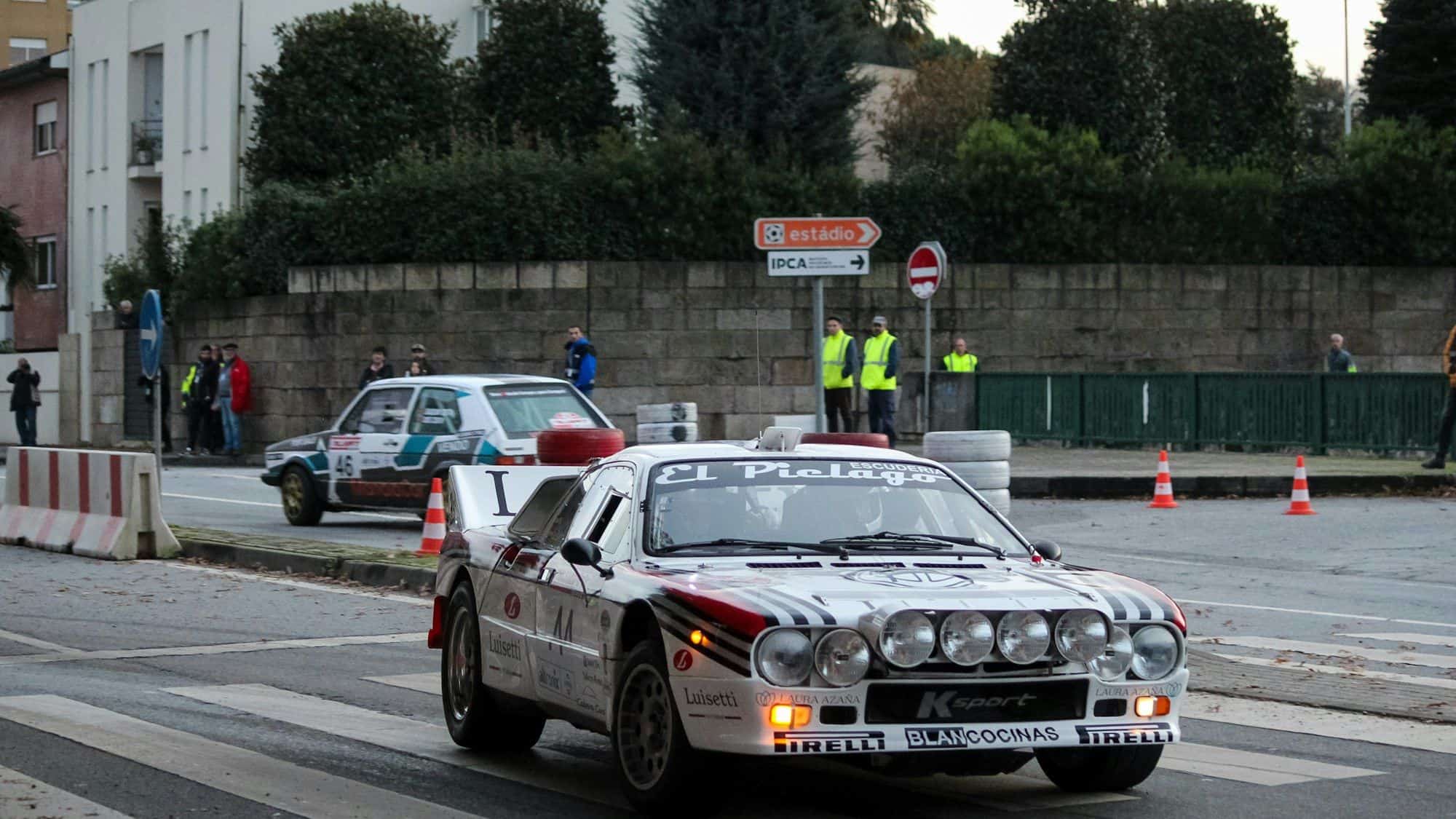
Group B lasted four seasons in the World Rally Championship. In that time, it produced the fastest, most technically advanced rally cars ever built on a production-car basis — and it killed drivers, co-drivers, and spectators often enough that the FIA banned it mid-championship rather than wait for the season to end. That sequence of events is not a coincidence. It is the direct result of how the regulations were written in the first place.
How the Regulations Created the Conditions for Both Brilliance and Disaster
Group B regulations were introduced by FISA — the sporting arm of the FIA at the time — for the 1982 World Rally Championship season. The stated purpose was to encourage manufacturer innovation by keeping the technical rulebook deliberately open. The minimum homologation production run was set at 200 road cars, later reduced to just 20 units for so-called Evolution variants. That threshold was low enough to allow manufacturers to build bespoke competition machines with almost no concession to road-car practicality, weight, or passive safety architecture.
The era ran from 1982 to 1986 — four full seasons. The FIA banned the category outright effective the 1987 season, making it one of the shortest-lived top-tier classes in WRC history. If you have watched Group B footage and wondered how spectators were standing inches from 500 hp cars on loose mountain roads with no barriers between them and the stage, the answer is straightforward: the rulebook didn’t require otherwise. That gap wasn’t an oversight anyone fixed in real time. It was structural, and it ran the full length of the category’s existence.
Group B was written as a category applying to both sports car racing and rallying. The FIA’s intent was to stimulate engineering freedom, not to mandate safety architecture. Roll cage standards, fireproof barriers, and crowd-control provisions were all notably thin compared to circuit racing regulations of the same period. No power ceiling appeared anywhere in the core regulations. Spectator management on special stages was left largely to individual national rally organizers rather than mandated by the FIA rulebook. That single gap — the absence of a universal, enforceable crowd-exclusion standard — was the direct mechanism through which spectator fatalities became a statistical near-certainty once the performance envelope reached Group B levels.
By the mid-1980s, turbocharged Group B cars were producing figures cited at over 500 hp in full qualifying trim, with some manufacturer estimates running higher. Those figures had no analogue in any other contemporary production-based category. The engineering ambition was real and measurable. So was the institutional failure to match it with proportionate safety provisions.
The Cars That Defined the Group B Era
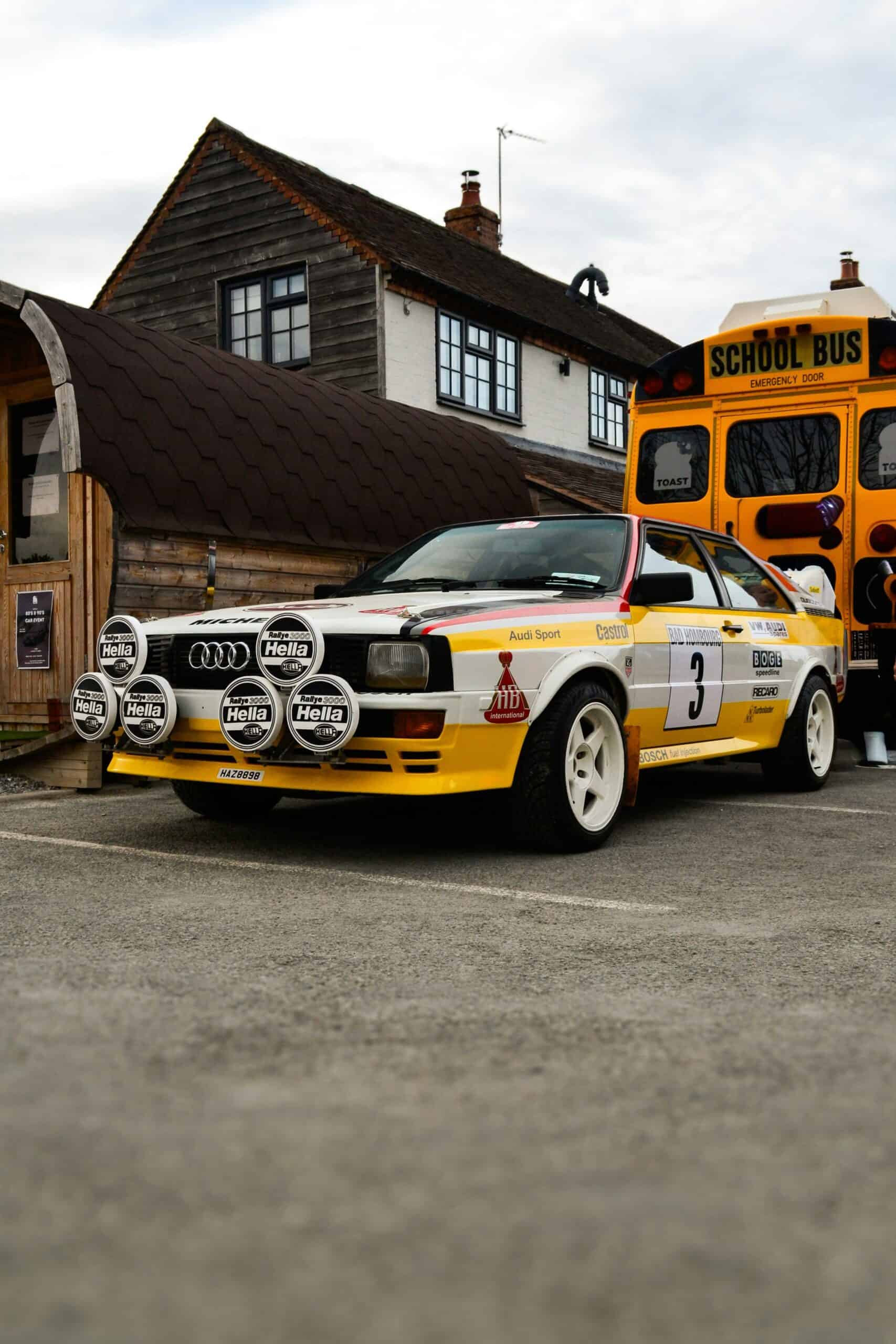
The Audi Sport Quattro was the defining early Group B machine. A shortened, high-output evolution of the production Quattro, it brought permanent four-wheel drive to top-level rallying and immediately changed what was possible on loose and mixed-surface stages. Every serious manufacturer followed Audi’s AWD lead within two seasons — the quattro system didn’t just win rallies, it made the previous generation of rear-drive cars effectively obsolete at the front of the field.
What followed was a generation of machines that each took a different engineering approach to the same problem: generate maximum power, route it through four driven wheels, and keep the car light enough to work on both tarmac and gravel. The cars that resulted included:
- Peugeot 205 T16 — mid-engined layout with a turbocharged four-cylinder; it bore almost no mechanical relationship to the road-going 205 hatchback beyond the bodyshell shape. The 205 T16 won back-to-back manufacturers’ and drivers’ championships in 1985 and 1986, with Timo Salonen taking the 1985 drivers’ title and Juha Kankkunen the 1986 title.
- Lancia Delta S4 — used both a supercharger for low-rpm response and a turbocharger for top-end power, a twin-forced-induction layout that illustrated how far engineers would push complexity when the rulebook didn’t say stop. The S4 represented Lancia’s attempt to leapfrog Peugeot after losing the 1985 championship.
- Ford RS200 — a purpose-built mid-engined four-wheel-drive machine developed with input from designer Tony Southgate, with a turbocharged inline-four mounted amidships. Ford’s program was terminated abruptly when the category was banned, leaving a fleet of competition-specification cars without a championship to enter.
- MG Metro 6R4 — unusually, naturally aspirated, running a bespoke V6 developed with Williams Grand Prix Engineering; it prioritized throttle response over outright peak power. The naturally aspirated configuration was a deliberate engineering choice intended to avoid turbo lag on the loose, unpredictable surfaces of special stages.
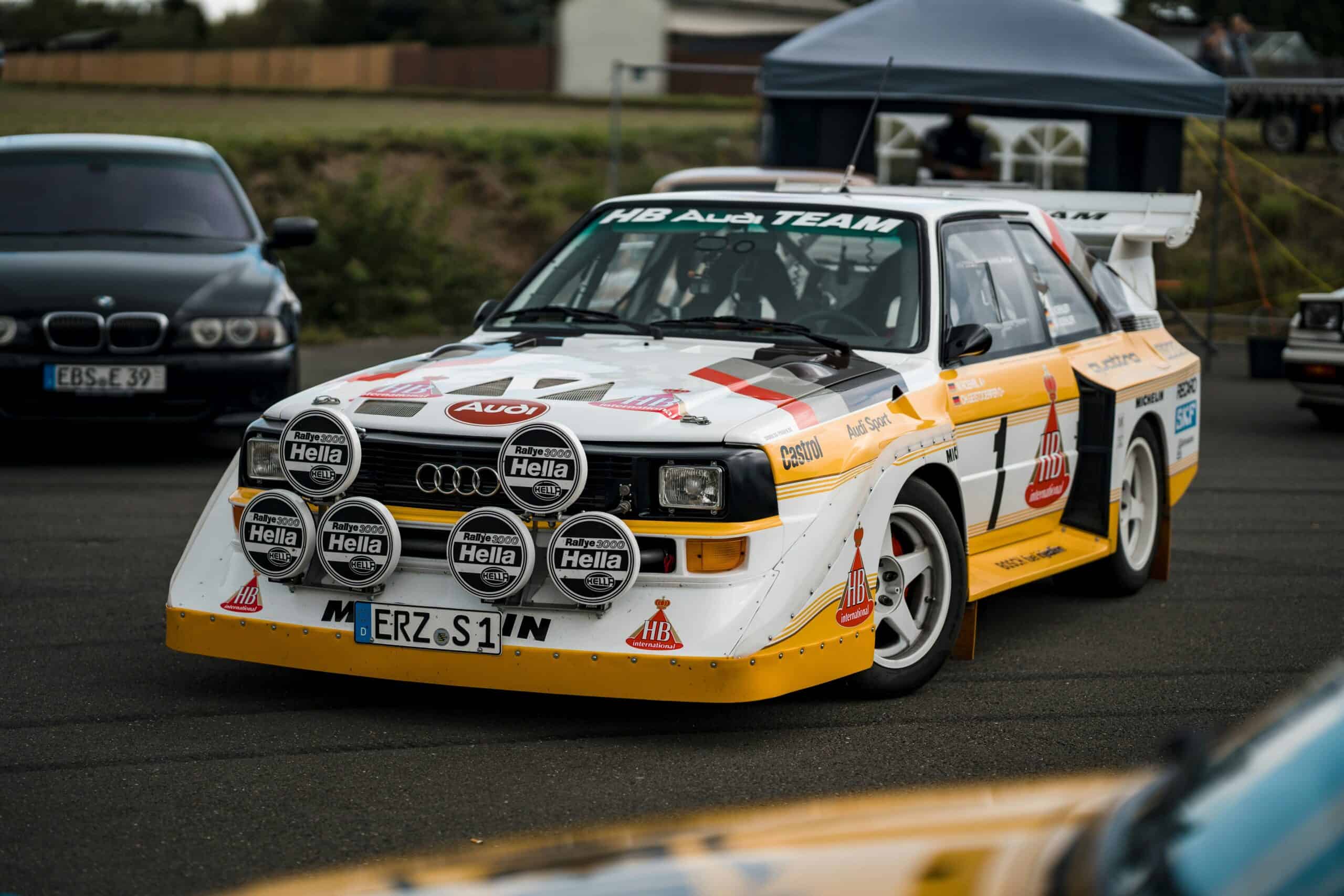
- Audi Sport Quattro S1 — the final evolution of the quattro line in Group B, with dramatically widened bodywork, revised aerodynamics, and an uprated five-cylinder engine. The S1 E2 variant in particular represented the outer limit of what the quattro platform could be stretched to produce under Group B rules.
These cars are now among the most historically significant rally machines ever built. Period road-going homologation versions of several Group B models command auction prices well into six figures. If you are considering one as a purchase, treat any valuation you read as a starting point requiring verification against recent, documented sale records — the market for these cars is narrow, specialist, and volatile enough that figures go stale quickly.
The Championship Results, Season by Season
The competitive record of the Group B era is worth examining in sequence, because the championship results map directly onto the technology arms race the regulations created.
In 1982, the first Group B season, the category coexisted with older Group 4 machinery, and Walter Röhrl won the drivers’ title in a Opel Ascona 400 — a rear-wheel-drive Group B car that reflected the transitional nature of the opening season. The quattro had already won its first WRC rally in 1981 before Group B formally began, but the full competitive implications of four-wheel drive hadn’t yet reshaped the entire field.
By 1983, Hannu Mikkola had won the drivers’ championship in the Audi Quattro, and the direction of travel was clear. 1984 brought Stig Blomqvist the title, again in an Audi, while Peugeot was completing development of the 205 T16 that would change the competitive order entirely.
The 1985 and 1986 seasons represented Group B at both its technical peak and its point of irreversible crisis. Peugeot dominated 1985. The 1986 season saw Lancia, Peugeot, and Ford all running fully developed evolution machinery — and produced the fatalities that ended the category.
The Drivers Who Competed at the Front
The drivers who competed at the front of Group B fields were operating at margins that had no equivalent elsewhere in contemporary motorsport. The combination of extreme power, comparatively narrow special stages, and absent spectator barriers created conditions where the consequences of any error were severe and immediate.
Walter Röhrl was widely regarded as one of the most technically precise drivers of the era — his ability to manage cars at the limit on tarmac stages in particular was considered exceptional by his contemporaries. Hannu Mikkola and Stig Blomqvist both demonstrated that the quattro’s four-wheel-drive advantage could be translated into championship results through consistent, controlled driving rather than outright risk-taking.
Henri Toivonen represented a different profile: raw speed that placed him regularly among the fastest drivers on any surface. His performance at the 1985 RAC Rally in a Lancia Delta S4, where he led stages by margins that surprised even experienced observers, was cited at the time as evidence that his natural speed was in a category of its own. That same quality made his death at the 1986 Tour de Corse the clearest single demonstration that driver skill, however exceptional, could not substitute for the safety architecture the regulations had omitted.
Michèle Mouton remains the only woman to have won a World Rally Championship round, taking four WRC victories in the Audi Quattro between 1981 and 1982. Her results in Group B were competitive at the front of the field rather than merely notable for their context — she finished second in the 1982 drivers’ championship, behind only Röhrl.
The Deaths That Made the Ban Inevitable
Group B’s danger was not theoretical, and describing it as the most dangerous rally category ever run is not nostalgia or exaggeration — it is the documented outcome of the regulatory framework. Multiple drivers, co-drivers, and spectators died across the era. The combination of extreme performance and absent crowd barriers made fatal outcomes predictable in hindsight; the question was never whether a car would reach an unprotected crowd, but when.
The 1986 season was the decisive breaking point. A series of serious accidents in rapid succession made it impossible for the FIA to treat the fatalities as isolated incidents. Henri Toivonen and co-driver Sergio Cresto were killed at the 1986 Tour de Corse when their Lancia Delta S4 left the road on the Col de Cagne stage and caught fire. The car’s composite bodywork contributed to the speed with which the fire became unsurvivable. Toivonen was among the fastest drivers of the era — his death removed any remaining argument that driver skill alone could manage the risk the cars represented.
Earlier in 1986, at the Rallye Portugal, a crash involving Joaquim Santos’s Ford RS200 on the Sintra stage killed three spectators and injured more than thirty others. The spectators were standing on the stage road with no barrier of any kind between them and the competing cars. That configuration was not unusual. It was the standard arrangement on the majority of special stages throughout the Group B era. The Portugal accident made the structural nature of the crowd-control failure undeniable in a way that individual driver accidents had not.
The spectator fatalities across the era were a direct consequence of the absent crowd-control requirements written into the original regulations. This is not a retrospective judgment being applied unfairly to a different era’s standards. The gap was identifiable at the time. It wasn’t addressed until the category was eliminated entirely. The drivers who competed in Group B did so understanding the margins were narrow; the spectators lining the stages had no equivalent informed choice about their exposure.
Why the Ban Came in a Single Season, Not Gradually
After the 1986 Tour de Corse fatalities, FISA president Jean-Marie Balestre moved to end Group B with unusual speed. The decision to ban the category effective 1987 — announced mid-season in 1986 — reflected political and liability pressure as much as engineering analysis. The speed was itself controversial: manufacturers including Ford, Peugeot, and Lancia had invested heavily in next-generation evolution cars that would never compete. Some argued a structured phase-out with mandated safety upgrades was more rational than an immediate cut.
Group S, the proposed successor category with stricter safety architecture built in from the start, was announced and then cancelled before a single car competed. Several Group S development cars were completed before the cancellation — Lancia, Peugeot, and Toyota had all begun programs — but none entered a championship event. Manufacturers that had already committed engineering resources had no path forward in the top WRC tier.
The replacement, Group A, ran cars producing roughly one-third of Group B’s power output. The transition was abrupt, and the structural failure that made the ban necessary — a governing body building a category without adequate safety provisions, then eliminating it when that failure became publicly undeniable — was never formally reckoned with as a regulatory lesson in the way it deserved to be. No institutional review of how the original regulations were written was published. The category was simply closed.
What Group B’s Engineering Legacy Actually Produced
Four-wheel drive became standard in top-level rallying and directly influenced road-car development. Audi’s commercial quattro AWD line traces its competitive credibility to the Sport Quattro’s Group B results in a direct, documentable line. Turbocharged four-cylinder and five-cylinder engines producing high specific outputs in compact, lightweight packages informed production performance cars through the late 1980s and 1990s. Active differential management, weight distribution strategies, and rally-specific suspension geometry all advanced faster during the four Group B seasons than in the preceding decade of WRC competition.
The twin-charged approach pioneered in competition by the Lancia Delta S4 — combining a supercharger’s low-rpm torque delivery with a turbocharger’s high-rpm output — appeared subsequently in road car applications, most notably in the Volkswagen Group’s twincharger engine used in production cars from the mid-2000s onward. The lineage is not always acknowledged directly, but the engineering logic is identical.
The honest assessment is this: Group B produced genuine engineering breakthroughs and genuine deaths in roughly equal measure. Every current WRC car’s mandatory roll cage specification, fire suppression system, and spectator exclusion zone on special stages exists in direct response to what Group B demonstrated was inadequate. The safety architecture of modern rallying is essentially a corrective document written over the 1982-86 rulebook.
If you are evaluating a homologation road car from this era — an RS200, a 205 T16, a Delta S4 — understand what you are actually buying. These cars were built to satisfy a production minimum, not to be usable daily transport. Mechanical complexity is high, parts availability is poor to nonexistent through normal channels, and maintenance costs are significant even before anything goes wrong. Any purchase decision should begin with a full documented history and a specialist inspection by someone who works specifically on that model. The historical significance is real. So are the ownership costs.
What Group B demonstrates — and what remains relevant every time a sanctioning body writes a new set of technical regulations — is that speed without a corresponding safety framework is a regulatory and engineering problem, not a driver skill problem. The FIA’s own decision to ban the category mid-championship is the clearest possible institutional acknowledgment that the framework it built in 1982 was inadequate. That lesson took four seasons and multiple lives to enforce. It has not been repeated at the same scale in WRC since — but the reason it has not is precisely because the corrective measures that followed were comprehensive enough to change the structural conditions that made Group B lethal. The engineering legacy is worth celebrating. The regulatory failure that accompanied it is worth understanding with equal clarity.