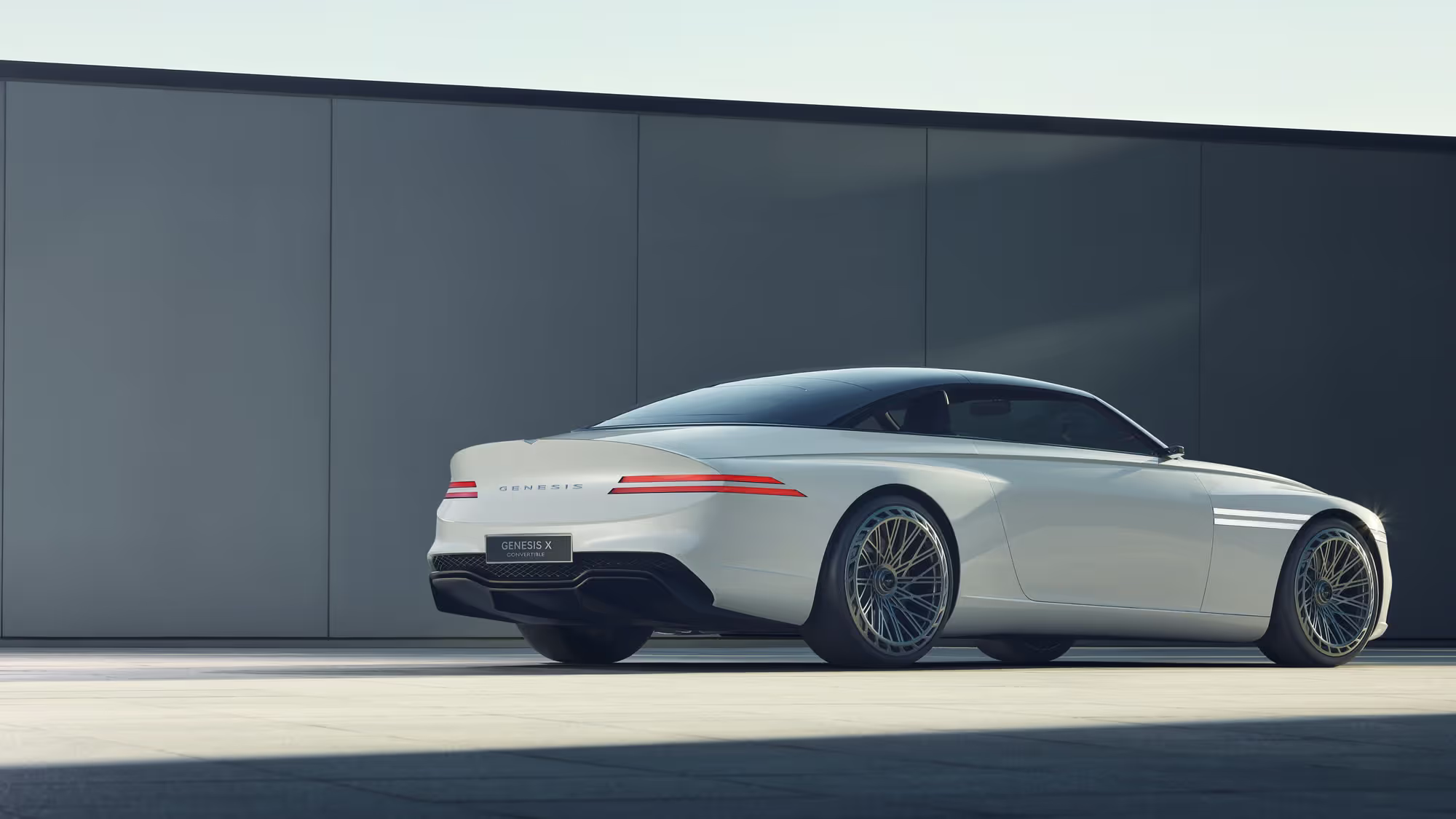
Genesis has confirmed it is actively exploring a road-legal version of the X Skorpio — a twin-turbocharged V8 concept that made its debut in the Rub’ al Khali desert producing 1,100 horsepower and 850 lb-ft of torque. Whether this moves from exploration to production depends entirely on what Genesis commits to in the next 12 to 24 months, and the gap between those two things is wider than the headlines suggest.
What the X Skorpio Concept Actually Is
Genesis built the X Skorpio around a bespoke tubular chassis with an integrated roll cage — the structural architecture of purpose-built racing and ultra-low-volume hypercars, not a repurposed GV80 floorpan. That distinction matters because it tells you Genesis’s engineering team was not doing cosmetic work. They were making real hardware decisions with real consequences for any production program.
The twin-turbo V8 rated at 1,100 hp and 850 lb-ft of torque is the headline figure, but the platform underneath is equally important. Tubular chassis construction is light and tunable. It is also fundamentally different from the unibody stamped-steel architecture used in production passenger cars, and that gap sits at the center of everything that makes road legalization genuinely difficult.
The 40-inch off-road tires mounted on 18-inch beadlock wheels compound the challenge further. Beadlock wheels — which mechanically clamp the tire bead to prevent unseating at low pressures — are not street-legal in most major markets. The 40-inch tire diameter requires wheel-arch clearance that affects aerodynamics, body structure, and noise regulations. These are not minor trim decisions. They are fundamental specification choices that would almost certainly need to change for any road-legal variant.
The desert reveal in the Rub’ al Khali was a deliberate brand statement, not a production preview. But the level of engineering committed to this concept — real chassis, real drivetrain, real off-road hardware — signals that the powertrain and structural work is not purely speculative. Something substantial was built and driven.
What ‘Road Legal’ Actually Requires — And Why It’s the Hard Part
Getting the X Skorpio from concept to road-legal status is not a paperwork exercise. It is a full re-engineering program, and the obstacles are specific and significant.
First, the chassis. A tubular frame with an integrated roll cage needs to pass frontal, side, and offset crash testing to meet FMVSS standards in the US or ECE regulations in Europe. That typically means adding crumple zones and energy-absorbing structures, which adds weight and changes geometry — both of which affect the performance character of the vehicle you end up with.
Second, the tires and wheels. Road-legalizing a vehicle with beadlock wheels and 40-inch off-road rubber means either substituting a different wheel and tire specification or pursuing market-specific exemptions. Neither path is straightforward at any meaningful volume, and changing the tire spec substantially would change both the vehicle’s performance profile and its design language.
Third, emissions. A twin-turbo V8 producing 1,100 hp faces genuine certification challenges in US and European markets heading toward 2030. Genesis has not disclosed whether a production version would pursue combustion-only homologation or add hybrid or electric assistance to meet standards. If electrification enters the picture, the final horsepower figure and the driving character could shift considerably from the concept specification.
Low-volume homologation pathways do exist. The US has an FMVSS low-volume exemption for manufacturers producing fewer than 325 units per year; Europe has analogous small-series type approval. Genesis is reportedly exploring exactly these kinds of regulatory paths, which suggests the team understands the landscape. But understanding the landscape and successfully navigating it to a production vehicle are very different things.
How the X Skorpio Specs Stack Up Against the Hypercar Field
On power output alone, the X Skorpio’s 1,100 hp figure puts it in legitimate company. For context:
| Vehicle | Powertrain | Horsepower | Torque |
|---|---|---|---|
| Genesis X Skorpio (concept) | Twin-turbo V8 | 1,100 hp | 850 lb-ft |
| Lamborghini Revuelto | Hybrid V12 | 1,001 hp | 535 lb-ft |
| Ferrari SF90 Stradale | Hybrid V8 | 986 hp | 590 lb-ft |
| Bugatti Chiron Super Sport 300+ | Quad-turbo W16 | 1,578 hp | 1,180 lb-ft |
What that table does not tell you: kerb weight, 0-60 time, top speed, drivetrain layout, or transmission type for the X Skorpio. None of those figures have been confirmed by Genesis. Without them, 1,100 hp tells you potential, not performance. A heavy all-terrain machine on 40-inch tires will not accelerate or handle like a mid-engine track hypercar at the same power output — the physics are entirely different.
The off-road tire and beadlock specification suggests Genesis may be targeting a niche that barely exists in production form: a high-performance all-terrain hypercar. The closest production comparisons — the Porsche 911 Dakar and Lamborghini Sterrato — operate at far lower power outputs and far more conventional tire specifications. If Genesis delivers on this concept, it would occupy territory that essentially no other production vehicle currently holds. That is either a significant market opportunity or a warning sign about market size, depending on your perspective.
Why Genesis Is Doing This — And Whether It Makes Strategic Sense
Genesis has spent the last several years building genuine credibility in the upper-luxury segment with the GV80, G80, and G90. Those vehicles have earned real respect on quality and value grounds. What they have not done is give Genesis a performance identity that competes with Ferrari, McLaren, or Lamborghini for cultural weight. A hypercar accomplishes that in a way no sedan or SUV can, even if the total production run numbers in the dozens.
The strategic logic is clear. The execution risk is equally clear. Genesis does not yet have a track record of delivering ultra-high-performance road cars. Buyers in the hypercar segment pay close attention to brand lineage, dealer and service infrastructure, and resale value — all areas where Genesis is still establishing itself. No amount of horsepower solves a service-network gap when you need a Genesis performance specialist and there isn’t one within a reasonable distance.
Hyundai’s CEO has indicated a production version is possible by 2030 — that is an exploration signal, not a confirmed program. No production number, confirmed price, or homologation strategy has been announced. The 2030 timeline gives Genesis time to do this properly, but it also means you are at minimum four years from a vehicle that may or may not arrive with the specification the concept implied.
What to Watch For Before This Becomes a Purchase Decision
Right now, the appropriate posture for any potential buyer is informed interest, not financial commitment. These are the specific developments that would actually move this story forward:
- A formal development program announcement. Genesis moving from “exploring road legal” to confirming a chassis specification, homologation strategy, and production target is the meaningful milestone. The concept unveil was not that announcement.
- Powertrain disclosure. If Genesis adds hybrid architecture to meet emissions certification in US or European markets, the final output figure and driving character could differ substantially from the 1,100 hp twin-turbo V8 concept specification. That disclosure matters enormously to what kind of vehicle this ultimately becomes.
- Tire and wheel specification on the production version. This single detail will tell you whether Genesis is building a road-biased hypercar or a genuine all-terrain performance machine. Those are different vehicles with different buyers, different running costs, and different performance profiles.
- Price and production volume. Neither has been disclosed. Volume determines the homologation pathway available to Genesis; price determines where this sits competitively and what the long-term resale story looks like.
The Bottom Line
The Genesis X Skorpio is credible hardware — 1,100 hp, 850 lb-ft of torque, tubular chassis, integrated roll cage — built and revealed in the Rub’ al Khali desert as a genuine engineering exercise, not a rendered fantasy. The road-legal exploration is a real regulatory and engineering undertaking, not a headline-chasing press release. The honest assessment is straightforward: if Genesis delivers a road-legal X Skorpio by 2030, buyers get a genuinely novel hypercar from a manufacturer with the full depth of Hyundai Group engineering and financial resources behind it. If the program stalls, what remains is a remarkable concept that never made production. Both outcomes are live possibilities right now, and nothing announced to date changes that.
For anyone tracking this story seriously: follow official Genesis program announcements, not the render-and-speculation cycle that reliably surrounds concept cars. The real signal will come in the form of a confirmed chassis spec, a disclosed homologation path, and a production number. None of those exist yet. The X Skorpio proves Genesis’s performance ambition is real. Whether the brand can execute on that ambition at the level the concept implies is still an open question — and that answer is worth waiting for before any deposit conversation begins.