
The Ferrari F40 was not designed to comfort you. It was designed to be the fastest, lightest, most uncompromising road car Ferrari had ever built — and to make that point without apology, padding, or a single unnecessary gram of interior trim. If you came here because the F40 makes extraordinary wallpaper material, you already know the shape. This is the deeper story behind it.
The Car That Made Every Other Supercar Feel Soft

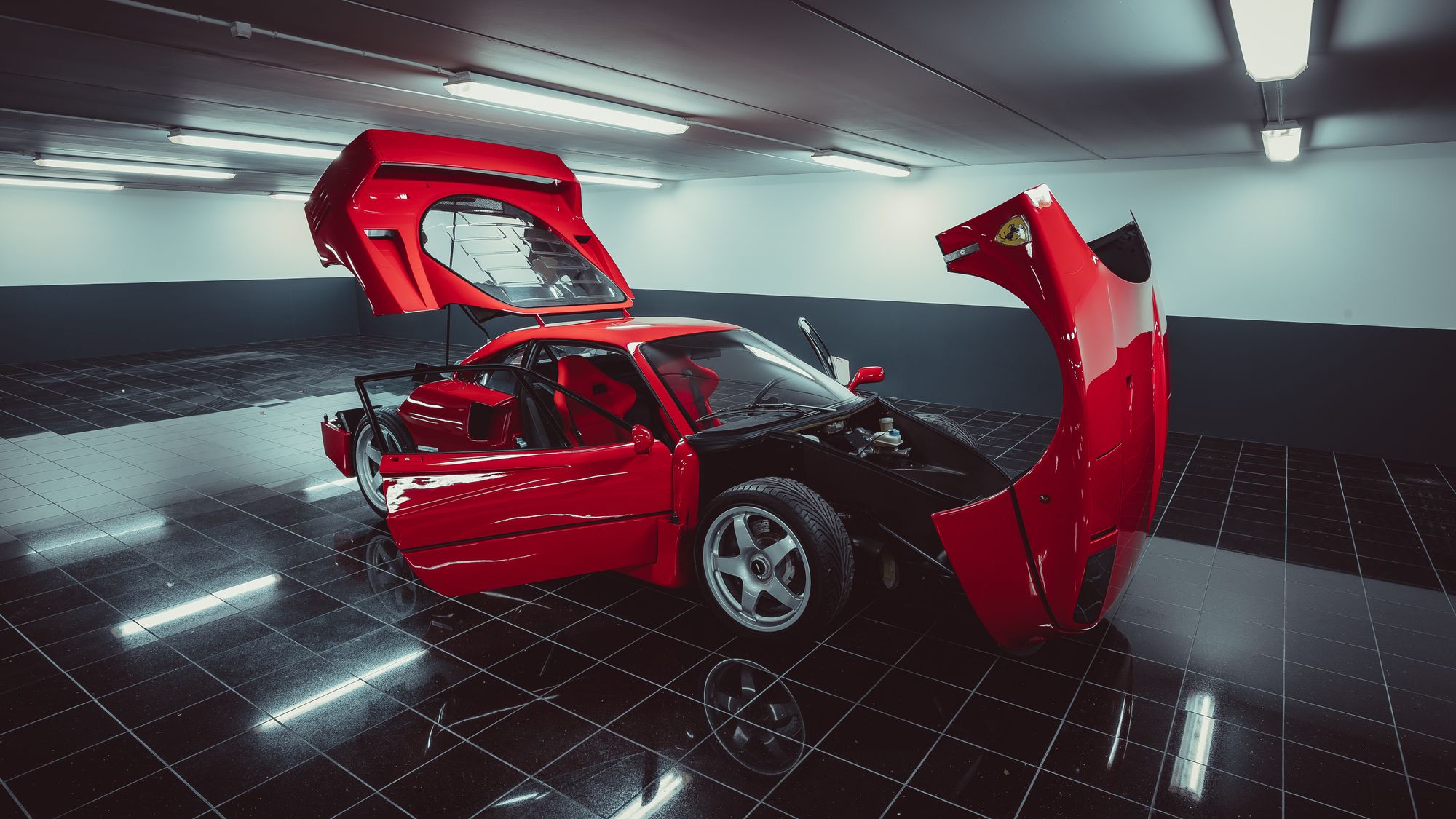
When the F40 arrived in 1987, it was Enzo Ferrari’s final personal project, and every decision reflected that. This was not a supercar shaped by committee with an eye on comfort scores or dealer feedback. It was a brutalist, race-derived machine that embarrassed its contemporaries on spec sheets and on track. That enormous rear wing, the wide haunches, the translucent engine cover revealing the twin-turbo V8 — every angle that dominates a wallpaper image is structural or aerodynamic, not cosmetic theater. Understanding why it looks the way it does starts with understanding what Ferrari deliberately refused to put inside it.
This is the car that proved a street-legal Ferrari could crack 200 mph — not by adding technology, but by stripping out everything your daily driver takes for granted. Whether you are a collector evaluating a purchase or an enthusiast who wants to understand what makes the F40 genuinely special rather than just visually iconic, the story is built on numbers and deliberate sacrifices worth knowing cold.
What Ferrari Deliberately Left Out — and Why It Matters

No radio. No carpets. No door handles. No ABS. No power steering. No air conditioning. The F40’s cabin was closer to an endurance racer’s cockpit than anything Ferrari had sold to a road-going customer before. You opened the door via a simple fabric strap pull. The side windows were fixed plexiglass panels with a small sliding vent — not roll-down glass. The door cards were bare. The firewall was visible. It photographs as drama and feels, in traffic, like punishment.
This was not a cost-cutting exercise. It was a weight-reduction mandate. Every deletion served a purpose: pushing the F40’s curb weight down to approximately 2,425 lbs (1,100 kg) in base form, achieved through a body constructed from Kevlar, carbon fiber, and fiberglass over a tubular steel spaceframe. That is a racing architecture applied wholesale to a road car — not a road car adapted with racing inspiration.
For a potential buyer or current owner, this means one thing practically: there is no electronic buffer between you and what the car is doing at speed. Every surface input, every gust of wind, every turbo spool comes directly to your hands and seat. That is the point. It is also the warning.
The Twin-Turbo V8 That Changed the Supercar Conversation

Under the rear clamshell sits a 2.9-liter twin-turbocharged V8 — the F120A — developed directly from Ferrari’s Group B racing program. In road trim it produces approximately 478 horsepower, fed by twin IHI turbochargers and a pair of intercoolers. At the time of launch, that specific power output was unmatched by any street-legal production car from a major manufacturer.
The engine’s racing lineage is not marketing language. The architecture, the compression ratio, and the fueling system all trace directly to competition use. That is a meaningful distinction when evaluating what the F40 actually is versus what later Ferraris became.
One trade-off to factor in before romanticizing the driving experience: turbo lag is real and abrupt. Below 4,000 rpm the F40 is manageable — almost docile by modern standards. Above it, boost arrives hard, power delivery becomes aggressive, and the car demands your complete attention. There is no stability control catching your mistakes. There is no traction management softening the transition. If you are coming from a modern performance car, the threshold at which the F40 punishes inattention is considerably lower than you expect.
F40 by the Numbers: A Specs Snapshot

| Spec | Figure | Context |
|---|---|---|
| Engine | 2.9L Twin-Turbo V8 | Race-derived F120A unit |
| Power | ~478 hp | Road specification |
| Curb Weight | ~2,425 lbs / 1,100 kg | Kevlar/carbon composite body |
| 0-60 mph | ~3.8 seconds | Per period road tests |
| Top Speed | ~201 mph / 324 km/h | First production car to officially exceed 200 mph |
| Transmission | 5-speed manual | No paddle shifts, no driver aids |
| Production Run | 1987-1992 | Approximately 1,315 units built |
Fuel economy was never a design priority — expect roughly 8-10 mpg in real-world spirited driving. That figure matters if you plan to actually use the car rather than store it. The F40 runs on premium fuel and is sensitive to fuel quality, a consideration that compounds with the age of the fuel system on any example you are evaluating today. If the car has sat, the fuel lines and seals move immediately to the top of your inspection checklist.
On valuation: clean, low-mileage examples are now firmly in seven-figure territory. Budget insurance and storage costs accordingly from the moment you take title. For a sense of what documented, competition-provenance examples command at the top of the market, this listing for a 1990 Ferrari F40 ‘Jean Sage’ by Michelotto illustrates why provenance documentation is worth scrutinizing before any purchase decision.
Why the F40 Remains the Benchmark Decades Later

The F40 was the last Ferrari personally approved by Enzo, who died in August 1988. That provenance separates it from every car Ferrari has produced since — not as sentiment, but as a concrete and documented part of the car’s history and collector value. No other Ferrari carries that specific weight.
Unlike the F50 or the Enzo that followed, the F40 has no traction control, no stability management, and no digital safety net. A direct comparison between the F40 and F50 makes the generational philosophy shift clear: Ferrari moved toward driver assistance and refinement with the F50, a car that is faster in certain respects and considerably easier to live with — but measurably further from what made the F40 the benchmark it became. If raw driver engagement is the metric, the F40 wins without argument.
Ferrari’s own design department still reaches back to this car as a primary reference point. The brand’s SC40 special project, explicitly inspired by the F40, demonstrates how thoroughly the original car’s visual and engineering language continues to define what Ferrari considers the ideal expression of a pure performance machine. That is not nostalgia — it is the company acknowledging that the F40 solved a problem with a clarity that has not been surpassed.
The visual design reflects the same discipline. The rear wing, the NACA hood ducts, the vented front splitter — each has a quantifiable aerodynamic function. There are no fake vents, no decorative scoops, no visual excess for its own sake. Every element that makes a compelling photograph is structural or functional. That integrity is rare in any era of car design, and increasingly rare in the context of modern hypercars, where aerodynamic surfaces frequently serve as much visual as functional purpose.
Reliability and Real-World Ownership: What You Need to Know Before Writing the Check
The twin-turbo system, fuel lines, and rubber seals are the primary aging concerns on any F40 you evaluate. A pre-purchase inspection by a Ferrari specialist is non-negotiable — not a formality, and not something you arrange after agreeing a price. Do it before. A compression test, a thorough examination of fuel system integrity, and a review of turbocharger condition will tell you more than the odometer reading ever will.
Exercise caution around very low-mileage examples that have been garaged as investments without regular exercise. A car that has not been driven does not necessarily mean a car in better condition. Seals dry out, fuel systems degrade, and turbo bearings suffer from inactivity. A moderate-mileage example with a complete and documented service history may present substantially less mechanical risk than a numbers-matching trailer queen with unknown fluid and seal condition.
Parts availability is manageable through Ferrari’s Classiche program and specialist suppliers, but labor costs and parts pricing reflect the car’s collector status. If you plan to drive the car regularly, budget $10,000-$30,000 or more annually in maintenance costs for an actively used example. That is not an exaggeration — it is the realistic cost of operating a 30-plus-year-old, high-stress turbocharged Ferrari at the level of use it was built for. Insist on documented service history covering the cam belts, turbos, and fuel system. These are the cost centers that separate a sound acquisition from an expensive and ongoing project.
For further context on how documented provenance and mechanical specification interact with collector valuations, this detailed breakdown of the ultra-rare Jean Sage Michelotto F40 is worth reading in full before you engage with any seller at the upper end of the market.
The F40 as a Wallpaper Icon — and What the Image Doesn’t Tell You
The reason the F40 dominates desktop backgrounds and bedroom walls is the same reason it is a legitimate all-time great car: it looks exactly like what it is. There is no visual dishonesty in the design. The rear wing is not theater — it is a functional aerodynamic device. The wide haunches exist because the chassis and tires demand them. The translucent engine cover is not a styling affectation — it is the lightest viable solution to a practical problem. The image earns every dramatic angle.
The honest trade-off is this: the F40 is loud, hot, physically demanding, and unforgiving. Those qualities photograph beautifully and feel very different when you are sitting in stop-and-go traffic with no air conditioning, a transmission tunnel running at high temperature, and a driving position calibrated for speed rather than comfort. It will tire you out on a long run in a way no modern supercar will. That is not a criticism — it is a precise description of what you are buying.
If the F40 is your dream car, it should be. The numbers support the legend, and the ownership reality confirms it on every drive. But go in knowing the poster represents the best possible version of a machine that is genuinely difficult, genuinely rewarding, and genuinely irreplaceable. Know both sides of that equation before you commit.