
In 1963, a tractor manufacturer with a grudge sat down and built one of the most consequential automobiles in Italian automotive history. The Lamborghini 350 GT wasn’t a concept, a prototype, or a vanity project — it was a fully realized, road-legal grand tourer with a purpose-built V12, professional coachwork, and a top speed that put it level with the best Ferrari had to offer. Understanding it means understanding where the entire Lamborghini lineage begins.
The Founding Rivalry: How a Dismissed Complaint Built a Brand

Ferruccio Lamborghini was already wealthy when he decided to build cars. His tractor manufacturing business — Lamborghini Trattori — had made him a serious industrial figure in postwar Italy, and he owned several Ferraris as a matter of course. The story of what happened next is one of the most retold in automotive history, and it earns that status because the outcome was real.
Ferruccio reportedly complained to Enzo Ferrari about the clutch behavior on one of his road cars. Ferrari’s response was dismissive: a tractor maker had no business telling him how to build sports cars. That exchange, whether precisely as legend describes or not, had consequences Ferrari could not have anticipated. Ferruccio returned to Sant’Agata Bolognese and set about building a competitor from scratch.
His first hire was Giotto Bizzarrini — the engineer Ferrari had recently dismissed during the internal purge known as the “Palace Revolt” of 1961, and the man centrally responsible for developing the engine in the Ferrari 250 GTO. Ferruccio tasked him with designing a V12 that would outclass anything coming out of Maranello. He also brought in Gian Paolo Dallara as chief engineer for the chassis and overall vehicle development. Together, they weren’t iterating on someone else’s work. They were building a credible rival from the ground up, with the explicit intention of beating the car that had embarrassed Ferruccio in the first place.
The result was the 350 GT: a production car that entered manufacturing in late 1963 and reached paying customers in 1964. If you want to understand what Lamborghini is today — the V12 lineage, the long bonnet, the Italian coachwork, the commercial rivalry with Ferrari — the 350 GT is where every bit of that begins.
Engineering the 350 GT: What Bizzarrini and Dallara Actually Built

The technical foundations of the 350 GT were serious from the outset. Bizzarrini’s engine was a 3.5-liter dual-overhead-cam V12 — four camshafts total, six twin-choke Weber carburetors, and an architecture conceived from the start as a road unit rather than a detuned racing engine. Lamborghini quoted output at approximately 270 horsepower in road trim, with a verified top speed of 148.8 mph recorded during testing. In 1964, that placed it squarely among the fastest production grand tourers available anywhere.
The chassis was a tubular steel space frame developed by Dallara, chosen for its rigidity and relative lightness. Suspension was independent all around — double wishbones front and rear — which gave the 350 GT handling manners more sophisticated than many contemporaries. The gearbox was a five-speed ZF unit sourced from Germany, a pragmatic decision that prioritized reliability and driver feel over in-house pride.
The body was the work of Carrozzeria Touring Superleggera of Milan, one of the most respected coachbuilders in Italy. Touring used their patented Superleggera construction method — a lightweight framework of small-diameter tubes over which formed aluminum panels were attached — to produce bodywork that was both elegant and structurally efficient. The proportions were classically Italian: a long bonnet to house the V12, a compact and well-appointed cabin, and a fastback roofline that read as sophisticated rather than aggressive. This was a grand tourer built for crossing Europe at sustained high speed, not a track car wearing road clothes.
Lamborghini built 120 examples between late 1963 and 1966, with the final four units completed in 1967. The launch price was $13,900 USD — approximately $135,000 in current terms — which positioned it directly against Ferrari’s 250-series grand tourers in the premium European and American market. According to Lamborghini’s own historical record, the 350 GT represented the complete realization of Ferruccio’s founding ambition: a market-ready product delivered within roughly two years of the company’s incorporation.
Specifications at a Glance

| Specification | Detail |
|---|---|
| Engine | 3.5-liter DOHC V12 (Bizzarrini-designed) |
| Camshaft configuration | Quad camshaft (DOHC per bank) |
| Carburetion | Six twin-choke Weber carburetors |
| Power output | ~270 hp |
| Top speed | 148.8 mph (verified) |
| Chassis | Tubular steel space frame |
| Suspension | Independent double wishbones, front and rear |
| Gearbox | ZF five-speed manual |
| Layout | Front-engine, rear-wheel drive |
| Coachwork | Carrozzeria Touring Superleggera (Superleggera construction) |
| Production period | Late 1963 – 1966 (final 4 units completed 1967) |
| Total produced | 120 units |
| Original price (1964) | $13,900 USD |
How It Compared to Ferrari in 1964
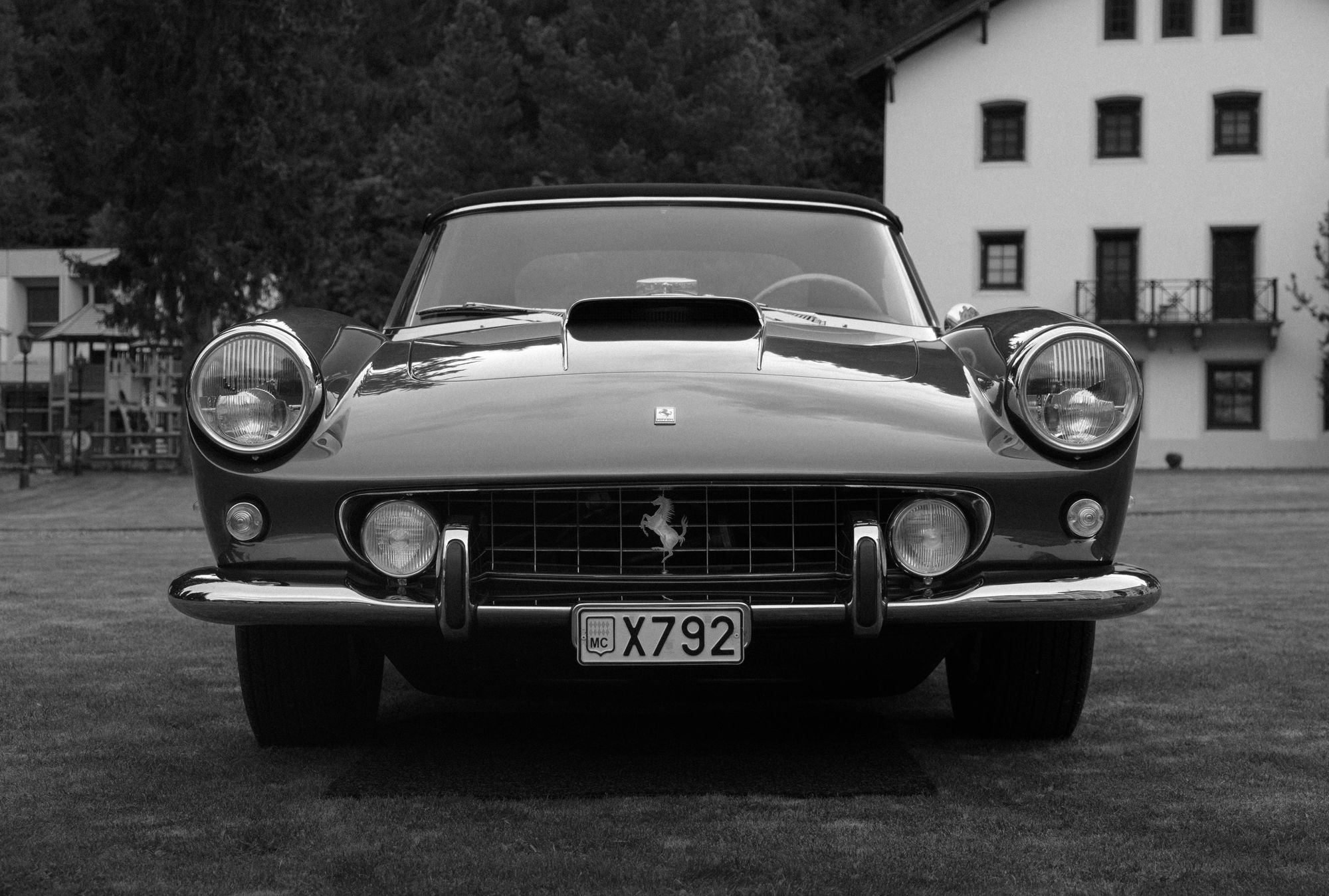
Ferruccio’s explicit benchmark was Ferrari’s 250 GT series — the defining grand tourer of the early 1960s and the car that dominated the premium market he intended to enter. On paper and in practice, the 350 GT matched or exceeded it in top speed, and the engine Bizzarrini designed was technically more sophisticated than the road-going V12s Ferrari was producing for private buyers at the time.
The strategic distinction Lamborghini drew was deliberate and commercially shrewd. Ferrari’s road cars of the period carried significant motorsport DNA — stiffness, compromises in refinement, and an engineering philosophy shaped by racing requirements. Lamborghini positioned the 350 GT at the opposite end of that axis: maximum refinement, smooth power delivery, and long-distance comfort as primary objectives. The grand touring half of “GT,” not the track half.
The independent all-round suspension — unusual at a time when many rivals still used live rear axles — contributed directly to that refinement. Buyers could drive the 350 GT hard across European roads without the jarring behavior that characterized some competitors. That was a choice, not a limitation, and it reflected a clear understanding of what wealthy private buyers actually wanted from a car at this price point.
Enzo Ferrari reportedly declined to take Lamborghini seriously as a commercial threat. Within two years of the company’s founding, Ferruccio had established genuine credibility with exactly the buyers Ferrari considered his own. The personal rivalry became a commercial reality, and it has shaped both brands’ positioning for the six decades since.
The Prototype That Preceded It: The 350 GTV

The 350 GT that reached customers was not the first car Lamborghini showed to the public. The 350 GTV prototype debuted at the Turin Motor Show in November 1963, and while it was visually striking, it was not a finished product. The show car’s engine bay reportedly contained ballast rather than a complete running engine, and the body — also styled by Franco Scaglione, rather than Touring — was considered too extreme for production. Lamborghini made the decision to commission Touring for the production body and to complete the engineering properly before delivering cars to buyers. That discipline — choosing correctness over speed to market — is part of why the 350 GT arrived as a credible product rather than an overpromised disappointment.
Why the 350 GT Matters Beyond the Origin Story

The personal narrative of Ferruccio and Enzo is compelling, but it can obscure what the 350 GT achieved as an engineering and industrial proposition. Building a complete, refined, market-ready grand tourer — with a purpose-designed V12, a properly engineered chassis, and professional Italian coachwork — in under two years from a standing start is a serious accomplishment by any measure. The mythology is real, but so is the car beneath it.
The 350 GT established the V12 as Lamborghini’s defining format, a lineage that runs without interruption through the Miura, Countach, Diablo, Murciélago, Aventador, and into the current Revuelto. Bizzarrini’s original architecture — oversquare bore-to-stroke ratio, quad camshafts, high-revving character — informed every V12 Lamborghini built for decades. That continuity is engineering history, not brand mythology.
The 350 GT also fixed Lamborghini’s commercial identity from the first year of production: not a racing manufacturer, but a builder of extreme, road-focused grand tourers for wealthy private buyers who wanted something other than Ferrari. That distinction has defined both brands’ positioning ever since, and it was the 350 GT that made the choice first.
Owning a 350 GT Today: Market Realities and Collector Considerations
With 120 units ever produced and the majority still accounted for, the 350 GT is among the rarest first-generation production cars from any Italian manufacturer of the era. Current market data for the 350 GT reflects both that rarity and the car’s historical position. Recent sales have ranged from approximately $555,000 to $585,000 for well-documented examples, placing it in the category of serious collector investment rather than active use.
The ownership calculus is straightforward if you approach it honestly. The six-carburetor 1960s V12 requires marque-specific expertise to maintain correctly, and with only 120 cars ever built, sourcing correct matching components is a specialist undertaking. Deferred maintenance or non-authentic restoration work affects both usability and value in a market where provenance is the primary driver of price. Matching numbers, complete service history, and documented ownership chain are not merely desirable — they are the basis on which serious buyers establish valuation. Auction records for the 350 GT and its successor 400 GT provide a realistic baseline for what the market has actually paid across different condition and provenance levels.
For provenance research before any acquisition, the Lamborghini Registry’s 350 GT chassis records are the authoritative reference. Individual car histories, production sequence, and known ownership records are documented there in a level of detail that no other source matches. This is essential reading before entering any serious purchase conversation.
On relative value, there is a legitimate collector argument worth considering. At current prices, the 350 GT sits substantially below Ferrari 250-series cars from the same period, which regularly trade at multiples of $555,000 to $585,000. The historical significance is arguably comparable — this is the car that established Lamborghini as Ferrari’s most credible rival — and the absolute rarity at 120 units is not in dispute. Whether the valuation gap narrows over time is a market question with no certain answer, but the underlying logic is coherent and the comparison is one serious collectors are already making.
The Bottom Line
The 350 GT was not a tentative first effort or a proof-of-concept built to settle a personal score. It was a fully engineered grand tourer with a purpose-built quad-cam V12, an independent suspension chassis developed by Gian Paolo Dallara, Touring Superleggera coachwork, and a verified 148.8 mph top speed — delivered at a price that competed directly with Ferrari in the market Enzo Ferrari considered his alone. On the numbers, in 1964, Ferruccio made a credible case that he had built something better.
Today, with 120 examples ever produced and current values in the $555,000 to $585,000 range for well-documented cars, the 350 GT represents the root of one of the most consequential rivalries in automotive history — and the origin point of every defining characteristic the Lamborghini brand has carried for sixty years since. Whether you are researching where Lamborghini’s engineering DNA comes from or evaluating whether the 350 GT belongs in a serious collection, the answer to both questions starts here.