
Enzo Ferrari built cars for a living and insulted rivals as a hobby — so when he reportedly called the Jaguar E-Type the most beautiful car ever built, the automotive world paid attention. Before you buy into the legend, you need to understand exactly what he was looking at, what it costs you today, and where the trade-offs live.
The Quote That Stopped the Automotive World

The Jaguar E-Type debuted at the 1961 Geneva Motor Show and caused a genuine disruption. Journalists crowded the stand, Jaguar’s own team couldn’t keep up with demand for test drives, and the reaction wasn’t manufactured. Ferrari’s reported comment wasn’t a solitary opinion — it reflected a consensus that something categorically different had arrived. A competitor, and one of the most competitive men in motorsport, was conceding on aesthetics.
That matters because Enzo Ferrari had no incentive to be generous. His comment, whether delivered formally or off the cuff, has survived six decades because it holds up to independent scrutiny every time someone sees a Series 1 E-Type in person. This isn’t a reputation built on marketing. It’s built on the proportions of a specific car, engineered at a specific moment, by a team working at the intersection of racing technology and production viability.
What follows breaks down the Series 1 in detail, the specs that justified the hype, what the car costs today, and where the honest trade-offs sit — because there are real ones, and you need to know them before you write a cheque.
What Ferrari Was Actually Looking At: The Series 1 Explained

The Series 1, produced from 1961 to 1968, is the car. Covered headlights behind curved glass fairings, a bonnet that accounts for roughly half the car’s total length, and an interior so tightly packaged it functions as a cockpit rather than a cabin — this is the design that earned the compliment. If you’re researching E-Type history and you skip the Series 1, you’re missing the point.
Two body styles launched simultaneously at Geneva: the Fixed Head Coupe (FHC) and the Roadster. A 2+2 FHC arrived in 1966 on a stretched wheelbase, accommodating rear passengers at the cost of the original proportions. Purists were focused on the short-wheelbase coupe. That’s the car with the unbroken visual line from nose to tail that makes the design work as a unified whole.
Engine options across the Series 1 broke down as follows:
- 3.8-litre straight-six (1961-1964): Carried over from the XK150, producing 265 bhp with a twin-cam architecture derived directly from Jaguar’s Le Mans racing programme. This is the purist’s engine — rawer, more demanding, and the earliest expression of the E-Type formula.
- 4.2-litre straight-six (1964-1968): The same headline power output, but torque arrives lower in the rev range, making the car substantially more usable on public roads. It also brought a fully synchronised gearbox — a meaningful practical improvement over the earlier unit that anyone driving regularly will notice immediately.
The Series 2 (1968-1971) and Series 3 (1971-1974, V12) followed, but emissions regulations — particularly US market requirements — softened the styling and compromised performance. Open headlights replaced the glass fairings, larger air intakes altered the nose, and something essential was lost in translation. If the Ferrari quote matters to you, you are shopping Series 1.
The Numbers Behind the Beauty: Specs That Held Up
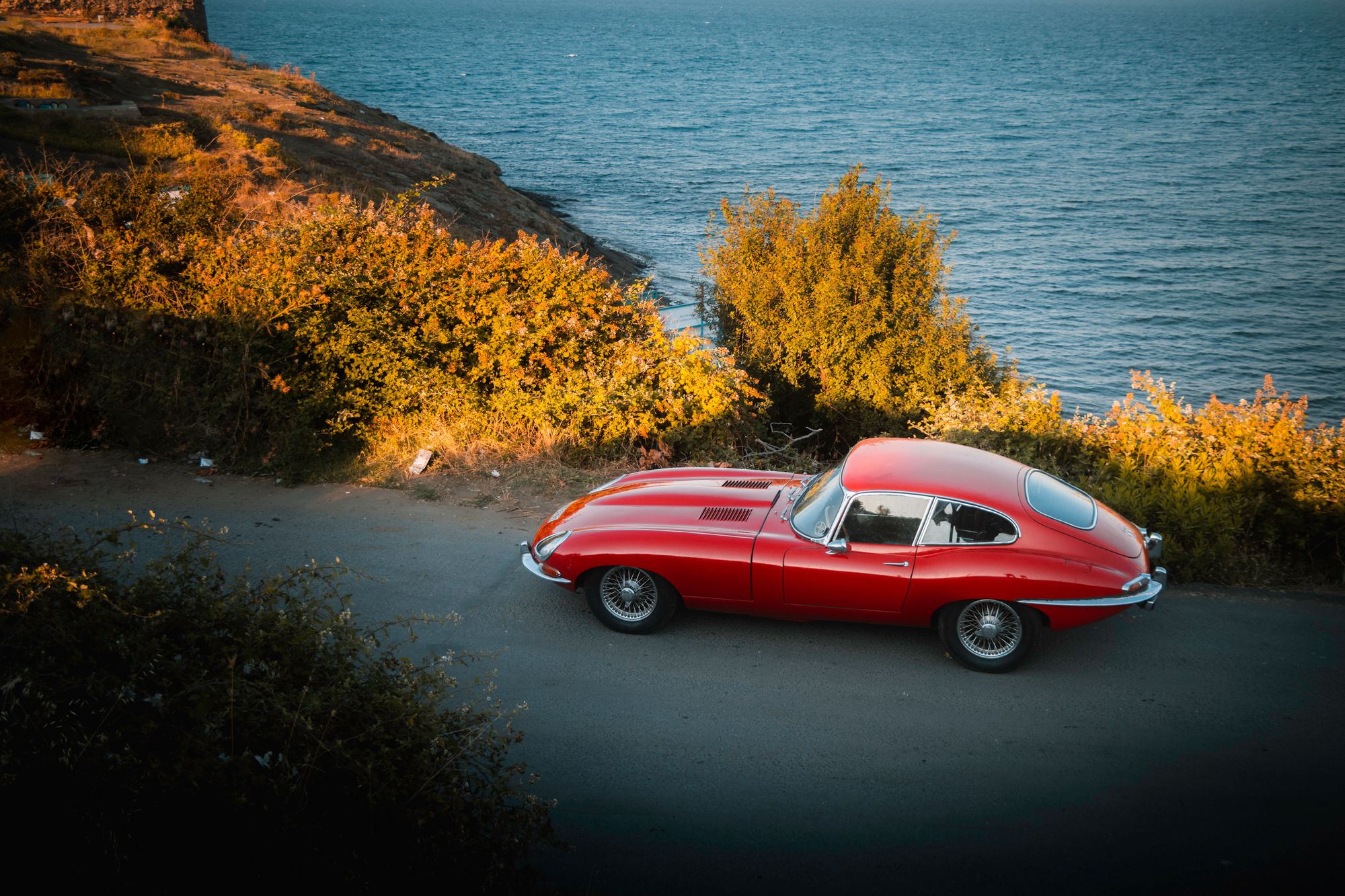
Beauty without substance doesn’t survive sixty years of scrutiny. The E-Type’s specifications justify the reputation independently of the aesthetics.
Autocar magazine tested a 4.2-litre FHC on a racetrack in May 1965 and recorded a top speed of approximately 153 mph (246 km/h). That figure was competitive with cars costing two or three times the E-Type’s UK launch price of around £2,097 — comparable performance to a Ferrari at roughly half the money. The value proposition was real, not a talking point.
The core specifications that defined the car:
- Engine: Twin-cam straight-six, 3.8-litre or 4.2-litre depending on series
- Power output: 265 bhp (both units, as quoted by Jaguar)
- Kerb weight: Approximately 1,120 kg for the FHC
- Top speed: Approximately 153 mph, as recorded in period road tests
- Suspension: Independent rear suspension — not standard practice among production cars in 1961
- Brakes: Four-wheel disc brakes across the entire range
The weight figure matters. At roughly 1,120 kg, the E-Type was genuinely light, and that’s why the performance numbers were achievable on a relatively modest power output. Independent rear suspension was an engineering statement, not a marketing feature — combined with four-wheel discs, this was a car built to handle, not just accelerate in a straight line. In 1961, that combination at that price point had no direct competitor.
Series Comparison: Which E-Type Actually Makes Sense for You

| Series | Years | Engine | Key Characteristic | Best For |
|---|---|---|---|---|
| Series 1 | 1961-1968 | 3.8 or 4.2 straight-six | Glass headlight covers, original proportions, strongest long-term values | Collector, long-term asset |
| Series 2 | 1968-1971 | 4.2 straight-six | Open headlights, US compliance changes, broader parts availability | Driver, lower entry cost |
| Series 3 | 1971-1974 | 5.3 V12 | Longest wheelbase, smoothest power delivery, significantly altered proportions | Driving experience over provenance |
The Series 3 V12 is the most refined E-Type to drive day-to-day, but its longer wheelbase changes the proportions substantially and it’s the furthest removed from what Ferrari was commenting on. If you’re buying to drive regularly and want to manage costs, the Series 2 is the honest answer — more parts availability, a lower entry price, and still a genuine E-Type with real character. If you’re buying as a long-term asset, a documented Series 1 3.8 or early 4.2 is where value concentration sits.
One distinction worth making within the Series 1: the very earliest 3.8-litre cars, often called “flat floor” examples due to their interior floor configuration, carry a premium among collectors over the later 4.2-litre cars. The 4.2, however, is the more practical choice if you intend to drive the car with any regularity.
What the E-Type Costs You Today — and What It Keeps Costing

E-Type values reflect both the car’s cultural standing and a sustained period of appreciation over the past decade. Broad market ranges as a starting point:
- Series 2 FHC, driver quality: $50,000-$70,000 USD
- Series 2 Roadster: Premium over the FHC, typically $70,000-$90,000
- Series 1, solid usable condition: $80,000-$120,000
- Series 1, fully restored with matching numbers: $200,000 and above, regularly
Those numbers are entry points, not ceilings. Buying the car is the beginning of the financial conversation, not the end of it. Maintenance requires specialist labour, and certain parts involve sourcing delays. The cooling system on the straight-six engines deserves specific attention — these engines run hot and do not forgive neglect or deferred servicing. Budget for this proactively rather than reactively.
Fuel consumption in real-world use sits around 15-18 mpg. That’s contextually acceptable for a classic of this era, but worth factoring into running-cost estimates if you plan to use the car seriously rather than covering 1,000 miles a year for shows and concours events.
The floor under E-Type values is unusually solid. The car holds permanent collection status at the Museum of Modern Art in New York, exhibited as a work of art in its own right. That cultural standing, combined with a prestige narrative that has persisted since 1961, gives the E-Type a profile that most classics cannot match. This is not a guarantee of continued appreciation, but it is a meaningful differentiator from the broader classic car market.
For detailed production specifications across all series, the Jaguar Club Russia E-Type catalogue provides useful technical reference material.
The Honest Trade-Offs You Need to Know Before Buying

The E-Type will test you in specific, predictable ways. Know these before you commit:
- Cockpit dimensions: If you’re over six feet tall, the FHC will become uncomfortable on drives beyond two hours. The Roadster offers more headroom but sacrifices weather protection. This is not a car you adapt to with time — either it fits you or it doesn’t. Sit in the car before you agree to anything.
- Electrical systems: The Lucas electrical components fitted to these cars have a well-documented reliability history. Budget for rewiring or an upgraded harness if you want day-to-day dependability. On a car you intend to use, this is not optional.
- Rust: The E-Type body has several structural areas that trap moisture and corrode in ways that are expensive to address properly. Sill sections, the bonnet frame, and the floor are the critical areas. A professional pre-purchase inspection from a specialist — not a general mechanic — is non-negotiable.
- Specialist dependency: Finding a competent E-Type specialist matters more than finding the right car. A mediocre example in the right hands will outperform a beautiful car with the wrong mechanic. Identify your specialist before you buy, not after.
- Usage model: This is not a daily driver. It is a car you plan around, prepare for, and maintain proactively. If that model of ownership conflicts with your life, the E-Type will disappoint you regardless of how beautiful it is.
Why the Ferrari Quote Still Matters — and What to Do With It
The Ferrari quote endures because it’s independently verifiable every time you look at a Series 1. The proportions — the long bonnet, the tapering rear, the glass-covered headlights — aren’t subjective in the way most automotive design is. They represent engineering and aesthetic decisions made simultaneously and coherently, which is considerably rarer than it sounds. Most cars compromise one discipline for the other. The E-Type managed both at the same time, at a price point that made its rivals look overpriced.
Jaguar priced the E-Type at launch to undercut Ferrari significantly. Comparable performance at roughly half the cost of an equivalent Italian rival was a deliberate strategic decision, and the market noticed in 1961. The collector premium on matching-numbers Series 1 cars sixty years later is the long-term echo of that original value proposition.
For a detailed look at the car’s development and design history, this documentary overview of the E-Type’s history covers the engineering and aesthetic decisions that defined the original car.
If you’re in a position to buy one, the E-Type is among the few classics where the story, the engineering, and the long-term value case all point in the same direction. Start with a Series 2 if budget is a genuine constraint. Get a professional pre-purchase inspection from an E-Type specialist — non-negotiable. Locate your long-term mechanic before you finalise anything. And buy the best-documented car you can find within your budget, not the most visually impressive example without paperwork. The beauty is already there in every one of them. Your job is to buy it in a condition that lets you actually enjoy it.