Section 1

High-performance engines renowned for their captivating sounds often come with significant maintenance costs. This section delves into specific examples of such engines, highlighting their unique auditory characteristics and the financial implications of their upkeep.
Ferrari 458 Italia’s 4.5-Liter V8 Engine
The Ferrari 458 Italia’s 4.5-liter flat-plane V8 engine set a new benchmark for naturally aspirated V8 sound when it debuted. Ferrari somehow managed to make 562 horsepower scream all the way to 9,000 rpm with a sound so distinctive that enthusiasts can identify it from blocks away. The flat-plane crank gives it a higher-pitched, more exotic note than traditional American V8s, while the intake howl at full throttle is pure theater. Starting around $240,000, the 458 represented the peak of naturally aspirated Ferrari V8s before the turbocharged 488 took over. Many still consider the sound sacrifice the biggest loss of the turbo transition. (autos.yahoo.com)
Mercedes-Benz SLR McLaren’s Supercharged 5.4-Liter V8 Engine
The Mercedes-Benz SLR McLaren’s supercharged 5.4-liter V8 creates a sound unlike anything else on this list: mechanical, aggressive, and oddly industrial. That supercharger whine combined with side-exit exhausts produces a soundtrack that’s instantly recognizable and completely addictive. The exhaust sits right next to the driver’s door, so every acceleration is accompanied by a crackling, popping symphony that threatens to set off car alarms. At around $455,000, the SLR was a proper grand tourer that happened to sound absolutely menacing. The combination of supercharger whine and exhaust roar makes it one of the most unique-sounding cars ever built. (autos.yahoo.com)
Lamborghini Murciélago LP670-4 SV’s 6.5-Liter V12 Engine
The final evolution of Lamborghini’s 6.5-liter V12 in the Murciélago SV produced what many consider the ultimate naturally aspirated V12 sound. This engine doesn’t just make noise — it announces its presence with the mechanical violence that only a Lamborghini can deliver. The V12 revs to 8,000 rpm with an aggressive snarl that makes the car sound genuinely angry. Limited to 350 units at around $450,000, the SV was the most extreme Murciélago ever made. The sound alone convinced many buyers to choose it over the newer, more refined Aventador. (autos.yahoo.com)
Alfa Romeo 8C Competizione’s 4.7-Liter V8 Engine
The Alfa Romeo 8C Competizione’s 4.7-liter V8, co-developed with Ferrari, produces one of the most intoxicating sounds in the supercar world. This engine sings with a distinctly Italian accent: dramatic, passionate, and completely unapologetic about demanding attention. The cross-plane V8 revs eagerly to 7,000 rpm while producing a sound that’s more sophisticated than the Viper but more emotional than most German offerings. Limited to just 500 coupes worldwide at around $300,000, the 8C was Alfa Romeo’s return to proper supercar territory. The exhaust note alone justified the price of admission. (guessingheadlights.com)
Audi R8 V10 Plus’s 5.2-Liter V10 Engine
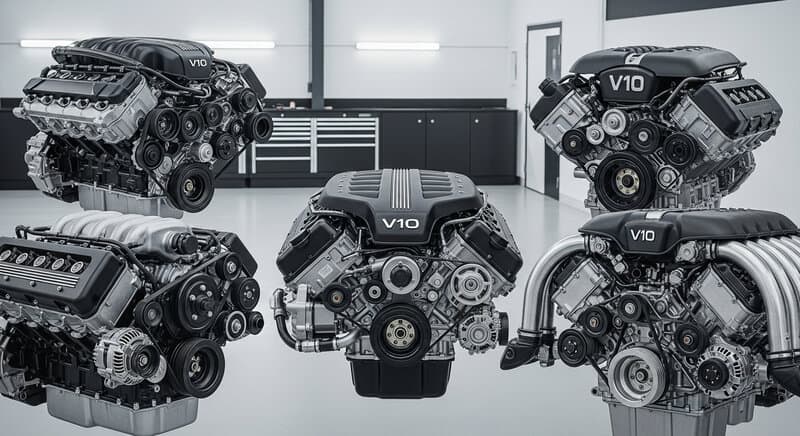
The Audi R8 V10 Plus shares its 5.2-liter V10 with the Lamborghini Huracán, delivering supercar acoustics with German reliability. The naturally aspirated engine screams to 8,700 rpm with a metallic edge that’s distinctive and addictive. Audi’s engineers added a “sport exhaust” button that opens valves for an even more aggressive sound, because sometimes you want the neighbors to know what you’re driving. At around $180,000, the R8 V10 Plus offered relatively attainable access to one of the best-sounding engines ever fitted to a production car. The fact that it could be your daily driver made the soundtrack even more appealing. (autos.yahoo.com)
Maintenance Considerations
While these engines provide an exhilarating auditory experience, they often require meticulous and costly maintenance. Factors contributing to higher upkeep costs include:
Complexity of Design: Advanced engineering and intricate components necessitate specialized knowledge and tools for repairs and servicing.
Parts Availability: Limited production numbers can lead to scarcity of replacement parts, driving up costs.
Labor Intensity: Precision required in maintenance procedures can result in longer labor times and higher service fees.
Performance Tuning: Regular tuning and calibration are essential to maintain optimal performance, adding to the overall expense.
Enthusiasts considering vehicles with these remarkable engines should be prepared for the financial commitment associated with their upkeep. While the reward is a symphony of sound and performance, it comes at a premium price. Careful budgeting and planning are essential to ensure a rewarding ownership experience without unexpected financial strain.