
Dodge bolted a 500-horsepower Viper V10 into something shaped like a motorcycle, called it the Tomahawk, admitted you couldn’t legally ride it anywhere — and nine people still paid over half a million dollars each for one. That’s the whole story in miniature, but the details are worth your time.
A Motorcycle That Was Never Really a Motorcycle

Introduced at the 2004 North American International Auto Show in Detroit, the Dodge Tomahawk was a deliberate provocation from a brand that understood provocation as strategy. It wasn’t a concept car. It wasn’t a production motorcycle. It occupied a category Dodge invented for it: rolling sculpture with genuine powertrain hardware and zero intention of passing any regulatory standard anywhere in the world.
What you probably want here are the verified specs, an honest assessment of the inflated top-speed claims that haunt every article about it, and a clear answer on the street legal question. That’s exactly what this covers — enthusiasm grounded in numbers, not press release fiction.
Core Specs at a Glance

Here’s what the Tomahawk actually is on paper. These are the figures Dodge published or that can be confirmed through documented sources:
| Specification | Detail |
|---|---|
| Engine | 8.3-liter Dodge Viper V10 |
| Power Output | 500 hp |
| Claimed Top Speed | 207 mph (theoretical, never verified in testing) |
| Wheel Configuration | Four wheels — closely paired front and rear |
| Weight | Approximately 1,500 lbs |
| Original Sale Price | $555,000 (Neiman Marcus Fantasy Gifts, 2003) |
| Units Sold | 9 |
| Street Legal Status | No — never intended to be |
The detail that changes every conversation about the Tomahawk is the four-wheel layout. Two closely paired wheels sit at the front axle, two at the rear. Each pair runs its own multi-pivot independent suspension — a purpose-built system required to keep the narrowly spaced wheels from conflicting with each other through cornering. That configuration is also what immediately disqualifies the Tomahawk from the U.S. federal definition of a motorcycle, which is precisely why street legality was never a realistic outcome and never a stated goal.
Neiman Marcus offered all nine units through its 2003 Fantasy Gifts Christmas catalog at $555,000 each. The catalog framing told you everything about what Dodge was selling: a collectible object, not a vehicle. Buyers understood that from the first conversation.
The Viper V10 Engine — 500 Horsepower With Nowhere Legal to Go
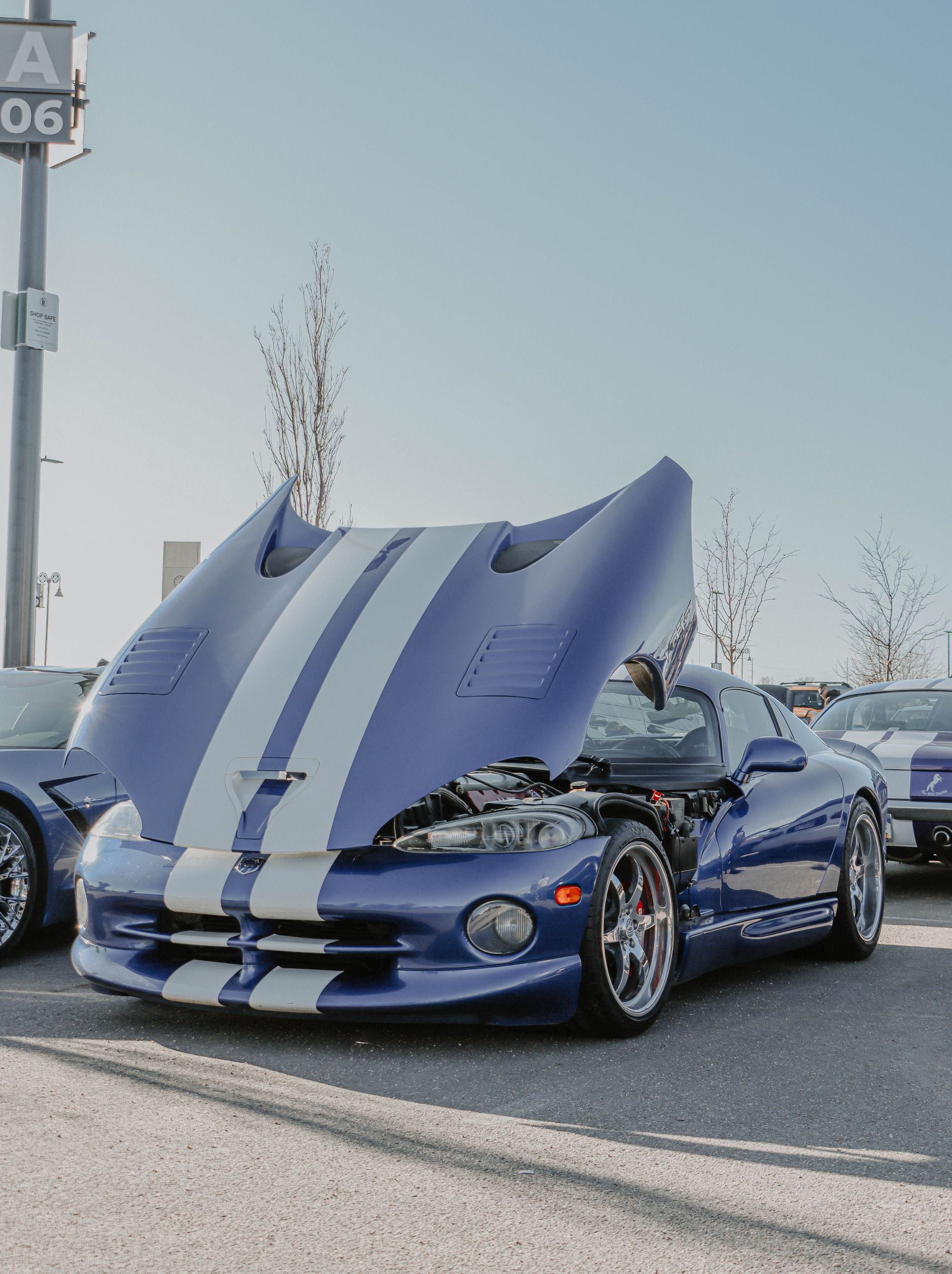
The 8.3-liter V10 sourced directly from the Dodge Viper is the entire engineering logic of the Tomahawk in one component. Five hundred horsepower in a rolling chassis this narrow represents maximum output crammed into minimum footprint, consequences be damned. The engine doesn’t just power the machine — it defines the machine. Everything else is structure built around it.
The trade-off worth understanding plainly: the rider sits essentially on top of a running V10 with no meaningful thermal or acoustic management. Heat, vibration, and noise are not mitigated — they are the experience. There is no insulation strategy, no comfort engineering. If the Tomahawk were ever ridden at any meaningful speed, the physical environment for the rider would be genuinely hostile by any modern standard.
On reliability: the Viper V10 is a proven engine with an established track record in a production sports car. The Tomahawk chassis surrounding it is a different matter entirely. No durability testing was conducted on the complete vehicle, no long-term mechanical data exists, and the nine units sold were classified as display pieces. The engine is reliable; the system it sits in was never validated beyond the concept stage.
The 400 MPH Claim: Where It Came From and Why It Is Not Real

Early media coverage of the Tomahawk circulated figures as high as 400 mph. You will still find this number attached to the Tomahawk across the internet. It has no basis in documented testing, validated engineering analysis, or physics that apply to this vehicle. Dodge’s own engineers never validated it.
The verified claimed top speed is 207 mph — itself a theoretical figure based on power-to-weight calculations and drivetrain assumptions, not a measured result from any sanctioned speed run with a rider aboard. The Tomahawk was never tested at speed under those conditions. The 207 mph figure is an honest projection; the 400 mph claim is not.
Here is why 400 mph is not achievable by this machine under any realistic conditions:
- Aerodynamic drag increases exponentially with speed. The Tomahawk’s geometry was designed to look extraordinary at a motor show, not to manage airflow at extreme velocity.
- Tire limitations are absolute. The tire specifications for this chassis cannot safely operate anywhere near 300 mph, let alone 400.
- No active stability systems of any kind exist on the Tomahawk — no traction control, no rider aids. At speeds well below 400 mph, the machine would become catastrophically unstable.
- No gearing configuration was ever confirmed — publicly or in engineering documentation — that would theoretically allow 400 mph regardless of available power.
The 207 mph figure is what responsible discussion of the Dodge Tomahawk top speed looks like, and even that number carries the honest caveat that it was never verified in practice.
Street Legal? No — Here Is the Clean Answer

The Dodge Tomahawk street legal question has a definitive answer: no, and Dodge never intended otherwise. The vehicle was formally classified as a rolling sculpture, exempt from Federal Motor Vehicle Safety Standards because it was never positioned as a road vehicle.
The four-wheel layout created an immediate regulatory problem. Under U.S. federal definitions, the Tomahawk does not qualify as a motorcycle. That classification would push it toward full automotive homologation requirements — crash testing, emissions certification, lighting standards, occupant protection systems — none of which the Tomahawk was designed to accommodate or could reasonably be retrofitted to meet.
No Vehicle Identification Numbers were issued for road registration. No homologation process was initiated. Dodge openly described the sold units as non-operational concepts. Buyers were not misled: they paid for a static display object with a running V10, not a rideable machine.
The closest the Tomahawk gets to a public outing is events like the Goodwood Festival of Speed, where it has appeared as a display piece. Footage from Goodwood shows the Tomahawk in exactly the context it was built for — spectacle on static display, engine running, crowd gathered, going nowhere.
Who Bought One and What It May Be Worth Now

The nine buyers who paid $555,000 each through the Neiman Marcus Christmas catalog were collectors and brand devotees, not riders. Dodge marketed to them accordingly — the Fantasy Gifts placement, the deliberate framing as an object of desire rather than a machine of use. That strategy was coherent and honest about what was being sold.
In 2003 dollars, $555,000 bought you more than a contemporary Dodge Viper and approached the price of a Ferrari Enzo. The premium was entirely for spectacle and exclusivity, and that calculus has not fundamentally changed.
Current collectible value is difficult to establish precisely because documented examples have rarely appeared at public auction. What can be said with confidence is that extreme rarity — nine units — combined with Viper V10 provenance and sustained cultural notoriety supports values at or above the original sale price for authenticated examples in confirmed display condition. That said, no public auction record exists to anchor a firm current valuation, and any seller quoting a specific figure should be pressed for comparable sales evidence.
If you are seriously evaluating a Tomahawk acquisition, two due diligence steps are non-negotiable:
- Authentication of original sale documentation from the Neiman Marcus transaction and Dodge delivery records.
- Confirmation of the unit’s complete condition history — specifically that it has been maintained as a display piece and has not been subjected to undocumented mechanical modification or attempted operation.
What the Tomahawk Actually Proved
The lasting legacy of the Tomahawk is not a speed record or a rideable motorcycle. It is proof that a mainstream automaker can build a rolling concept with genuine powertrain hardware, price it at supercar money, and generate years of global coverage without the vehicle ever completing a documented public run under its own power. That is a specific kind of achievement, and it is a legitimate one on its own terms.
For Dodge, the Tomahawk elevated the Viper V10 from a sports car engine to a standalone cultural icon — something capable of carrying brand identity into entirely new contexts and sustaining conversation well over a decade after the concept debuted. Brand work with that kind of longevity has measurable value even when the vehicle itself has no measurable lap times.
The bottom line: the Dodge Tomahawk is not a machine you ride, not an investment with predictable returns, and not a vehicle with a verified top speed backed by sanctioned testing. It is one of the most committed acts of automotive theater ever executed by a mainstream manufacturer. On those terms — and only those terms — it delivers completely.