
Booking an electric vehicle rental without doing the right homework first is one of the most common — and most avoidable — ways to turn a road trip into a roadside headache. Consumer Reports published targeted guidance around July 3, 2026, spelling out exactly what to verify before you confirm that reservation. The checklist is shorter than you might expect, but every item on it carries real consequences if you skip it.
Why EV Rentals Punish the Unprepared

Millions of travelers are choosing EV rentals for the first time, drawn in by lower fuel costs and the novelty of the experience. The problem is that an electric vehicle punishes the unprepared in ways a gas car simply does not. A wrong charger network, a range estimate taken at face value, or an unfamiliar charging interface can cost you hours and real money.
Unlike pulling into any gas station on the highway, charging requires advance planning — and that planning has to happen before you leave home, not when you are sitting at 8 percent battery in a strip mall parking lot.
Consumer Reports’ EV rental guidance, as covered by WSLS, and a companion Consumer Reports YouTube walkthrough on what to check before booking an electric vehicle, cut straight to the practical checkpoints that separate a smooth rental from a frustrating one. Here is how to work through all of them.
Check #1: Is There Confirmed, Working Charging at Your Destination?

Consumer Reports leads with this checkpoint, and for good reason — it is the assumption that ruins trips most often. You arrive at your hotel or vacation rental expecting a Level 2 charger, only to find the outlet is broken, incompatible with your car, or simply does not exist. By then, your options are poor and your evening is gone.
Before you book anything, confirm that your accommodation has Level 2 charging on-site, or that a reliable public DC fast charger is within a short, convenient distance. Do not rely on hotel websites — they frequently list amenities inaccurately or fail to update when equipment goes offline. Use PlugShare or the U.S. Department of Energy’s Alternative Fuels Station Locator to verify charger locations, connector types, and real user check-ins. Those check-ins are the critical detail: they tell you whether a charger actually worked recently, not whether it was installed two years ago and has sat dormant since.
If your destination has no usable charging infrastructure, you have two rational responses: choose a different vehicle class for that trip, or build a concrete charging plan with confirmed stops before you leave — not a hopeful one based on what you think might be available.
Check #2: Does the Car’s Rated Range Actually Cover Your Drive?

Consumer Reports explicitly advises verifying that the rental EV’s battery range matches your planned driving needs before you commit. That is the right instinct, but there is an important layer underneath it: EPA range ratings are a starting point, not a real-world guarantee.
Real-world highway range routinely runs 15 to 25 percent below the EPA figure once you factor in sustained highway speeds, climate control use, elevation changes, and the weight of luggage and passengers. A car rated at 300 miles EPA might reliably deliver 230 to 250 miles on an interstate road trip in summer heat with the air conditioning running. In winter, that gap widens further.
The practical planning rule: never schedule a driving leg that uses more than 80 percent of the car’s realistic — not EPA — range without a confirmed charging stop in the middle. That 20 percent buffer is your insurance against headwinds, unexpected detours, and chargers that are out of service when you arrive.
EV Rental Range Reality Check: Common Models Compared
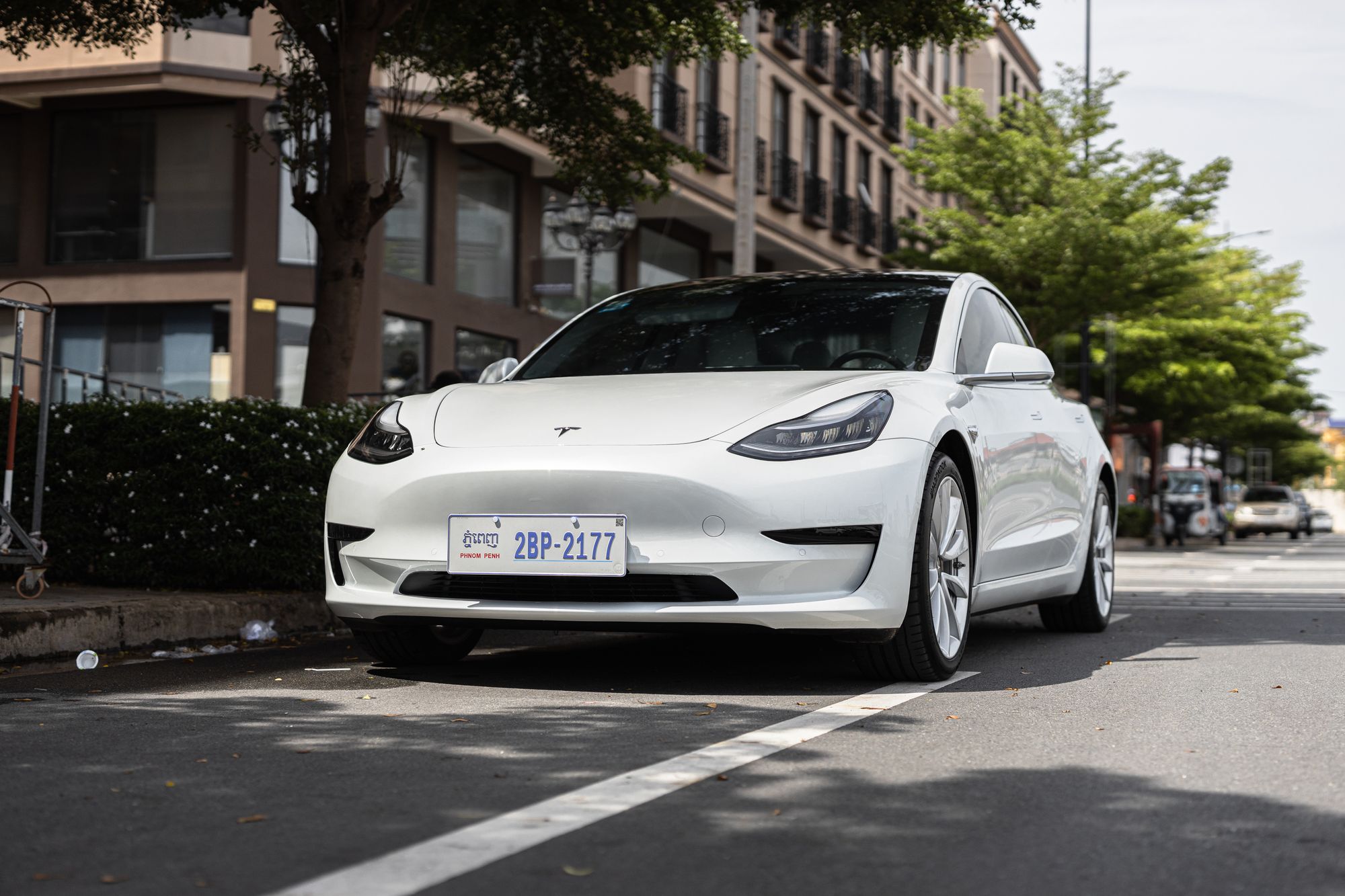
Rental fleets vary by region and company, but the models below are among those you are most likely to encounter. Note that fleet vehicles may not be the current model year — always ask the rental counter which specific trim and battery configuration you are receiving before you drive off the lot. The figures below are estimates based on publicly available EPA data and real-world testing reports; your conditions will vary.
| Model | EPA Range (est.) | Realistic Highway Range (est.) | Charging Network | DC Fast Charge Speed (est.) |
|---|---|---|---|---|
| Tesla Model 3 Long Range | 341 mi | 270-295 mi | Tesla Supercharger / NACS | Up to 250 kW |
| Hyundai Ioniq 6 Long Range RWD | 361 mi | 285-310 mi | CCS / NACS adapter available | Up to 350 kW |
| Ford Mustang Mach-E Standard Range | 230 mi | 175-200 mi | CCS / NACS | Up to 150 kW |
| Chevy Equinox EV | 319 mi | 250-275 mi | CCS / NACS | Up to 150 kW |
| Nissan Leaf (older trims) | ~150 mi | 115-130 mi | CHAdeMO (limited availability) | Up to 50 kW |
The Nissan Leaf warrants a direct callout: older trims top out around 150 miles EPA, and base models use CHAdeMO fast charging — a connector network that has been contracting rather than growing for years. If a rental counter assigns you a Leaf for anything beyond short local driving, it is worth asking whether a different vehicle is available. It is a poor fit for road-trip rentals in most scenarios.
The Ioniq 6 Long Range and the Model 3 Long Range are the strongest options on this list for actual road trips. Both deliver real-world range above 270 miles, charge quickly, and have widespread fast-charging infrastructure behind them. The Equinox EV is a capable middle-ground choice — better range than many drivers expect from a Chevrolet crossover, with a growing NACS-compatible charging footprint.
What Else to Confirm Before You Leave the Lot

Range and destination charging are the two biggest variables, but several operational details will catch you off guard if you do not address them before departure.
- Charging network compatibility: Ask specifically which networks the car supports natively. Tesla’s Supercharger network and the broader CCS and NACS ecosystem are not universally interchangeable without an adapter. Some rental vehicles include adapters; many do not. Clarify this before you need one at 11 PM on a Sunday with no alternatives nearby.
- Cable and adapter situation: Confirm whether the rental includes a charging cable — particularly a Level 2 J1772 or NACS cable for destination charging at hotels and vacation rentals. This is one of the most frequently overlooked details, and it is rarely documented clearly in online booking systems.
- Onboard navigation and charge routing: Spend a few minutes at the lot learning how the car’s built-in navigation handles charge stop planning. Many EVs will route you automatically to fast chargers when range gets low, but the interface varies significantly between brands. Knowing how yours works before you leave prevents a lengthy confusion session when you actually need the feature.
- Return state-of-charge policy: Some rental companies require you to return the car at or above a minimum battery level. Others charge fees if the battery falls below a set threshold. Get this confirmed in writing — or at minimum verbally acknowledged — before you sign any rental agreement.
How to Build a Charging Itinerary That Actually Works

Range anxiety is not irrational. It is the rational response to inadequate preparation — and the solution is not willpower or optimism, it is a written charging itinerary built before you leave home.
Use A Better Route Planner (ABRP) to map your charging stops specific to the model you are renting. ABRP accounts for real-world range degradation, elevation changes, and charging speeds at specific stations along your route. It provides time estimates, not just mileage estimates — which is what you actually need when deciding whether to stop now or push to the next charger.
On the road, aim to keep your battery between 20 and 80 percent during road-trip legs. Charging from 80 to 100 percent on most EVs takes roughly as long as charging from 20 to 80 percent, because charge rates taper sharply at the top of the range. Stopping at 80 percent and continuing to your next stop is nearly always faster than topping off completely at every station.
Consumer Reports’ guidance reinforces the central point: preparation is what separates a successful EV rental experience from a frustrating one — not the technology itself. The car is capable. The planning is what does the work.
Three Questions to Answer Before You Book
Before you confirm any EV rental reservation, get honest, verified answers to these three questions:
- Is there confirmed, working charging at or near your destination? Verify it with real user check-ins, not a hotel amenities listing. If the answer is no, resolve that problem before you book — not after you arrive.
- Does the specific trim you are renting have enough real-world range to handle your longest daily driving leg with a 20 percent buffer remaining? Use realistic highway range estimates, not the EPA number, to do that math.
- Do you understand the car’s charging network compatibility, the cable situation, and the rental company’s return policy on battery state of charge? These are operational details that cost nothing to clarify upfront and potentially a great deal to discover at the wrong moment.
Answer yes to all three and you are not just booking an EV rental — you are booking a trip that will actually go the way you planned.