
In 2021, Subaru quietly built the last WRX STI off the line. No farewell tour, no successor announcement — just the end of a nameplate that had spent decades finishing on rally podiums and in the driveways of people who genuinely knew the difference between all-wheel drive and real all-wheel drive. But if you think that means STI is finished, look more carefully at what Subaru bolted onto the 2025 WRX.
The Badge Is Gone. The DNA Isn’t.

Whether you’re deciding between a used STI and a new WRX, or trying to understand what you already own, the distinction matters in dollars and in feel. Here’s the bottom line before anything else: used STI values are holding stubbornly high, the 2025 WRX has absorbed more STI hardware than most buyers realize, and the choice between them is a genuine trade-off — not an obvious one.
What the STI Actually Was: Rally Roots, Not Marketing

Subaru Tecnica International wasn’t created to produce eye-catching badges. It was Subaru’s in-house performance division, built to develop and homologate the company’s rally competition cars. Homologation rules required manufacturers to produce road-going versions of their competition hardware in sufficient numbers — which is exactly how the STI became a car you could buy at a dealership. The car existed because the rules demanded it. That’s not a romantic origin story. It’s a better one.
The WRX STI ran in its final generation from 2014 through 2021, carrying a 2.5-liter turbocharged flat-four (the EJ257), a driver-controlled center differential known as the DCCD, and Brembo brakes. These weren’t options dressed up to sound technical — they were components with direct lineage to rally programs. The DCCD gave you genuine, adjustable front-to-rear torque split across a driver-selectable range, a capability the standard WRX never offered. That’s the core of the mechanical difference between WRX and WRX STI that matters most to how the car actually behaves at the limit.
Understanding that heritage shapes your buying decision. It explains why used STIs command a premium, and it tells you whether that premium is justified for how you’ll actually use the car.
Why Subaru Discontinued the STI

Subaru never issued a single definitive public explanation, but the contributing factors aren’t hard to read. The STI’s EJ-series engine was an aging architecture facing an increasingly hostile emissions regulatory environment in key global markets. Electrification planning was reshaping platform investment priorities across the industry. And engineering a direct replacement — a new STI built around a modern engine while meeting current standards and hitting a competitive price point — would have required capital Subaru chose not to deploy.
The 2022 WRX generation launched without an STI variant. Subaru confirmed no STI was planned for that platform. That was the end of the nameplate, at least for now.
What Subaru did instead is more interesting than most coverage acknowledged. The 2025 WRX received STI-tuned suspension with electronically adjustable dampers, 19-inch alloy wheels shod with high-performance tires, and Recaro performance-design front seats. In any previous generation, that hardware combination would have been STI-spec. Subaru moved the equipment down without moving the badge — which is either a quiet tribute or a calculated hedge, depending on your level of cynicism.
The honest trade-off: the 2025 WRX gains the STI’s chassis refinements but loses the DCCD, the larger-displacement engine, and the mechanical drama that made the STI feel like a barely tamed rally car. For the right buyer, those are not minor omissions.
Specs That Actually Matter: 2021 STI vs. 2025 WRX

| Specification | 2021 WRX STI | 2025 WRX |
|---|---|---|
| Engine | 2.5L turbocharged EJ257 flat-four | 2.4L turbocharged FA24 flat-four |
| Output | 310 hp / 290 lb-ft torque | 271 hp / 258 lb-ft torque |
| AWD System | Symmetrical AWD with DCCD (driver-adjustable torque split) | Symmetrical AWD with VTD (no DCCD) |
| Transmission | 6-speed manual only | 6-speed manual or CVT |
| Wheels | 19-inch alloy | 19-inch alloy |
| Suspension | Bilstein dampers | STI-tuned electronically adjustable dampers |
| Brakes | Brembo front calipers | Standard performance brakes |
| Front Seats | Heated front seats (standard) | Recaro performance-design front seats |
| Fuel Economy (city) | Approximately 15 mpg (EPA est.) | Approximately 19 mpg (EPA est.) |
Two ownership realities flow directly from this table. First, the EJ257 in the STI carries a well-documented history of head gasket sensitivity and demands premium fuel, disciplined oil change intervals, and proper warm-up cycles — especially in cold climates. These aren’t dealbreakers for the right owner, but they are real, recurring costs. Second, the FA24 in the 2025 WRX is a substantially more modern design that largely avoids those concerns and returns meaningfully better fuel economy. If you’re daily-driving in stop-and-go traffic and not monitoring oil condition between changes, that gap compounds over years of ownership.
The suspension story cuts the other way. The 2021 STI’s Bilstein dampers were fixed-rate units with proven rally-derived tuning. The 2025 WRX’s electronically adjustable dampers offer more everyday compliance in comfort mode and genuine sharpness in sport mode — a flexibility the older car couldn’t provide. Neither setup is strictly superior; they reflect different philosophies about what a performance sedan should do.
Used STI Values: What the Market Is Actually Telling You
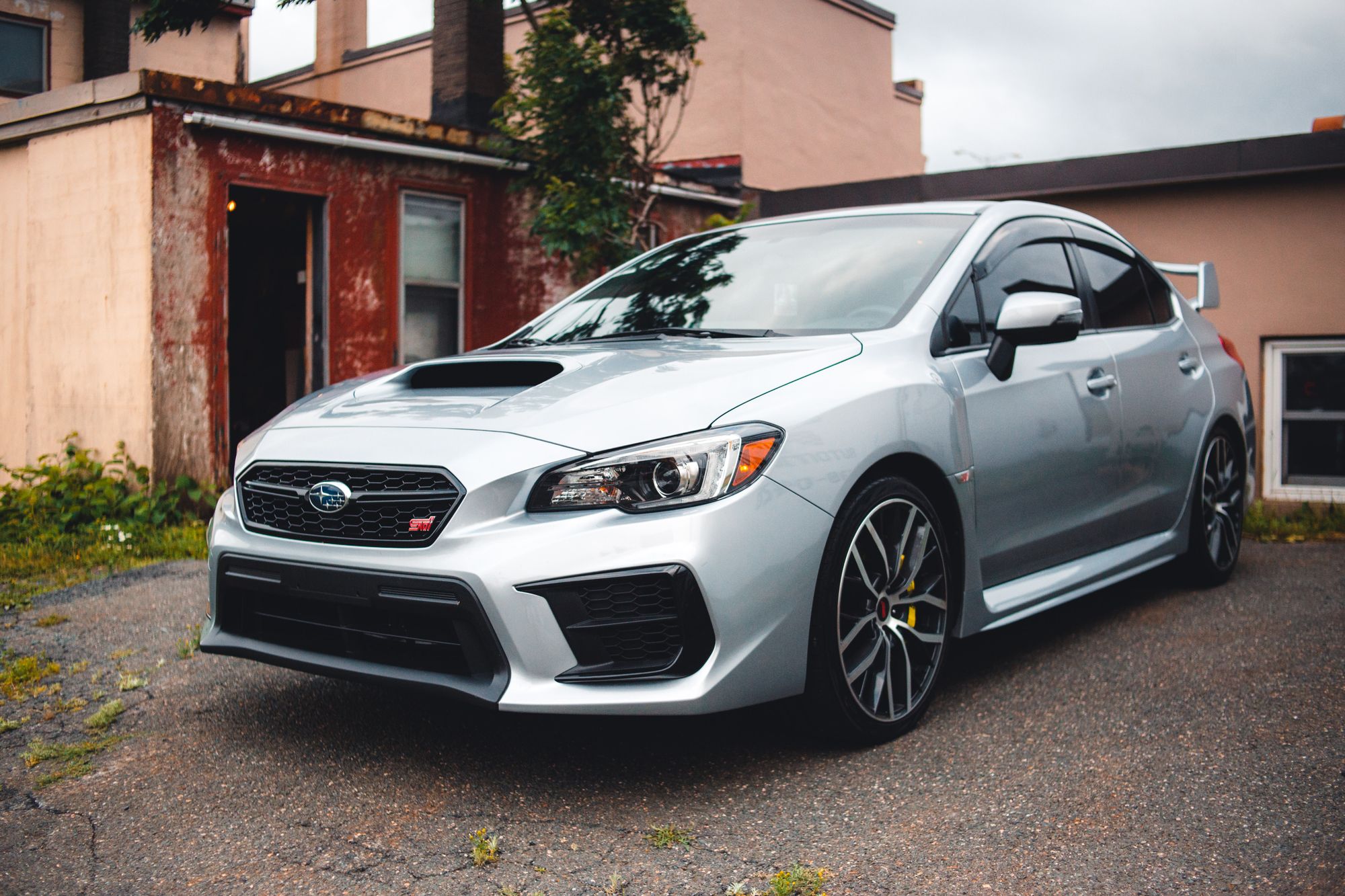
If you expected a discontinued performance model to depreciate quickly, the used STI market has disagreed with you persistently. Final-year 2021 STIs with documented low mileage are retaining value at levels that reflect both collector sentiment and genuine scarcity. Clean examples in desirable trims regularly trade at prices that put them near — or occasionally above — the base MSRP of a new WRX. You are paying for the DCCD and the nameplate. You are not finding a bargain in the traditional sense.
Before committing to a used STI purchase, treat these inspection points as non-negotiable:
- Compression and leak-down test: Head gasket integrity on the EJ257 is the single most important mechanical check. A shop doing a pre-purchase inspection should perform both. Don’t negotiate around it.
- Transmission feel through all gears: Run it deliberately through second and third under load, where worn synchros reveal themselves. The STI’s transmission is robust when maintained but punishing when it isn’t.
- DCCD operation: Cycle through the full range of driver-selectable settings. Each mode should produce a perceptibly different character in how the car rotates. Vague or non-responsive behavior warrants further inspection.
- Oil condition and service history: Interval documentation matters more on the EJ257 than on most modern engines. Short, documented service intervals are genuinely worth paying extra for. An undocumented history on this engine is a meaningful risk, not a minor caveat.
- Cooling system history: Overheating events are particularly damaging to the EJ257’s head gaskets. Look for evidence of coolant loss, milky residue on the oil cap, or any history of running hot.
You can search used WRX STI listings with vehicle history reports to get a realistic picture of what documented, low-mileage examples are actually selling for in your region. The price spread between a clean, well-serviced car and a neglected one is significant — large enough that skipping the pre-purchase inspection to save a few hundred dollars is a poor calculation.
The Modification Question

Any honest guide to the STI has to address this directly: a substantial percentage of used STIs have been modified, and modifications on these cars run a wide spectrum from sensible bolt-ons to engine-threatening power builds on stock internals. A tune, an aftermarket intake, and a cat-back exhaust on an otherwise stock, well-maintained STI are generally low risk. A high-boost tune on the factory EJ257 without supporting fuel system and cooling upgrades is a recipe for an engine that won’t survive long. When evaluating a modified example, ask for documentation of every change and — if the car has been tuned — confirm the tune was performed by a reputable shop on a proper dynamometer with appropriate supporting modifications. An undisclosed tune is a red flag, not a bonus.
Should You Buy a Used STI or a New WRX?
The answer isn’t the same for everyone. Here’s the honest split:
Buy the used STI if you want genuine driver-adjustable AWD torque split that no current Subaru offers, you’ve found a documented low-mileage example at a price reflecting realistic depreciation rather than speculation, and you’re prepared to maintain an older platform on its own terms — including the EJ257’s particular demands. The mechanical engagement is real. Nothing in the current lineup replicates it.
Buy the 2025 WRX if you’re daily-driving in all conditions, value a factory warranty and current-generation safety electronics, and can accept trading the STI badge for STI-calibrated suspension, Recaro seats, and meaningfully better fuel economy and reliability. You are not settling for a lesser car. You are choosing a more rational one — and in most real-world use cases, the more appropriate one.
What both options share is the thing that made the STI worth caring about in the first place: Subaru’s symmetrical all-wheel-drive system remains one of the most capable all-weather performance platforms available at this price point, regardless of generation. The STI name may be gone from the order sheet, but the 2025 WRX is Subaru’s quietest possible confirmation that the rally heritage still drives product decisions — even when nobody is saying so out loud.